Ouster (OUST): supplier posture, counterparty map, and what it means for investors
Ouster designs and manufactures digital lidar sensors sold into industrial automation, intelligent infrastructure, robotics and automotive channels; it monetizes through product sales to OEMs and system integrators, contract-manufactured hardware, and related services. For investors evaluating supplier risk and operational leverage, the company’s business sits squarely on the manufacturing and contract services axis: revenue depends on a small set of manufacturing partners and long-term facility commitments that drive cost structure and delivery risk. If you want a structured view of counterparties and supplier signals, start here and visit https://nullexposure.com/ for deeper supplier intelligence.
How Ouster’s supply chain converts product design into revenue
Ouster’s operating model separates core sensor design and IP from the physical labor of assembly and test. The firm outsources a significant portion of manufacturing to contracted partners in APAC, while retaining product engineering and market-facing sales. That posture yields two clear commercial characteristics: scalability of design vs. concentration of supply — the former supports margin expansion as volumes rise, the latter creates single-point operational risks.
- Contracting posture: Ouster carries long-term, non-cancellable lease obligations assumed through the Velodyne merger, which signal fixed overhead and a commitment to scale manufacturing and office footprints over multiple years. These leases translate into higher fixed cost leverage and sensitivity to demand cycles.
- Concentration and criticality: The company identifies Benchmark and Fabrinet as primary manufacturing partners, with the majority of production located in Thailand; this creates concentrated vendor exposure that is operationally critical to shipments.
- Maturity and governance: Ouster engages outside specialists for cybersecurity, security assessments and independent audits, reflecting mature third-party governance for critical IT and control functions rather than ad hoc outsourcing.
- Spend profile: Public disclosures show non-cancellable purchase commitments of roughly $12.5 million to contract manufacturers and $4.4 million to other vendors as of December 31, 2024, which places annual locked-in spend in the $1M–$100M band and informs working capital and renegotiation flexibility.
These traits combine to produce a supplier risk profile that is operationally concentrated but contractually committed, creating outsized downside if a key manufacturer encounters disruption and outsized upside if demand scales and fixed costs are absorbed.
Counterparty relationships you should track right now
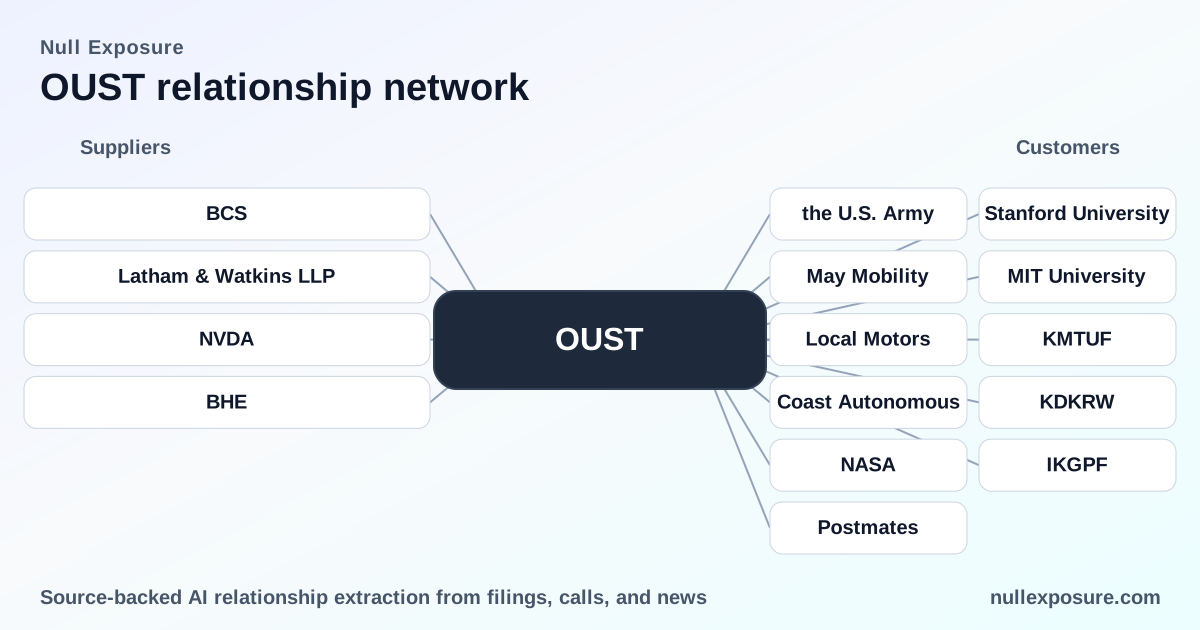
Below are the counterparties surfaced in public coverage and filings with concise one- to two-sentence takeaways and source notes.
Barclays — financial advisor in the Velodyne merger
Barclays served as a financial advisor to Ouster in connection with the proposed merger-of-equals with Velodyne, a role that positioned the bank on strategic, valuation and transaction execution work for the deal. Source: SuasNews coverage of the proposed merger, November 2022 (reporting Barclays’ advisory role).
Latham & Watkins LLP — legal advisor on the transaction
Latham & Watkins LLP acted as legal counsel to Ouster in the same transaction context, handling the legal structuring and documentation that accompanied the merger with Velodyne. Source: SuasNews coverage of the proposed merger, November 2022 (reporting the legal advisory engagement).
NVIDIA — ecosystem and edge compute relevance
Public commentary in an earnings-call transcript references NVIDIA Jetson and Orin system-on-modules as the runtime platform for BlueCity’s trained perception networks delivering real-time inference at the edge, signaling product-level interoperability and ecosystem relevance for Ouster’s sensing stack where NVIDIA’s edge compute is used by adjacent solution providers. Source: InsiderMonkey transcript of Ouster Q2 2025 earnings call coverage (2025).
Benchmark Electronics, Inc. — primary contract manufacturer
Benchmark Electronics is identified as a key third‑party supplier and manufacturer that produces a significant share of Ouster’s products, with manufacturing activity concentrated in Thailand; this makes Benchmark a critical operational counterparty for volume delivery. Source: SamoaObserver technology coverage (citing supplier dependence, 2021) and company disclosures referencing Benchmark as a main manufacturing partner.
(Each of the above entries is drawn from public reporting and company disclosures; see the referenced articles and transcripts for original language and context.)
What the constraints reveal for procurement and risk management
The structured constraints drawn from Ouster’s public disclosures reveal several investor-relevant points:
- Long-term fixed commitments: Ouster assumed long-term, non-cancellable leases (including substantial San Jose manufacturing/office space and other locations) as of February 10, 2023, increasing fixed cost and reducing short-term flexibility. This is a company-level signal about capital commitments and geographic footprint.
- APAC manufacturing concentration: The firm reports that the majority of products are manufactured at partners’ facilities in Thailand, reinforcing single-region operational exposure for production continuity and geopolitical risk.
- Manufacturer role clarity: The company explicitly names Benchmark and Fabrinet as its main manufacturing partners, confirming that certain suppliers are both strategically critical and high-concentration for finished goods.
- Outsourced services for security and operations: Ouster engages specialists for cybersecurity and independent security audits, signaling maturing governance over outsourced operational and security functions rather than informal vendor relationships.
- Locked-in spend bands: Non-cancelable purchase commitments totaled about $12.5M to contract manufacturers and $4.4M to other vendors as of Dec 31, 2024, placing Ouster’s near-term supplier commitment in the $10M–$100M and mid-tier bands — material but not overwhelmingly large vs. revenue.
Together these constraints indicate a supplier model that is contractually committed and concentrated, with operational criticality centered on a small number of APAC manufacturers and a cost base shaped by long-term facility and purchase commitments.
Investment implications and operational red flags
- Upside scenario: If demand scales and Ouster absorbs fixed lease and manufacturing costs, gross-to-operating leverage will improve quickly because product design and IP operate on a scalable cost curve. Analyst consensus (where available) still recognizes growth potential in lidar adoption across robotics and infrastructure.
- Downside scenario: A disruption at Benchmark or Thai manufacturing hubs, or an inability to flex long-term lease obligations, would cause immediate delivery bottlenecks and margin pressure given the concentrated supplier map.
- Governance and mitigation: The company’s use of external cybersecurity and audit specialists is a positive governance signal; however, supply-side redundancy and geographical diversification remain the primary mitigation levers investors should monitor.
If you require a supplier-risk scorecard or counterparty monitoring for Ouster, review our supplier maps and alerts at https://nullexposure.com/ — we keep track of counterparties, contract commitments, and concentration metrics for investors and operators.
Final takeaways and next steps
- Ouster’s model is design-led but manufacturing-dependent: strong product IP flows through a small set of APAC contract manufacturers and long-term real estate commitments.
- Key counterparties to watch include Benchmark (manufacturing), Fabrinet (manufacturing partner cited in disclosures), and the advisory firms that managed the Velodyne transaction (Barclays and Latham & Watkins) as indicators of strategic repositioning.
- Material spend is committed at the tens-of-millions scale, which constrains near-term flexibility and increases the value of supplier continuity.
For a deeper diligence package on these counterparties and to set up ongoing monitoring of Ouster’s supplier exposures, visit https://nullexposure.com/ and request a tailored supplier risk brief.