OUSTER (OUST-WS-A) — Supplier Relationships and Operational Implications for Investors
Ouster designs and sells lidar sensors and related hardware and monetizes primarily through hardware sales and downstream customer integration services; its manufacturing model relies on external contract manufacturers and specialized optical/assembly suppliers to scale production and manage cost. Investors should treat Ouster as a hardware-centric OEM with concentrated manufacturing partners whose performance directly affects revenue growth, gross margins, and delivery cadence. For further supplier intelligence and deeper relationship mapping, visit https://nullexposure.com/.
What the disclosed supplier roster actually says about risk and scale
Public filings and company press releases repeatedly flag the same set of manufacturing partners, creating a clear signal: Ouster depends on a small group of third‑party suppliers for production and assembly. Those partners appear across multiple quarterly and annual press statements from FY2022 through FY2025, which implies relationships with multi‑year commercial importance rather than ad hoc sourcing.
Below are the supplier relationships identified in the public record and the specific citations supporting each mention.
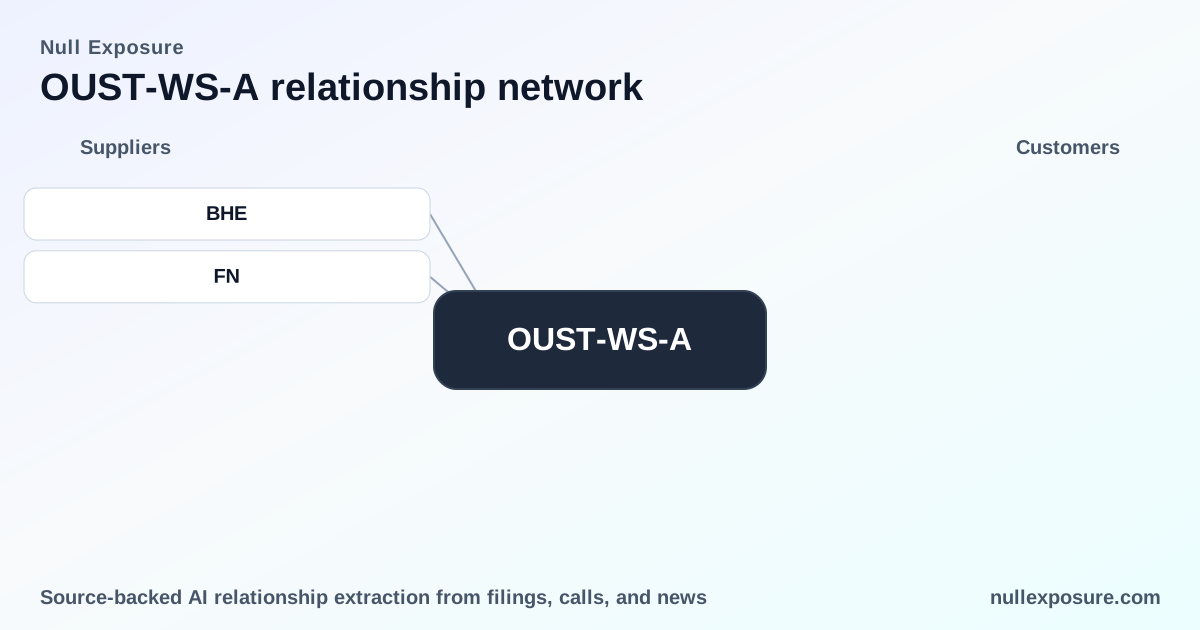
Benchmark Electronics, Inc. (BHE)
Benchmark is cited repeatedly as a key third‑party supplier for Ouster in press releases covering FY2022–FY2025; the language in those releases identifies Benchmark as a principal manufacturing partner whose operations are material to Ouster’s ability to deliver finished product. Source: multiple BizWire press releases republished by Markets.FinancialContent and other outlets referencing Ouster’s dependence on Benchmark (FY2022; FY2024; FY2025) — for example, a FY2022 BizWire release distributed via Markets.FinancialContent documented Ouster’s dependence on Benchmark Electronics (https://markets.financialcontent.com/wral/article/bizwire-2022-5-3-ouster-bolsters-market-position-reports-second-highest-revenue-quarter).
Fabrinet (FN)
Fabrinet is named alongside Benchmark in Ouster press coverage for FY2024–FY2025 as a key contract supplier involved in manufacturing or assembly activities; public statements list Fabrinet among the limited set of suppliers critical to Ouster’s production pipeline. Source: Ouster press releases aggregated on Yahoo Finance and Markets.FinancialContent that explicitly list Fabrinet as a key third‑party supplier (FY2024; FY2025) — for example, the FY2025 announcement on Yahoo Finance noting dependence on Fabrinet (https://finance.yahoo.com/news/ouster-announces-record-revenue-fourth-201000811.html).
How these supplier relationships translate into operating constraints
Ouster’s disclosures and press narrative establish several company‑level operating signals that investors and operators must internalize:
- Concentration of manufacturing risk. The recurrent naming of Benchmark and Fabrinet indicates a concentrated supplier base, which creates single‑point supply risk and amplifies operational sensitivity to capacity disruptions, lead‑time shifts, and quality issues.
- Contract manufacturing posture. Ouster operates as an OEM that outsources fabrication and assembly to specialized contractors rather than vertically integrating full production; this model accelerates scale but shifts critical execution risk to suppliers.
- Commercial criticality and continuity. Mentions spanning FY2022 through FY2025 show persistent, not transactional, relationships — evidence of established manufacturing channels that are important to revenue delivery and product cadence.
- Maturity and leverage dynamics. The firm’s reliance on established EMS/optical suppliers suggests Ouster trades some margin and control for manufacturing expertise and capacity; negotiating leverage depends on order volumes, technical switching costs, and how substitutable the supplier capability is.
These signals are company‑level assessments drawn from the public mentions and not attributed to any internal constraint excerpt.
What investors should watch next
Supply relationships drive both upside and downside for hardware OEMs. For Ouster, focus on three monitoring actions:
- Track production and delivery commentary in quarterly earnings and investor releases for signs of inventory buildup or supplier‑related backlogs. Persistent supplier callouts have historically preceded investor attention to gross‑margin volatility.
- Monitor supplier financial health and capacity changes at Benchmark and Fabrinet; any material capacity reallocation or financial stress at these partners will have immediate operational consequences for Ouster.
- Watch contract terms disclosed in filings (if and when provided): long‑lead commitments, purchase‑order financing, and minimum‑volume guarantees materially affect cash flow and margin stability.
Visit https://nullexposure.com/ for ongoing supplier surveillance and deeper context on how partner health feeds into equity risk.
Operational and procurement implications for operators
Operators negotiating with or auditing Ouster’s supplier base should prioritize:
- Diversification and dual‑sourcing clauses in procurement documents to avoid single‑supplier failure modes.
- Demand‑flexibility provisions and clear escalation paths for capacity ramps, given seasonal or program‑driven order volatility.
- Tight quality and NPI governance during supplier transitions and product revisions, since third‑party assembly controls end‑product performance.
- Visibility into supplier sub‑tier (critical components, optics, semiconductors) to understand where supply chain chokepoints could form.
These are practical controls that reduce delivery and margin risk without changing the fundamental tradeoffs of an outsourced manufacturing model.
Bottom line — investment view and action points
Ouster’s public narrative identifies Benchmark Electronics and Fabrinet as repeat, material manufacturing partners, which positions the company as an outsourcing OEM with concentrated supplier risk. For investors, that structure means growth is scalable but contingent on partner performance; supply disruptions or capacity bottlenecks at those suppliers will translate directly into revenue and margin volatility.
Key takeaways:
- Supplier concentration is a primary operational risk.
- Contract manufacturing enables fast scale but transfers execution risk to partners.
- Multi‑year mentions imply established, not ad hoc, supply relationships — good for stability but bad for diversification.
For investors and operators who need structured, ongoing intelligence on these relationships and how they affect credit, revenue, and delivery forecasts, explore detailed supplier mapping and monitoring at https://nullexposure.com/.
Invest with the operational context in mind: supplier health is as important as product-market fit for hardware OEM profitability and predictability.