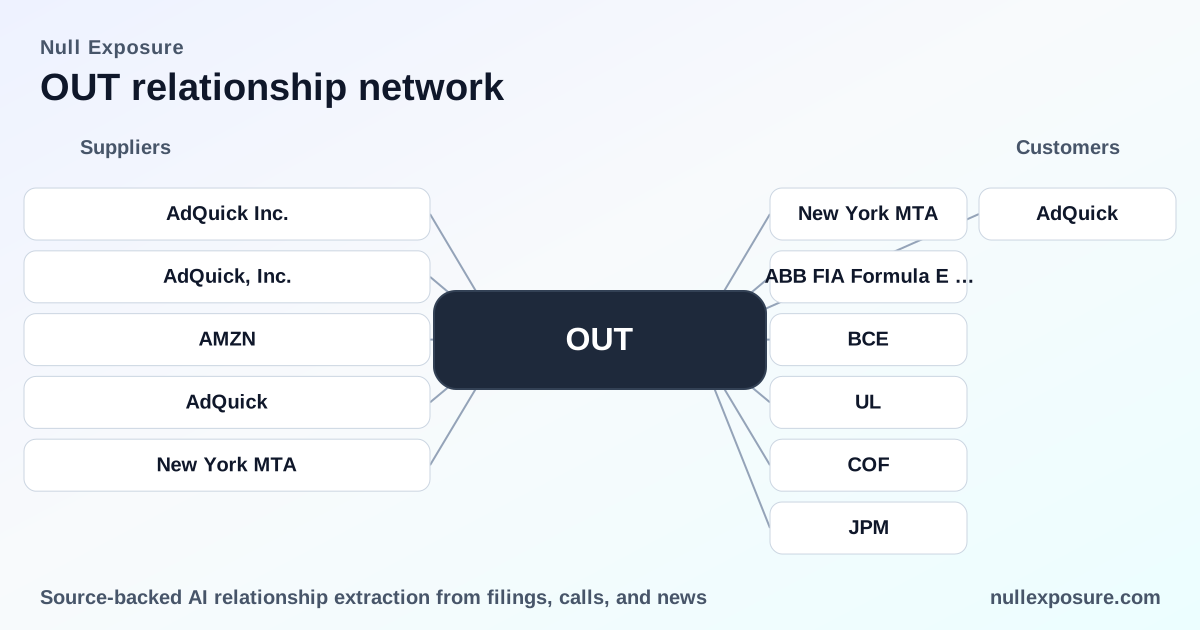
OUTFRONT Media: supplier relationships and what they mean for investors
Outfront Media operates large-scale out-of-home (OOH) advertising networks—billboards, transit displays and mobile assets—monetizing through long-term advertising leases, transit franchise revenue shares and direct/digital ad sales. Revenue derives from selling audience-attention inventory and from structured transit contracts that provide recurring, often inflation‑linked cash flow, while recent technology partnerships accelerate programmatic and measurement capabilities. For a closer look at how these supplier relationships change the operational profile and competitive moat, visit https://nullexposure.com/.
Quick investment thesis
Outfront is a specialty REIT that converts physical advertising real estate into recurring cash flow and margin expansion through digital upgrades and third‑party technology partnerships. The business rests on two durable pillars: multi‑year transit franchises that create revenue visibility, and software/technology alliances that increase ad sell‑through and pricing power. These supplier ties are strategic levers to lift yield per asset and to lower distribution friction for advertisers.
Catalog of reported supplier relationships (each result documented)
- AdQuick Inc. — DigitalSignageToday reported that AdQuick will license its OOH sales cloud to Outfront under an initial three‑year deal and that Outfront will commit up to $20 million in staged investment, including an exclusivity period (DigitalSignageToday, March 2026).
- AdQuick, Inc. — PR Newswire confirmed the same structure: a three‑year licensing agreement with an exclusivity window and an equity investment of up to $20.0 million tied to milestones (PR Newswire press release, March 2026).
- Amazon Web Services — TradingView coverage noted that Outfront signed a commercial agreement with AWS to modernize OOH through AI‑enabled workflows, positioning cloud and AI as the backbone for digital inventory planning and execution (TradingView summary, early 2026).
- AWS (Finviz coverage) — A market note highlighted that the AWS partnership enables end‑to‑end planning, purchasing and measurement of static and digital OOH using natural‑language interfaces and intelligent agents (Finviz market commentary, January 2026).
- AWS (company earnings call) — Management reiterated on the 2025 Q3 earnings call that the AWS collaboration is a strategic initiative expected to usher in a new era for the out‑of‑home medium, emphasizing operational importance from Outfront’s perspective (Q3 2025 earnings call transcript).
- Amazon Web Services (Sharewise/aggregator) — An additional market writeup repeated the value proposition: AWS adds a layer of automation and measurement across Outfront’s inventory, reinforcing the company’s digital transformation narrative (Sharewise aggregation, January 2026).
- AdQuick (TradingView mention) — TradingView also described AdQuick as an AI‑driven platform for planning, purchasing and measuring OOH, underscoring why Outfront pursued both a commercial license and equity stake to integrate the tool into its sales stack (TradingView summary, early 2026).
- New York MTA — A Yahoo Finance report noted that inflation‑linked minimum annual guarantees tied to transit contracts such as the New York MTA remain a structural cost factor for Outfront, underlining the materiality of large municipal franchise arrangements to margins (Yahoo Finance coverage, Q4 2025 results commentary).
What these relationships mean for the operating model
Outfront’s supplier and technology partnerships change the company’s contracting posture, concentration risk, criticality of suppliers and maturity profile:
- Contracting posture (long‑term orientation): Outfront runs business under long‑dated transit franchises and extended licensing deals; the company’s core revenue base is structured around multi‑year agreements that deliver predictable cash flow and support REIT valuation metrics.
- Counterparty concentration and criticality (government counterparties): Transit contracts with municipalities and operators are significant and entitle franchisors to revenue shares or guaranteed minimums, embedding government counterparties as both stable revenue sources and structural cost considerations. The MTA, explicitly cited in company materials, exemplifies that dynamic and is a critical counterparty in New York.
- Technology/partner criticality (licensor + service provider roles): AdQuick is a licensor of sales software and the subject of strategic equity investment, shifting Outfront’s supplier mix toward technology partners that increase sell‑through and measurement. AWS acts as a service provider and cloud partner, elevating Outfront’s operational maturity toward AI and scalable measurement.
- Manufacturing and installation dependence: Outfront relies on third parties for manufacture, transport and installation of digital displays, which keeps capital intensity managed but introduces execution and timing risk on digital rollouts.
These characteristics combine into a business that is capital‑light on tech, capital‑intensive on assets, and reliant on a small set of high‑importance counterparties for both revenue generation and cost obligations.
Risk and upside drivers tied to these suppliers
- Upside: Technology integrations with AdQuick and AWS improve price realization and reduce friction for advertisers, directly supporting revenue per site and digital fill rates—key drivers of the company’s forward multiple expansion.
- Risk: Large municipal agreements, typified by the New York MTA disclosure, create structural minimum payments and potential inflational cost exposure; execution risk exists in digitizing inventory given reliance on third‑party manufacturers and integrators.
Takeaway: technology partnerships materially increase monetization levers, while municipal franchise economics remain the company’s most consequential fixed obligation.
For a strategic overview of how these supplier ties affect competitive positioning and valuation scenarios, explore our in‑depth analysis at https://nullexposure.com/.
What investors should do next
- Monitor integration milestones for the AdQuick investment and the terms of the exclusivity window; these will determine whether software licensing converts into measurable revenue uplift. (Source: PR Newswire, March 2026; DigitalSignageToday, March 2026.)
- Watch execution updates on the AWS initiative—proof points will be migration milestones, product rollouts that enable natural‑language buying, and measurable improvements in sell‑through and CPM realization (Outfront Q3 2025 earnings call; TradingView/Finviz coverage, Jan–Mar 2026).
- Keep the transit contract ledger visible: any material revisions to minimum guarantees or termination provisions—especially related to the MTA—change cash flow durability and downside protections (Yahoo Finance recap of Q4 2025 results).
If you want a tailored supplier‑risk briefing or a scenario model that quantifies the impact of AdQuick and AWS integrations on AFFO and valuation, request a custom report via https://nullexposure.com/.
Bottom line
Outfront’s supplier relationships show a clear strategic pivot: double down on technology to monetize hard assets more efficiently while accepting the structural realities of long‑term transit contracts. For investors focused on REIT cash flow durability and digital growth optionality, Outfront presents a hybrid case of steady franchise income plus scalable margin upside from strategic tech partners. For more detailed workups and source‑backed scenario analysis, visit https://nullexposure.com/.