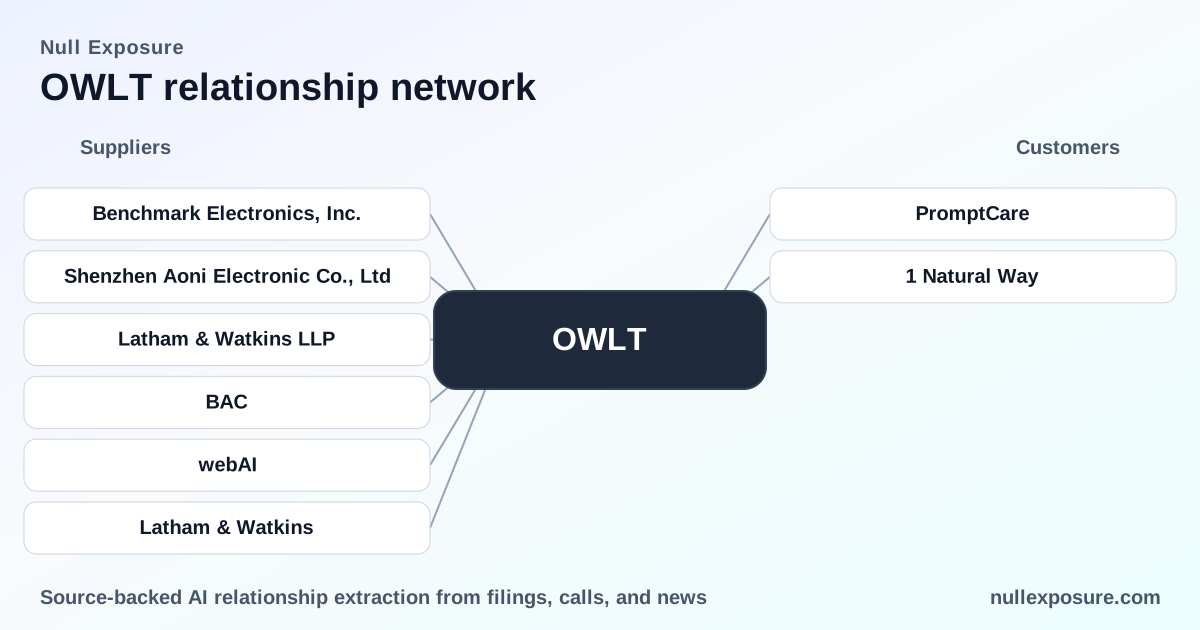
Owlet (OWLT) — supplier relationships, operating posture, and what investors should know
Owlet monetizes by selling infant-monitoring hardware (Smart Sock, Dream Sock, Owlet Cam and related devices) and the subscription and services that enhance those devices; the company outsources production and some operational infrastructure to third parties, earning revenue from unit sales and recurring services while relying on external partners for manufacturing, legal capital markets execution, and AI capabilities. For investors, the critical lens is supplier concentration, contract tenor, and the commercial partners that enable scale rather than in‑house manufacturing. Read more supplier intelligence at https://nullexposure.com/.
A practical supplier map: who actually makes and supports Owlet's products
Owlet’s 2024 public filings and subsequent press coverage identify a short list of material external relationships that underpin product production, capital markets execution, legal counsel, and nascent AI capability. Below I cover each named partner and the role they play for Owlet.
Benchmark Electronics, Inc.
Benchmark provides manufacturing and related services for Owlet’s Dream Sock, Smart Sock, BabySat, and Dream Duo out of its Thailand facilities, including component procurement, assembly and test. According to Owlet’s 2024 Form 10‑K, the company entered into a manufacturing services agreement with Benchmark in October 2017 and continues to use Benchmark for these product families (FY2024 10‑K).
Shenzhen Aoni Electronic Co., Ltd
Shenzhen Aoni handles manufacturing and supply for the Owlet Cam, with responsibilities that include procuring materials, assembly and packaging of finished products. Owlet disclosed a manufacturing and supply agreement with Aoni entered in June 2018 in its 2024 Form 10‑K (FY2024 10‑K).
Latham & Watkins LLP
Latham & Watkins has served as Owlet’s legal advisor on capital markets matters: the firm advised on Owlet’s SPAC combination and initial NYSE listing in 2021 and again advised on a $30 million Class A stock offering and a warrant exchange in 2025. Legal coverage and announcements list Latham & Watkins as lead counsel on those financings (transaction coverage, 2021 and 2025 press reports).
BofA Securities
BofA Securities acted as Owlet’s exclusive financial advisor during the company’s 2021 SPAC business combination and NYSE listing, serving as the principal investment bank for that capital markets transaction (media reports and deal notices, 2021).
webAI
Owlet announced a strategic partnership with webAI to incorporate advanced AI-driven personalization for infant health and sleep insights, an initiative disclosed publicly in December 2025 as part of the company’s product and analytics roadmap (press release coverage, Dec. 18, 2025).
What the supplier footprint tells investors about Owlet’s operating model
Owlet is a largely asset‑light medical-device company that outsources manufacturing, assembly and certain operational services. That posture creates distinct commercial characteristics:
- Contracting posture: short‑term, third‑party dependence. Owlet discloses it has not entered into long‑term agreements with current contract manufacturers and lacks internal manufacturing capability, a company-level signal that gives suppliers leverage over cost, timing and quality (Owlet 2024 Form 10‑K).
- Concentration risk: material single‑vendor exposures. The company relies on a single manufacturer for assembly of its core product family and a separate single manufacturer for the Owlet Cam; that concentration elevates operational risk if a supplier credit line is revoked or a facility is disrupted (Owlet 2024 Form 10‑K).
- Global supply base: international sourcing and geopolitical exposure. Owlet sources raw materials and components from international suppliers, increasing exposure to logistics, tariffs and regional labor constraints (company disclosure).
- Service dependencies: cloud and hosted support. The company operates customer support, digital services and device hosting on third‑party cloud and call center platforms, positioning these vendors as critical to subscription revenues and customer experience.
- Relationship stage and commercial terms. Manufacturers reportedly extend credit to Owlet and the company uses that credit to scale production, indicating active, working‑capital relationships rather than passive vendor arrangements (10‑K evidence).
These factors combine into a strategy that lowers capital intensity but raises supplier and operational concentration risk — a tradeoff investors must weigh when modeling cash flow volatility and downside scenarios.
Read more detailed supplier scoring and risk matrices at https://nullexposure.com/.
Financial and strategic implications for investors
Owlet’s monetization profile — hardware sales plus subscription services — depends on uninterrupted production and timely product launches. The manufacturing relationships with Benchmark and Shenzhen Aoni are therefore operationally critical while not contractually locked into long-term protection. That creates scenarios where supply disruption, a sudden change in supplier credit, or quality problems would create outsized revenue and margin pressure in a company with negative operating leverage in recent periods.
Legal and capital markets advisors (Latham & Watkins; BofA Securities) reduce execution risk for financing and public listings, but they do not mitigate the core production and supply vulnerabilities. The nascent AI partnership with webAI is strategically important for product differentiation and subscription engagement, but it is complementary to — not a substitute for — robust manufacturing continuity.
Key investor takeaways:
- High supplier concentration on a small set of contract manufacturers increases single‑point failure risk.
- Short contract tenor and lack of internal manufacturing capability grant vendors negotiating leverage on pricing and capacity.
- Capital markets and legal partners are best‑in‑class and reduce financing execution risk but do not address production dependency.
- AI partnership supports long‑term subscription growth through product enhancement, but near‑term revenue depends on manufacturing throughput.
Quick checklist for diligence before allocating capital
- Confirm the current status, terms or renewals with primary contract manufacturers (Benchmark; Shenzhen Aoni) and any contingency manufacturing plans.
- Validate supplier credit lines and any covenants that could affect production scale.
- Assess integration status and roadmap delivery with webAI for subscription monetization lift.
- Review any material adverse supplier events since the 2024 Form 10‑K.
If you want a structured supplier risk report or scenario analysis for OWLT, start here: https://nullexposure.com/.
Closing view and recommended next steps
Owlet is positioned as a software-enabled hardware company in infant health: revenue upside depends on product adoption and subscription growth, while downside is concentrated in outsourced manufacturing and global sourcing. For investors prioritizing operational stability, the combination of single‑vendor assembly and short contract tenors is the primary risk to model; for growth investors, the webAI relationship and continued capital markets access support scaling if supply remains uninterrupted.
For a deeper supplier risk scorecard, counterparty exposure map, and tailored diligence, visit https://nullexposure.com/ — or contact my team for a focused briefing.