Oxbridge Re Holdings (OXBR): underwriting base, sidecars and a bet on tokenized capital
Oxbridge Re Holdings (OXBR) operates as a specialist property & casualty reinsurance underwriter that monetizes through traditional underwriting margins, fee income from sidecar vehicles and increasingly through tokenized reinsurance products that bring alternative capital into its books. The company combines legacy retrocession and quota-share mechanics with new Web3 distribution partnerships, while funding activity via small-cap equity placements and placement agents. For investors, the core question is whether underwriting economics and fee captures from third‑party capital will scale faster than ongoing operating losses.
Explore deeper supplier relationship intelligence at https://nullexposure.com/.
The business model in plain English: underwriting plus third‑party capital
Oxbridge is a compact reinsurance platform: primary revenue comes from net premiums and investment income, supplemented by structured fee income when Oxbridge sponsors sidecars or manages third‑party capital. The firm uses quota‑share and retrocession arrangements to cede or attract capacity, and is actively partnering with tokenization platforms to broaden distribution of structured reinsurance tranches to institutional and qualified investors.
- Contracting posture: the company engages external placement agents and arrangers to raise capital and distribute securities, consistent with a capital‑constrained, outsourced distribution model.
- Concentration and governance: with a market capitalization near $6.6m and insider ownership around 15.8%, ownership and liquidity are limited, elevating governance and market‑liquidity considerations for counterparties and investors.
- Criticality of relationships: sidecars and tokenization partners are operationally material because they supply capital and distribution—these partnerships are not ornamental.
- Maturity: Oxbridge remains an early‑stage public reinsurer with negative operating margins and limited scale, so business model execution risk is elevated.
The company-level constraint signal is explicit: Oxbridge is willing to pay external distributors for capital—a sales agent commission equal to 3% of gross proceeds is disclosed for recent offerings, indicating an acquisitive capital posture that increases funding costs.
Commercial relationships and what each one means for risk and upside
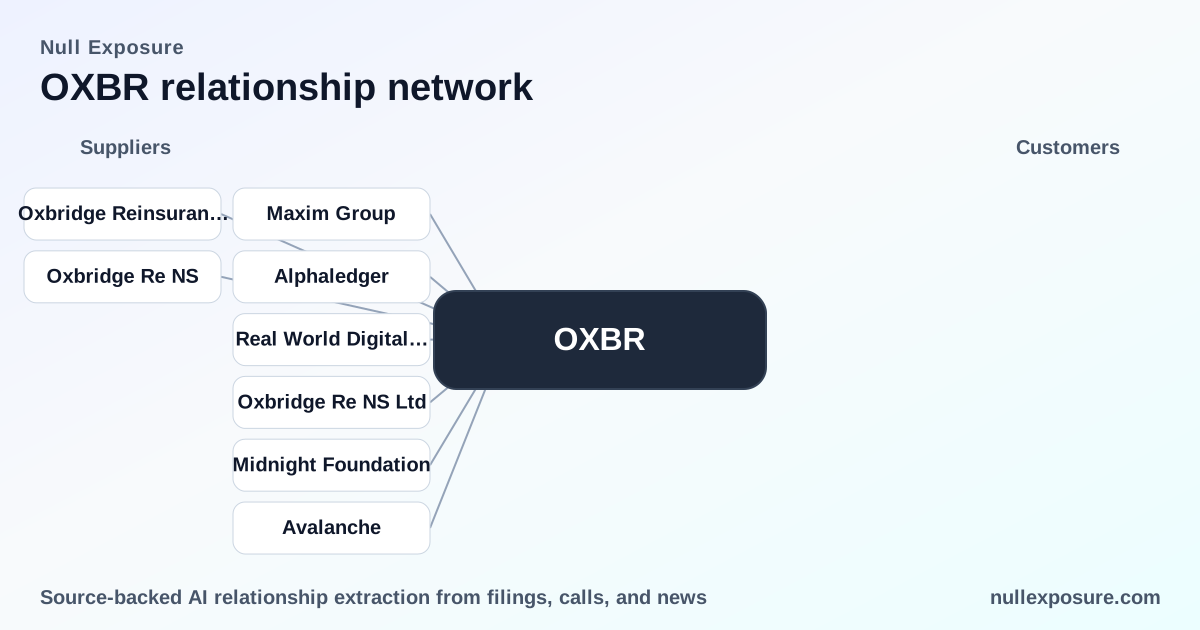
Maxim Group — placement agent for equity raises
Maxim Group acted as the sole placement agent for a registered direct offering that closed around February 26, 2025, signaling Oxbridge’s reliance on boutique capital markets intermediaries to raise incremental equity. Source: Reinsurance News (Feb 2025) — https://www.reinsurancene.ws/oxbridge-re-prices-3m-registered-direct-offering-and-private-placement/
Alphaledger — tokenization and distribution on Solana
Alphaledger is a strategic distribution and tokenization partner: Oxbridge’s SurancePlus products (balanced‑yield and high‑yield tranches) are being listed on Alphaledger’s regulated, Solana‑native platform to reach institutions and accredited investors. This expands distribution but shifts counterparty and regulatory risk into the crypto ecosystem. Source: Sahm Capital press release (Dec 11, 2025) and Yahoo Finance coverage (Dec 2025) — https://www.sahmcapital.com/news/content/oxbridge-suranceplus-bring-tokenized-reinsurance-to-solana-in-blockchain-partnership-2025-12-11; https://finance.yahoo.com/news/oxbridge-suranceplus-bring-tokenized-reinsurance-133128509.html
Real World Digital Assets — financing agreements to bolster liquidity
Oxbridge entered financing arrangements with Real World Digital Assets to improve near‑term liquidity, indicating active use of non‑bank financing channels to support underwriting and tokenization initiatives. Source: TradingView news (2026) — https://www.tradingview.com/news/tradingview:1dc182cd85ebe:0-oxbridge-re-holdings-signs-multiple-material-agreements/
Oxbridge Re NS Ltd — sidecar vehicle and quota‑share retrocession partner
Oxbridge Re NS Ltd is Oxbridge’s dedicated sidecar vehicle used to bring third‑party capital into its property catastrophe program under a retrocessional quota‑share structure; investors in the sidecar provided collateral and shared losses with the parent. This vehicle generated meaningful fee income historically and delivered targeted investor returns. Source: Artemis (2020/2021) — https://www.artemis.bm/news/oxbridge-res-sidecar-on-track-to-deliver-40-returns-to-investors/ and https://www.artemis.bm/news/oxbridge-res-sidecar-shrinks-to-216k-for-2020-renewal/
Oxbridge Re NS (non‑Ltd mentions) — investor‑aligned capital platform
Oxbridge Re NS (alternate naming in filings and press) functions as the channel through which aligned retrocession capacity from capital markets investors is managed, enabling Oxbridge to earn management and arrangement fees while gaining balance‑sheet relief. Source: Artemis (2021) — https://www.artemis.bm/news/oxbridge-res-sidecar-investors-earn-17-return/
Oxbridge Reinsurance Ltd — retrocession counterparty for sidecars
Oxbridge Reinsurance Ltd takes the complementary retrocession position in historical sidecar deals, receiving quota share ceded business from Oxbridge Re NS, which concentrates operational loss‑sharing mechanics within the group. This internal retrocession relationship underpins how the company structures capital and claims risk across affiliates. Source: Artemis (2020) — https://www.artemis.bm/news/oxbridge-res-sidecar-shrinks-to-216k-for-2020-renewal/
Midnight Foundation — privacy‑first RWA tokenization partner
Midnight Foundation is integrated as a privacy‑focused blockchain network for regulated real‑world asset tokenization tied to SurancePlus offerings, exposing Oxbridge to specialized technical and compliance dependencies in the tokenization stack. Source: Yahoo Finance coverage (Dec 2025) — https://finance.yahoo.com/news/oxbridge-suranceplus-announces-partnership-midnight-120000748.html
Avalanche — infrastructure used for SurancePlus tokenized securities
Oxbridge’s SurancePlus venture originally utilized the Avalanche blockchain to create tokenized reinsurance securities, demonstrating the firm’s multi‑chain experimentation and exposure to chain‑specific operational risk. Source: Artemis (2025) — https://www.artemis.bm/news/oxbridge-re-confirms-20-42-return-targets-for-tokenized-reinsurance-sidecar-tranches/
(Each relationship above is pulled from public press and industry reporting between 2020–2026 as cited.)
Mid‑analysis takeaway
Oxbridge combines traditional quota‑share mechanics with an aggressive push into tokenized distribution; that dual strategy can amplify fee income if underwriting holds, but it also introduces concentrated counterparty and crypto‑infrastructure risk. For deeper supplier relationship mapping, visit https://nullexposure.com/.
Financial and operational risk profile investors must price
- Funding cost and dilution: the company uses paid placement agents (3% commission disclosed) and small equity raises, which dilute existing holders and increase capital acquisition costs.
- Small scale and negative margins: with trailing revenue below $2.5m, negative EPS, and a market cap roughly $6.6m, scale limitations constrain underwriting diversification and reinsurance negotiation leverage.
- Counterparty and ecosystem risk: reliance on specialized partners (sidecar investors, Alphaledger, Midnight, Avalanche) concentrates operational risk outside the core insurance industry; any platform failure or regulatory action could impair distribution and capital flows.
- Concentration of ownership: insider and institutional stakes are significant relative to float, which affects liquidity and the ease of executing strategic capital raises.
What investors and operators should do next
- For investors: price in execution risk—value Oxbridge on the likelihood that sidecar fee income and tokenized product distribution will scale before persistent underwriting losses force additional capital raises.
- For counterparties and potential partners: insist on operational and regulatory controls around tokenized instruments and sidecar capital flows before committing material capacity.
- For diligence: confirm contractual terms for placement agent fees and sidecar retrocession language in filings and press releases before underwriting counterparty exposure.
Final note: Oxbridge is a small‑cap, high‑conviction operator combining niche reinsurance underwriting with a clear push into tokenized capital markets; returns hinge on execution—both underwriting discipline and the success of its tokenization and sidecar program. Learn more about supplier relationship risk and mapping at https://nullexposure.com/.