Oxford Lane Capital (OXLCL): An investor-focused supplier map and operating thesis
Oxford Lane Capital Corp. funds a diversified portfolio of senior secured loans and debt instruments and monetizes through a mix of investment income and capital markets financing — most visibly its 6.75% Notes due 2031, which function as a stable cash-cost borrowing line for the closed-end vehicle. For investors and counterparties evaluating supplier relationships, the company’s business model centers on an external investment-adviser relationship, concentrated funding instruments, and an income-oriented distribution profile that is sensitive to portfolio cashflow and dividend policy. Learn more about relationship mapping and risk signals at https://nullexposure.com/.
The core business: how the notes and the adviser generate returns
Oxford Lane operates as a closed-end investment company that purchases credit assets and funds them with a mix of equity, retained earnings, and fixed-income instruments such as the 6.75% Notes due 2031. The notes provide predictable financing cost and allow the manager to leverage asset returns where attractive. The firm’s public market profile—market capitalization of roughly $758.2 million and a reported dividend yield around 7.27%—signals a yield-first investor base and a corporate governance model built around income delivery and balance-sheet management (company market data, latest filings through Q3 2025).
- Business driver: income generation via interest spread between portfolio yields and the fixed coupon on issued notes.
- Financing posture: reliance on public notes and closed-end structure gives access to long-dated financing while concentrating refinancing and interest-rate risk around bond maturities such as 2031.
- Investor implications: counterparties and service providers should prioritize cashflow visibility and dividend policy as indicators of near-term stability.
What the March 2026 market reaction tells counterparties
A headline market move in March 2026—shares down roughly 13% following a dividend adjustment—highlights the operational reality: dividend policy materially affects investor valuation and counterparty risk perception. The event underlines that credit selection and realized portfolio income are front-line drivers for liquidity and market confidence in a closed-end vehicle like Oxford Lane. According to an Intellectia news item dated March 10, 2026, the market reacted sharply after the dividend cut was announced (Intellectia, 2026-03-10).
Supplier relationships: who actually runs the investment activity
Oxford Lane Management, LLC — the investment adviser you need to know
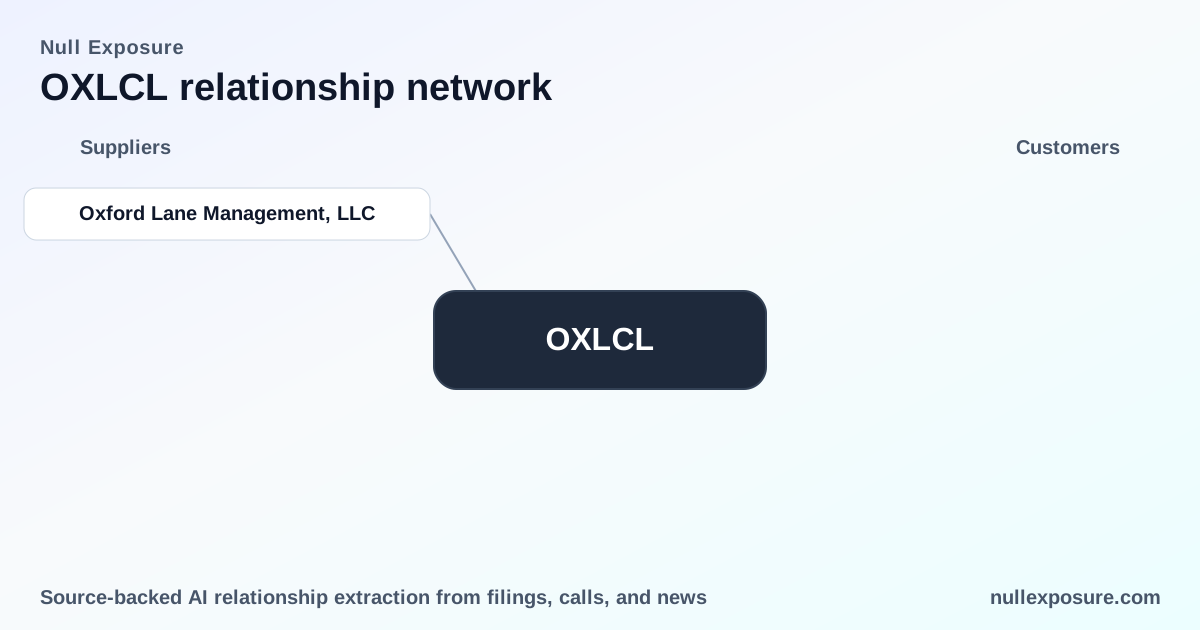
Oxford Lane Management, LLC is the designated investment adviser and manages the Fund’s investment activities; that adviser relationship is the operational hinge for portfolio construction and day-to-day execution. According to an Intellectia news item filed on March 10, 2026, “The Fund’s investment activities are managed by Oxford Lane Management, LLC,” confirming the adviser’s central role in portfolio decisions (Intellectia, 2026-03-10; https://intellectia.ai/news/stock/oxford-lane-capital-shares-drop-13-after-dividend-cut).
Constraints and operating model signals that matter to suppliers and investors
While there are no formal constraint excerpts provided in the available record, the public company facts and supplier mapping imply a set of company-level operating characteristics that buyers, lenders, and service suppliers should treat as givens:
- Contracting posture: The investment adviser relationship establishes a principal-agent contracting form. Service agreements and performance incentives will govern trade execution, asset selection, and distribution decisions. Assess contract length, fee structures, and control rights when underwriting exposure.
- Concentration: Operational control is concentrated in the hands of a single named investment adviser for portfolio management, increasing key-person and counterparty concentration risk for any vendor or lender that depends on stable asset management.
- Criticality: The adviser is functionally critical for returns and liquidity generation because portfolio cashflows drive dividend capacity and debt servicing for instruments like the 2031 notes.
- Maturity and refinancing profile: The existence of a fixed coupon note maturing in 2031 imposes a medium-term refinancing horizon and measurable interest-rate exposure on the balance sheet; planning around that maturity is a counterparties’ operational priority.
These attributes should be integrated into any supplier diligence checklist (legal terms, termination rights, collateral remedies, operational continuity clauses). For deeper due diligence and monitoring workflows, visit https://nullexposure.com/.
Risk profile and what to watch next
- Dividend policy volatility is the immediate market lever; the March 2026 dividend change produced a material equity repricing, demonstrating sensitivity to short-term cashflow shifts (Intellectia, 2026-03-10).
- Capital structure timing risk centers on the 2031 notes: counterparties need clarity on sinking funds, covenants (if any), and the adviser’s strategy for managing asset-liability duration.
- Concentration risk derives from reliance on a single investment adviser; succession planning and delegation frameworks are critical contract elements for vendors and institutional counterparties.
Practical takeaways for investors and vendor partners
- Treat the investment adviser as the primary supplier. Contract terms and operational oversight of Oxford Lane Management, LLC determine portfolio direction and therefore influence the security of coupon and dividend flows.
- Stress-test dividend scenarios and refinancing options. Given the public market reaction to dividend changes, counterparties should model downside cashflow and covenant outcomes into pricing and legal protections.
- Prioritize contractual protections around continuity and control. Because asset management is concentrated, suppliers should negotiate termination and continuity clauses that mitigate key-person and transition risk.
If you need a tailored supplier-risk brief or proactive monitoring for Oxford Lane, start here: https://nullexposure.com/.
Bottom line
Oxford Lane’s model is clear and concentrated: generate yield on credit assets and fund them through a mix of equity and fixed-coupon notes, with execution centralized through Oxford Lane Management, LLC. That structure delivers predictable income when portfolio cashflow is stable, and it amplifies volatility when distribution policy shifts. For counterparties and investors, the key decisions are contractual—how the adviser relationship is governed, how the company manages its 2031 financing maturity, and how dividend policy is handled during earnings cycles. For ongoing surveillance and supplier-level intelligence, visit https://nullexposure.com/.
Sources: Company public filings and market data through Q3 2025; Intellectia news report on March 10, 2026 (https://intellectia.ai/news/stock/oxford-lane-capital-shares-drop-13-after-dividend-cut).