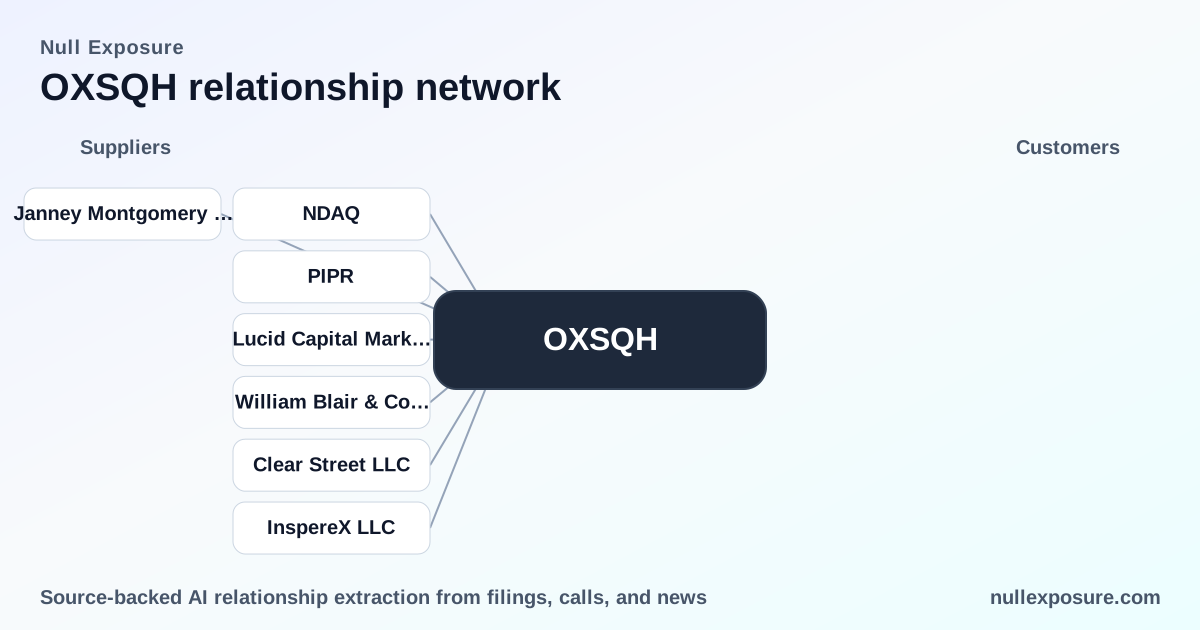
Oxford Square Capital (OXSQH): Who it Uses to Place the 7.75% Notes — a supplier map for investors
Oxford Square Capital operates as a fixed‑income investment vehicle that finances middle‑market companies through corporate debt, CLO exposures and selective equity investments; it monetizes by capturing interest and principal returns from portfolio credit, while paying management and administration fees to affiliated service providers. The company funds its strategy both from capital markets issuances (notably the recently priced 7.75% notes due 2030) and from reinvesting returns from its debt and CLO holdings, with fees paid to an external adviser and administrators forming a predictable operating expense base.
Explore a concise supplier and placement view at https://nullexposure.com/ to benchmark counterparties and fee dynamics.
Market event in focus Oxford Square priced a $65 million offering of unsecured 7.75% notes due 2030 that were announced to trade under the symbol OXSQH; the deal used a mix of institutional managers and lead brokers for distribution and was confirmed in market releases on March 10, 2026. This issuance is the immediate commercial context around the counterparties listed below and establishes the company’s active engagement with capital markets intermediaries. According to the QuiverQuant news summary published March 10, 2026, the notes are expected to be listed on the NASDAQ Global Select Market and trade under OXSQH.
Deal counterparties and listing partners The filing and press summary name a discrete set of distributors and market venues engaged with the notes offering. Below are plain‑English summaries of each relationship, with source context.
NASDAQ Global Select Market
The notes are expected to be listed and trade on the NASDAQ Global Select Market under the ticker OXSQH, giving Oxford Square access to a regulated secondary market and public investor liquidity. This listing detail was published in the offering announcement and market coverage on March 10, 2026 by QuiverQuant.
Piper Sandler & Co. (PIPR)
Piper Sandler served as a joint book‑running manager on the offering, positioning it as a primary distribution partner for the debt placement and institutional book building. The role was described in the March 10, 2026 offering notice reported by QuiverQuant.
Lucid Capital Markets, LLC
Lucid Capital Markets acted as a joint book‑running manager alongside Piper Sandler, indicating active underwriting and execution responsibilities for the notes sale. QuiverQuant’s March 10, 2026 coverage lists Lucid as a book‑runner for the transaction.
Clear Street LLC
Clear Street is listed among the lead managers for the offering, functioning as a lead distribution and execution desk supporting liquidity and placement. QuiverQuant’s March 10, 2026 press summary includes Clear Street as a lead manager.
InspereX LLC
InspereX appears as a lead manager on the deal, suggesting a role in block distribution and broker‑dealer level execution for the offering. This was noted in the QuiverQuant announcement dated March 10, 2026.
Janney Montgomery Scott LLC
Janney Montgomery Scott is identified as one of the lead managers for Oxford Square’s notes offering, which positions Janney as a placement partner to reach retail and institutional accounts. The March 10, 2026 release on QuiverQuant lists Janney in the syndicate.
William Blair & Company, L.L.C.
William Blair is also named among the lead managers, indicating participation in underwriting and investor solicitation for the $65 million note issuance. The listing of William Blair in the syndicate appears in the QuiverQuant March 10, 2026 news item.
Operating model and supplier constraints — what the filings say Oxford Square’s operating posture is governed by a few clear, company‑level signals that shape supplier engagement and financial relationships. Below I translate the filing excerpts into investor‑relevant constraints and implications.
- Contracting posture — long‑term finance and advisory continuity. Debt exposures often carry significant principal at maturity and the Investment Advisory Agreement is subject to annual board reapproval but includes standard termination provisions (60 days’ notice). This produces durable counterparty ties to the investment adviser while allowing routine governance review, a balance between stability and oversight as evidenced in the company’s filings through 2024.
- Geographic exposure — global credit linkages. The company explicitly invests in foreign securities and Cayman‑formed CLO vehicles, creating cross‑jurisdictional counterparty and legal complexity that suppliers (custodians, auditors, counsel) must accommodate.
- Materiality signal — third‑party auditor independence. PricewaterhouseCoopers LLP reported no material financial interest in the company, which is a standard but important governance signal about auditor neutrality and third‑party independence.
- Role mix — buyer plus outsourced service model. Oxford Square is principally a buyer of corporate credit and CLO equity but also operates with an outsourced service architecture: it pays an investment adviser and allocates administrative costs to an affiliated fund manager. The filings name Oxford Square Management, Oxford Funds, ACA Group (compliance), and U.S. Bank as the custodian in the company’s agreements and disclosures.
- Operational maturity — active and resourced. Advisory agreements were re‑approved and the company reported investments across 21 portfolio companies and meaningful CLO equity positions as of December 31, 2024, indicating mature operating activity and ongoing reliance on external managers.
- Spend profile — operational vendors in the mid‑band. Reported fees show meaningful but non‑outsized spend (audit fees near $948k; $120k accrued to ACA Group; roughly $747k allocable administration compensation), which positions suppliers in the $100k–$1m annual band for many services.
These constraints imply stable, moderately concentrated service relationships where third‑party firms handling custody, audit, compliance and distribution are operationally critical but not dominant revenue contributors to Oxford Square’s counterparty base.
Middle reading and benchmarking For investors and operators assessing counterparty risk, focus on three vectors: distribution concentration (multiple lead managers vs single book‑runner), operational outsourcing (adviser and admin reliance), and legal/geographic complexity from non‑U.S. CLO exposure. Each vector affects liquidity, counterparty credit exposure, and operational continuity. Browse comparable supplier maps and syndicate histories at https://nullexposure.com/ to put this syndicate into market context.
Risk and opportunity for counterparties The syndicate of boutique and bulge‑bracket firms used for the offering gives Oxford Square distribution flexibility and a diversified placement channel, which reduces execution risk while preserving access to retail and institutional books. For service providers, the mid‑band fee profile makes the relationship meaningful but not financially dominant, creating room for competitive sourcing if service quality or cost becomes an issue. The company’s global credit exposure elevates legal and custody complexity for counterparties that must handle offshore CLOs.
Final takeaway and next steps for desk and ops teams Oxford Square’s 7.75% note issuance demonstrates a pragmatic capital‑markets approach: diversified syndicate placement coupled with an outsourced investment and administrative model that produces steady operating demand for advisers, custodians and auditors. Investors evaluating supplier relationships should prioritize counterparties with cross‑border custody capabilities, fixed‑income distribution reach, and cost transparency.
For a deeper supplier and syndicate benchmark, visit https://nullexposure.com/ to compare fee bands, manager roles, and custody footprints across similar note issuances.