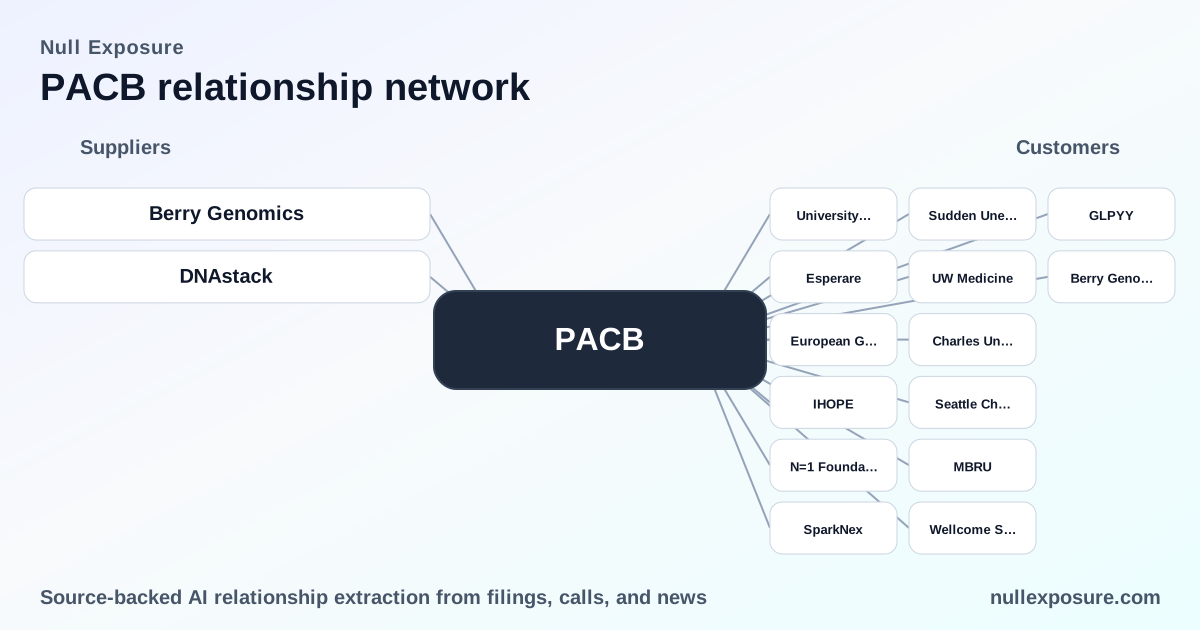
PACB Supplier Intelligence: How supplier dynamics shape Pacific Biosciences’ commercial runway
Pacific Biosciences of California designs, develops and manufactures long-read DNA sequencing systems and sells related products worldwide. The company monetizes primarily through equipment sales and recurring commercial engagement in genomics markets, with regional adoption and partnerships driving localized revenue spikes. Supplier and partner arrangements—particularly long-term supply agreements and strategic collaborations in Asia—directly influence PacBio’s capacity to deliver instruments and expand clinical adoption. For investors evaluating PACB supplier relationships, the interplay of guaranteed supplier capacity, regional commercialization wins, and research partnerships sets the near-term operational profile and the strategic growth vectors.
Explore supplier and partner linkage intelligence at https://nullexposure.com/ for deeper diligence and continuous monitoring.
Why supplier posture matters to stock performance and operational continuity
PacBio’s business is capital- and supply-sensitive: instruments require specialized components and contract manufacturing, and revenue growth requires both product availability and regional regulatory acceptance. Long-term supply agreements that include minimum purchase commitments lock in capacity but also create committed outlays; a geographically broad supplier base reduces single-source risk but raises coordination complexity. Those features together shape capital efficiency, margin volatility, and the company’s ability to scale commercial deployments.
Key public metrics frame the picture: trailing twelve‑month revenue of $160.0M and gross profit of $54.9M contrast with substantial operating losses (negative EBITDA of roughly $169.2M), indicating that operational execution and supply continuity materially affect profitability and cash flow trajectories.
Supplier and partner mentions you must know
Below are the relationships surfaced in recent public records. Each entry is summarized in plain language with a direct source reference.
Berry Genomics — clinical adoption in China driving Asia revenue
PacBio reported that Asia Pacific revenue increased to $9.3 million in Q4 2025 primarily due to increased sales related to Berry Genomics, following regulatory approval for clinical long‑read sequencing in China that enables routine hospital testing for thalassemia. This represents a conversion of regulatory clearance into commercial instrument deployments in a high‑volume regional market. According to PacBio’s Q4 2025 earnings call (reported March 2026), this commercial activity materially contributed to regional revenue growth.
DNAstack — federated HiFi whole‑genome collaboration for rare disease research
PacBio partnered with DNAstack to launch the first global federated HiFi whole‑genome dataset accessible via hifisolves.org, enabling researchers to query harmonized data across institutions without centralizing protected data and preserving regional privacy compliance. This is a research‑collaboration and data access initiative that expands the value proposition of PacBio’s HiFi sequencing for rare disease studies and institutional partners. The collaboration was reported in a February 24, 2026 press release covered on Sahm Capital’s news feed and describes an active, outward‑facing research partnership.
What corporate disclosures tell investors about supplier constraints
PACB’s public disclosures and recent amendments reveal a procurement posture that investors should treat as strategic and binding:
- Long‑term contracted supply: The company disclosed a long‑term supply agreement amended September 2024 that includes minimum purchase commitments through 2027 and guaranteed capacity with a semiconductor manufacturer; this indicates a contractual commitment to secured capacity over multiple years (company filings and disclosure language).
- Global sourcing footprint: PacBio purchases custom and off‑the‑shelf components from a large number of suppliers worldwide and subjects them to high quality specifications, signaling broad supplier geography and complex procurement operations (company disclosure language).
- Material dependency on a limited set of parts: Management notes several key parts are sourced from a limited number of suppliers and that interruptions could produce cost increases or operational impact, making some components materially important to manufacturing continuity.
- Manufacturer and contract manufacturing relationships: The company’s commitments include contract manufacturers and suppliers for goods not yet received, pointing to a supply chain that integrates outsourced manufacturing and vendor-managed capacity.
- Active supply relationships: The September 2024 amendment and its purchase commitments demonstrate that supplier arrangements are operational and active through the near term (through 2027).
These constraints are company-level signals recorded in recent disclosures and are not attributed to any single named supplier unless explicitly stated.
How these signals change the investment and operational calculus
The combined signals produce a specific risk/reward profile:
- Operational upside: Regulatory wins in China and research partnerships increase addressable demand and create pathways for recurring instrument orders plus downstream collaborator engagement (as illustrated by Berry Genomics and DNAstack).
- Balance sheet and margin risk: Minimum purchase commitments and reliance on critical parts magnify downside if demand plateaus; fixed commitments reduce flexibility and can pressure cash flow during soft demand periods.
- Execution sensitivity: Guaranteed capacity with a semiconductor manufacturer reduces short‑term supply shortage risk but increases exposure to pricing and obsolescence risk if technology cycles accelerate.
- Diversification benefit: A global supplier base reduces single‑country sourcing risk but requires mature procurement and quality control to avoid disruptions.
Investors should watch order flow trends, regional reimbursement/regulatory developments (China in particular), and any supplier cost or lead‑time disclosures in quarterly filings.
Explore ongoing supplier risk scoring and relationship histories at https://nullexposure.com/ to track these dynamics continuously.
Practical recommendations for investors and operators
- For investors: monitor Asia Pacific instrument bookings and recurring service revenue as leading indicators of whether regulatory approvals translate into sustained demand; track supplier‑related disclosure changes in 10‑Q/10‑K filings.
- For operators: prioritize supplier redundancy for critical components and negotiate capacity‑flexible terms at upcoming renewal points to reduce minimum‑purchase risk.
- For both groups: use partnership milestones—such as dataset launches and institutional collaborations—as proxy signals for pipeline strength and future instrument demand.
Explore PACB supplier histories and live relationship alerts at https://nullexposure.com/ for actionable monitoring and decision support.
Bottom line
Pacific Biosciences’ immediate commercial prospects are driven by two intertwined themes: regional commercialization wins that convert regulatory approvals into instrument demand, and binding supply agreements that secure capacity at the cost of reduced flexibility. Berry Genomics’ role in driving Asia revenue and the DNAstack collaboration expanding research reach are concrete examples of how partnerships and market access fuel growth. At the same time, minimum purchase commitments and a concentration in certain key parts create a meaningful operational lever that can amplify both upside and downside for investors. Regular review of procurement disclosures, partner announcements, and regional order trends is essential to position around PACB’s supplier-driven dynamics.