PagSeguro (PAGS): supplier relationships and operational posture investors should price in
PagSeguro is a Brazil‑focused fintech platform that monetizes through a mix of payments processing, acquiring and merchant services, and embedded financial products for consumers and micro‑ and small businesses. The company collects transaction and service fees from merchants, earns interest and spreads on financial products, and captures recurring revenue from digital bank and payments subscriptions — a hybrid payments‑plus‑financial‑services model that scales with merchant acceptance and retail customer adoption. For a deeper supplier‑risk view and supplier relationship tracking, visit https://nullexposure.com/.
How PagSeguro’s economics stack up in plain terms
PagSeguro runs a platform business anchored in payments acceptance and financial services. Revenue TTM was roughly BRL 19.74 billion and gross profit about BRL 10.05 billion, producing a profit margin near 10.7% and operating margin of 39% on reported figures. Market capitalization sits around $2.68 billion, with a trailing P/E of 7.05 and EV/EBITDA of 5.52, signaling a value orientation for investors focused on cash generation rather than growth premium.
Key financial drivers to watch:
- Transaction volumes and merchant counts (core top‑line lever).
- Net interest and spread income from PagBank and financial products.
- Cost of risk and marketing as PagSeguro pushes deeper into embedded banking.
- Regulatory and payment‑rail dynamics in Brazil, which influence margins and product rollout.
These are the operating levers that connect supplier relationships (distribution, custody, rails) to earnings outcomes, and they deserve targeted due diligence. If you want ongoing supplier intelligence tied to this thesis, explore https://nullexposure.com/ for vendor monitoring.
Supplier relationships uncovered (what we found)
Below is the complete set of supplier relationships surfaced in available sourcing for PAGS. Each relationship is summarized in plain English with source attribution.
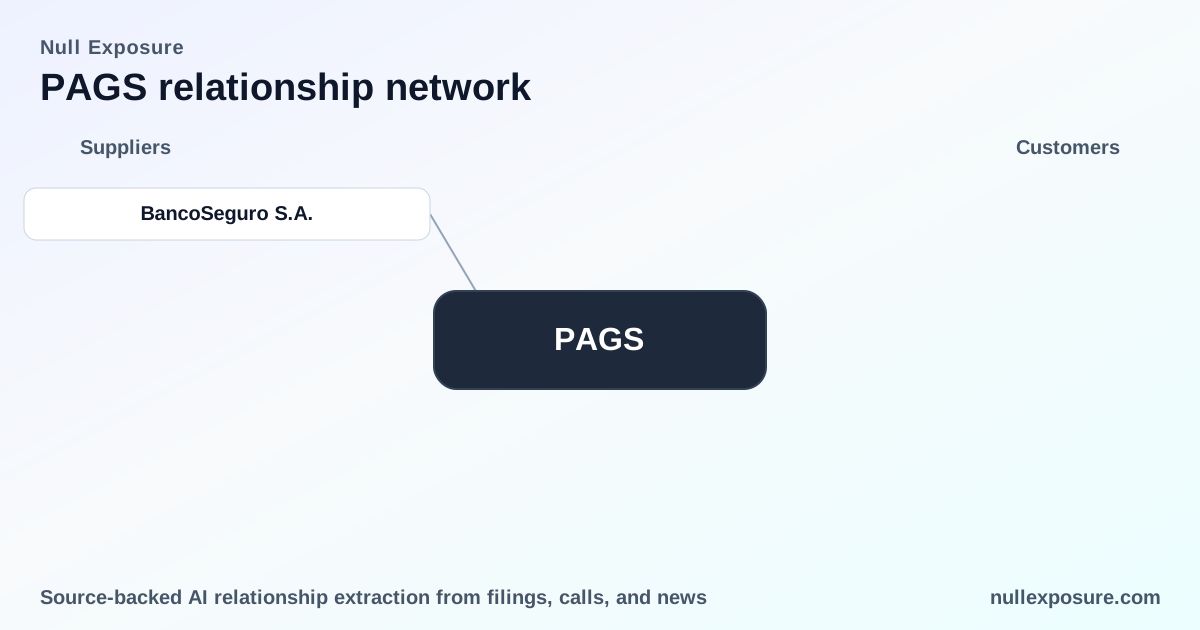
BancoSeguro S.A.
BancoSeguro S.A. handles distribution of mutual funds for PagSeguro’s ecosystem and is authorized by the Central Bank of Brazil and the Securities and Exchange Commission, with affiliation to ANBIMA — a regulatory credential important for institutional product distribution in Brazil. This relationship influences PagSeguro’s ability to offer regulated investment products to its customer base and supports cross‑sell into PagBank. (Source: Sahm Capital news report, FY2026 — https://www.sahmcapital.com/news/content/pagbank-reaches-34-million-customers-and-reports-recurring-profit-of-r-678-million-with-an-roae-of-184-in-4q25-2026-03-05)
Operational posture and company‑level constraints investors should treat as signals
There were no explicit supplier constraints disclosed in the supplied relationship data set. That absence is itself informative: PagSeguro’s publicly surfaced supplier relationships are sparse in the reviewed sources, which signals either limited disclosure or a dispersed supplier base that the company does not emphasize in filings. Presenting company‑level operational characteristics:
- Contracting posture: PagSeguro operates as an integrated fintech platform that historically combines in‑house capabilities (payments, digital bank) with third‑party regulated partners for distribution and licensing. This creates a contracting mix that is both direct (merchant agreements) and intermediated (regulated partners like BancoSeguro for investment products).
- Concentration: The reviewed data does not indicate a concentrated supplier list; however, the criticality of any partner that enables regulated product distribution is high — losing authorization or a distribution partner would be operationally material.
- Criticality: Suppliers that enable regulated activity (custody, fund distribution, payment rails) are critical to product delivery and to revenue that depends on financial services cross‑sell.
- Maturity: PagSeguro’s supplier ecosystem supports a mature, revenue‑generating platform with established distribution channels and regulatory registrations referenced in partner disclosures.
Treat these signals as company‑level intelligence when modeling tail risks and operational dependencies, since no per‑supplier contractual constraints were captured in the input.
Investment implications: what matters for valuation and risk
PagSeguro’s supplier relationships — especially with regulated distribution partners — control product breadth and speed to market. Investors should price the following realities into models:
- Revenue sensitivity to distribution partners: The ability to distribute mutual funds and other regulated products expands yield and fee income; a constrained partner network reduces cross‑sell upside.
- Regulatory counterparty risk: Partners authorized by the Central Bank and securities regulators are essential; changes in those relationships or regulatory treatment directly affect near‑term product launches.
- Concentration risk where unreported: Absence of disclosed constraints increases the importance of ongoing monitoring; a single critical partner failure would have outsized operational impact.
- Valuation defensibility: Current multiples (P/E ~7x, EV/EBITDA ~5.5x) price a resilient cash generator with execution risk rather than a growth premium; supplier‑related operational failures would compress the multiple further.
For operators, a prioritized list of vendor controls around compliance, continuity, and SLAs is the most effective mitigation of the above exposures.
If you track counterparties or need alerts when supplier relationships change for holdings like PAGS, check https://nullexposure.com/ for supplier monitoring and alerting.
Practical next steps for investors and operators
- For investors: Stress test scenarios where a key regulated distributor or custody partner is lost or limited; quantify revenue at risk from investment product distribution and re‑distribution costs.
- For operators: Document fallbacks for regulated product channels and require contractual rights that secure continuity and data access in the event of partner exit.
- For analysts: Reconcile platform revenue buckets and model sensitivity to cross‑sell penetration and merchant acceptance growth given the limited supplier disclosure.
Bottom line
PagSeguro is a payments‑anchored fintech whose earnings are tied to a mix of merchant fees and financial product distribution that depends on regulated partners. The supplier evidence available surfaces BancoSeguro S.A. as a distribution partner for mutual funds, and the lack of broad supplier constraint disclosure is itself an operational signal worth pricing into risk frameworks. For ongoing supplier intelligence and to integrate supplier dynamics into your investment model, visit https://nullexposure.com/.
Bold action: monitor regulated distribution partners and contract terms closely — they materially affect PagSeguro’s path from payments provider to full‑stack digital bank and materially influence upside and downside for PAGS shareholders.