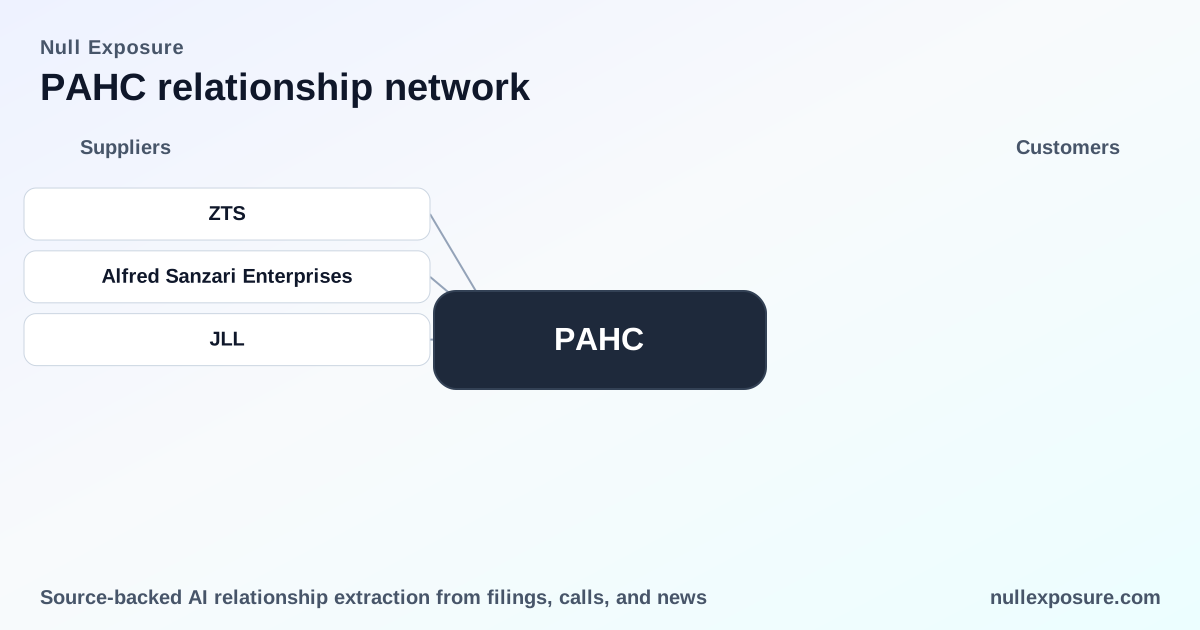
Phibro Animal Health (PAHC): Supplier relationships that shape margin and operational risk
Phibro Animal Health Corporation develops, manufactures and supplies mineral nutrition and animal health products to livestock markets and monetizes primarily through product sales across its integrated manufacturing and commercial footprint. The business generates roughly $1.46 billion in trailing revenue and $229 million in EBITDA, selling finished products and formulations while sourcing certain active ingredients from third-party manufacturers. For investors and operators, the critical lens is how supplier, real-estate and financial counterparties influence margin stability and operational continuity — and where concentration and geographic exposure create upside or downside. Read more company-supplier profiles at https://nullexposure.com/.
Quick read: what matters from PAHC’s external links
PAHC combines in-house manufacturing with external CMOs for active pharmaceutical ingredients, runs a stable corporate HQ lease, and maintains banking relationships that underpin its capital structure. Key takeaways: PAHC leverages third-party manufacturing for specific APIs, anchors its headquarters in Teaneck with a long-term lease, and operates with bank financing that signals maturity but also contractual covenants.
- Growth catalyst: Integration of legacy portfolios (including an MFA integration referenced with Zoetis) can drive near-term revenue expansion.
- Operational exposure: Active pharmaceutical ingredients are sourced from CMOs in China and India, creating geographic supply risk and potential concentration.
- Corporate stability: A renewed 50,000 sq. ft. lease at its Teaneck campus preserves headquarters continuity and reduces real-estate uncertainty.
If you evaluate supplier counterparty risk for portfolios, start with direct relationship reads and documented constraints at https://nullexposure.com/.
What the public relationships say — line by line
Zoetis — strategic product integration fueling Animal Health growth
PAHC referenced a Zoetis MFA integration as a driver of a 77% increase in a segment during the fourth quarter of fiscal 2025, indicating that portfolio consolidations or product hand-offs have materially contributed to recent unit growth. According to the Q4 2025 earnings call transcript (published March 7, 2026), management tied that integration directly to Animal Health momentum.
Alfred Sanzari Enterprises — long-term HQ lease anchored in Teaneck
A Real Estate NJ story reporting on FY2021 activity noted that an animal health company renewed nearly 50,000 square feet at Alfred Sanzari Enterprises’ Teaneck campus, the site of PAHC’s global headquarters since 2012; this renewal underscores operational continuity and low real-estate churn for its corporate functions. The article was cited in March 2026 reflecting the FY2021 lease renewal.
JLL — professional representation in tenancy negotiations
The same Real Estate NJ coverage credited JLL brokers Susan Mason and Tom Reilly with representing the tenant in the Teaneck lease transaction, signaling that PAHC engages institutional commercial real-estate advisors for major occupancy transactions. The Real Estate NJ article (FY2021, referenced March 2026) lists JLL as the tenant representative.
What the constraints tell investors about PAHC’s operating model
The contractual evidence pulled from company exhibits and filings provides actionable signals about PAHC’s supplier posture, counterparty mix, geography and financial counterparties.
- Third‑party manufacturers are part of the model. An exhibit notes that PAHC purchases certain active pharmaceutical ingredients from CMOs in China, India and other locations, indicating a hybrid manufacturing posture where in-house production is complemented by offshore suppliers. This structure reduces fixed capital intensity but creates supply concentration and geopolitical risk where specific APIs are not vertically integrated.
- Financial services relationships are formalized. A Credit Agreement dated July 3, 2024 names Coöperatieve Rabobank U.A., New York Branch, as Administrative Agent and reflects an institutional bank financing layer supporting working capital and growth needs. The existence of that credit facility is a maturity signal and implies covenants and counterparty exposure to monitor.
- Global employee compensation and governance footprint. Form of 2025 RSU agreements cover the U.S., Brazil and Israel, showing multi‑region employment relationships that align pay structures across NA, LATAM and EMEA jurisdictions and can affect talent retention and governance complexity.
- Executives under contract. Publicly filed employment agreements (for example, an employment agreement with an individual executive) confirm standard corporate contracting with named officers, which is relevant for key-person dependency assessments.
These constraints are company-level signals about supplier strategy, financing posture and geographic footprint; they are not tied to a single vendor unless the excerpt names that vendor explicitly.
Operational implications: concentration, criticality, and contracting posture
PAHC’s sourcing and contractual cues create a predictable operating profile for risk managers and portfolio analysts.
- Contracting posture: The firm combines in-house manufacturing with outsourced CMOs, which produces flexible capacity but requires active supplier management, quality oversight, and multi-jurisdiction compliance. Contracts with banks and documented employment/RWU agreements reflect formalized, institutional contracting practices.
- Concentration and criticality: Reliance on CMOs in China and India for certain APIs implies node-based concentration; a disruption at any single CMO or trade corridor would be immediately critical for affected SKUs. Investors should treat those suppliers as high-criticality counterparties until redundancy is proven.
- Maturity: A formal credit agreement and established HQ tenancy indicate corporate maturity and credit access that support working capital and strategic M&A, but also introduce covenant monitoring as a component of counterparty risk.
If you want a detailed counterparty heatmap and contractual exposure summary, see practical tools and vendor profiles at https://nullexposure.com/.
Risk and opportunity checklist for investors and operators
- Strength: Diversified revenue base and clear recent segment growth driven by product integrations (Zoetis MFA reference).
- Risk: Offshore API sourcing — prioritize supplier audits and contingency plans for CMOs in China and India.
- Operational: Stable HQ lease and institutional real-estate advisors reduce corporate relocation risk but underline fixed occupancy costs.
- Financial: Bank credit facility provides liquidity and strategic optionality while creating covenant monitoring obligations.
Conclusion and next steps
For investors, the synthesis of relationship data shows a company that scales revenue through product integrations while outsourcing critical inputs, producing a blend of margin opportunity and supply-chain vulnerability. Operators should prioritize supplier redundancy for APIs, maintain strong lender communications, and codify real‑estate continuity plans.
For a deeper supplier risk profile and contract-level analysis, visit https://nullexposure.com/ to request a tailored report. If you want investor-ready briefings or vendor-specific exposure mapping, start with a direct review at https://nullexposure.com/ — we provide the structured intelligence that underwrites portfolio decisions.