Pyrophyte Acquisition Corp. II (PAII): What its supplier relationships tell investors
Pyrophyte Acquisition Corp. II (PAII) is a special purpose acquisition company that raises capital through a public unit offering and monetizes by completing a business combination with a target in the sustainability and technology sectors. The company’s economics are driven by IPO proceeds, sponsor promote, and post-merger equity in the target; execution depends on capital markets partners and legal counsel that facilitate the offering and structure the deal. For investors and operators evaluating PAII, the supplier roster from its IPO offers a direct window into market access, deal execution capability, and legal sophistication. Learn more at https://nullexposure.com/.
How PAII runs the business and where the money flows
PAII operates as a classic SPAC: it sells units at IPO, holds proceeds in trust, and seeks a merger target. Value is created when the SPAC secures an attractive target at favorable terms, consummates a business combination, and the combined entity trades above the pro forma valuation after sponsor dilution and redemption dynamics. The suppliers disclosed around the IPO—an investment bank lead, co-manager, and outside counsel—are the core merchant-banking and legal plumbing required to convert sponsor strategy into a public vehicle and ultimately close a deal.
- Contracting posture: PAII outsourced underwriting and syndicate management to external investment bank partners rather than using captive distribution, which is standard for newly listed SPACs and indicates reliance on market-facing intermediaries.
- Concentration: The underwriting and legal roles are concentrated among a small group of market participants, which is normal but increases counterparty importance during execution windows.
- Criticality: Underwriter and counsel relationships are mission-critical for IPO closing, over-allotment exercises, and regulatory compliance before a merger can be announced.
- Maturity: The supplier set—lead book-runner, co-manager, and national law firm—matches an early-stage SPAC in its capital formation phase and signals established capital-market readiness rather than boutique or experimental structuring.
The suppliers on file — who did what
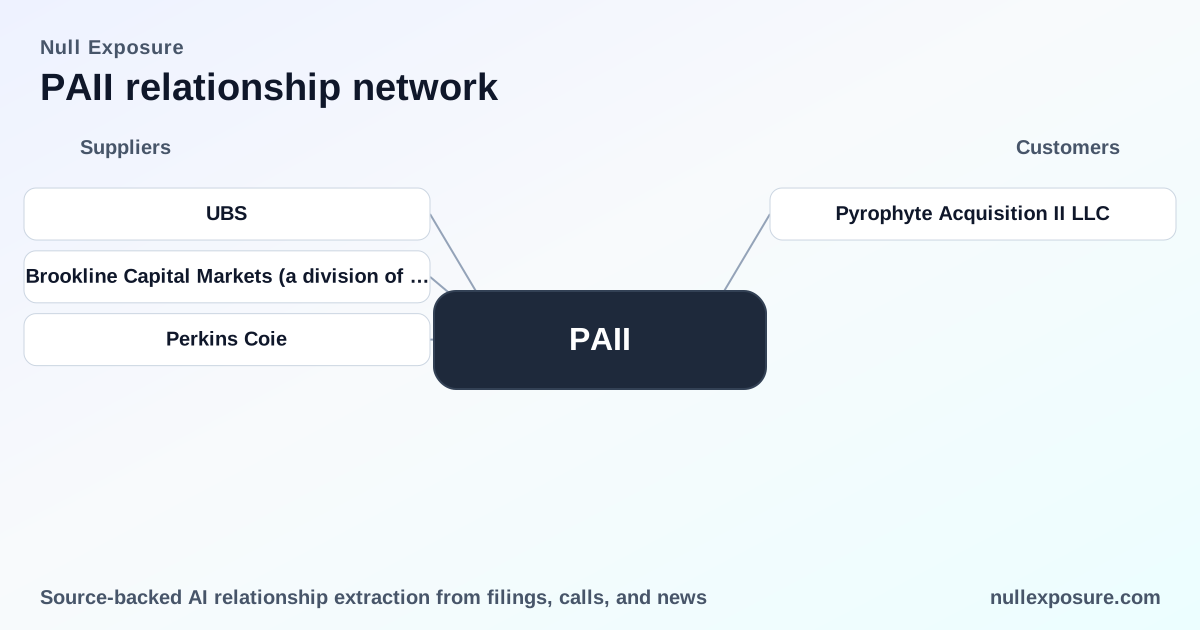
UBS Investment Bank — lead book-running manager
UBS Investment Bank served as the lead book-running manager on PAII’s IPO and the exercised over-allotment that increased gross proceeds to $200.4 million. According to a FinancialContent report on the offering closing (FY2025), UBS led the underwriting syndicate for the transaction. This placement demonstrates institutional distribution capability and market access for the SPAC’s unit sale.
Source: FinancialContent markets report on the closing of the over-allotment option (FY2025).
Brookline Capital Markets (a division of Arcadia Securities, LLC) — co-manager
Brookline Capital Markets, operating as a division of Arcadia Securities, served as a co-manager on the offering, supporting syndicate distribution and investor placement. The FinancialContent coverage of the IPO closing (FY2025) lists Brookline Capital Markets among the underwriting team, indicating a role in retail or regional distribution alongside UBS.
Source: FinancialContent markets report on the closing of the over-allotment option (FY2025).
Perkins Coie — outside counsel to the SPAC
Perkins Coie acted as legal counsel to Pyrophyte Acquisition Corp. II in connection with the $200.4 million initial public offering of units, including advising on the partial exercise of the underwriters’ over-allotment option. A Perkins Coie press release (FY2025) confirms the firm’s advisory role, underscoring the transaction’s reliance on a large national law firm for regulatory filings and securities compliance.
Source: Perkins Coie press release advising PAII on its initial public offering (FY2025).
(Each relationship above reflects the available public reporting tied to PAII’s capital formation in FY2025.)
What the supplier mix signals about execution risk and strengths
The composition of PAII’s supplier roster is textbook for a SPAC IPO: a global investment bank as lead, a regional co-manager for distribution breadth, and a national law firm for securities counsel. That structure delivers both scale (UBS brings institutional book-running and underwriting capacity) and reach (Brookline brings targeted placement channels). Perkins Coie provides the legal scaffolding necessary for SEC reporting, disclosure and closing mechanics.
- Strengths: The lead bank relationship suggests strong placement capability and market credibility. Legal counsel from a recognized firm reduces execution risk around disclosure, trust mechanics, and deal documentation.
- Execution risk: Concentration in a few suppliers elevates counterparty dependency during short windows—such as IPO allocation, over-allotment exercises, and subsequent deal announcements—so market disruptions or conflicts at a single provider could materially affect timing.
- Commercial posture: PAII’s contracting posture is transactional and market-facing: it engages external partners for discrete IPO tasks rather than vertically integrating distribution or counsel, which is appropriate for a newly listed SPAC focused on speed and optionality.
For a deeper look at transactional partner quality and vendor exposure, consider the platform at https://nullexposure.com/.
Investment implications and near-term watch items
- Market access is solid: With UBS leading the book and Brookline supporting syndicate distribution, PAII has the distribution footprint needed to place units and exercise over-allotments, a practical advantage when competing for high-demand targets.
- Legal readiness is intact: Perkins Coie’s role reduces legal execution risk on filings, trust compliance and offering structure—critical in an environment of heightened regulatory scrutiny of SPACs.
- Concentration risk is present: The reliance on a small set of market participants creates a single-point-of-failure dynamic during key execution events; sponsors and investors should monitor counterparty availability and any conflicts that could impede deal timelines.
- Execution, not strategy, is the primary risk levers: For investors, the core value driver remains identification and negotiation of a compelling business combination; supplier relationships enable that process but do not replace due diligence on target economics.
If you want ongoing tracking of PAII’s counterparty profile and supplier changes, visit https://nullexposure.com/ for updated supplier intelligence.
Closing view: what to watch and a final takeaway
PAII’s disclosed suppliers around the FY2025 IPO are standard, capable partners that provide market distribution, underwriting muscle, and legal compliance. These relationships support the SPAC’s ability to originate and finance a business combination, but they do not reduce the fundamental dependency on finding and closing a high-quality target at attractive economics. For investors, the presence of UBS and Perkins Coie is a positive signal on execution capability; the limited vendor set is a reminder to monitor counterparty continuity and timing risk.
To review PAII’s supplier relationships and related intelligence on similar issuers, go to https://nullexposure.com/.