Paloma Acquisition Corp I (PALOU): Underwriter and Listing Relationships Define a Pre-Merger Risk Profile
Paloma Acquisition Corp I operates as a classic SPAC vehicle: it lists units on a public exchange, holds capital in trust, and monetizes by completing a business combination with a target company or returning capital if no merger is consummated. Value creation for investors and counterparties depends on execution of a definitive merger, sponsor and underwriter support, and market liquidity for the units. For investors and service providers evaluating supplier relationships, the immediate commercial reality is that PALOU’s external partners — notably its underwriters and exchange — shape deal flow, distribution, and timing more than internal operations at this stage. If you need a rapid supplier-risk check on SPAC counterparties, visit https://nullexposure.com/ for curated relationship intelligence.
How Paloma positions itself and where the economics live
Paloma is a blank-check company listed as Paloma Acquisition Corp I Units (PALOU) on Nasdaq. The vehicle’s balance-sheet economics are straightforward: no reported operating revenue, no EBITDA, and virtually all commercial optionality sits in the ability to identify and close a merger. Public-market indicators show the units trading in the traditional SPAC price band — mid-to-high single digits approaching $10 — with a shares float of roughly 2.95 million and institutional ownership under 10 percent, signaling limited passive investor concentration.
- Business model driver: Execute a de-SPAC transaction that converts the trust value into equity value for public shareholders and generates sponsor economics (promote and transaction fees).
- Liquidity and market access driver: A Nasdaq listing and an underwriter relationship determine the public distribution channel and aftermarket demand.
- Structural risk: As a pre-merger SPAC, counterparty relationships are critical: underwriting, legal, and exchange access are the operational levers for deal completion.
If you want a deeper supplier map for this class of issuer, Null Exposure’s analyst portal consolidates underwriter, exchange, and sponsor relationships in one view: https://nullexposure.com/.
Who the company is doing business with — relationship map
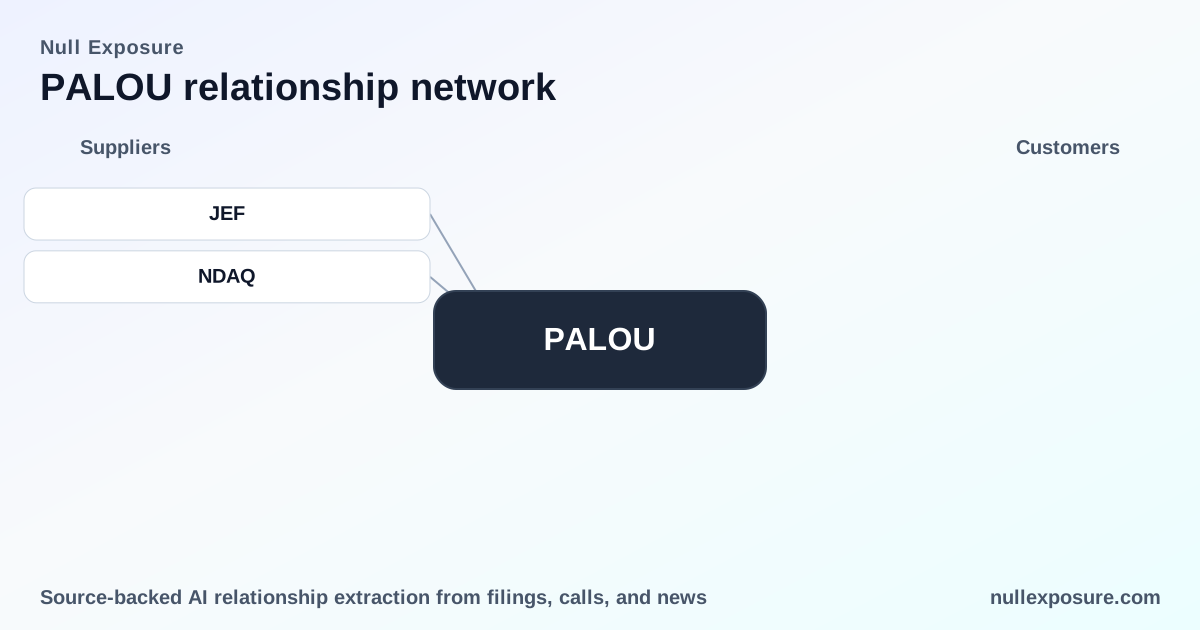
Below I cover every supplier relationship surfaced in public reporting for PALOU and what each partner contributes to the commercial picture.
Jefferies / Jefferies LLC — sole book-running manager
Jefferies served as the sole book-running manager for PALOU’s offering, which places it in the primary role for capital formation and distribution of units to the investor base. This underwriting posture gives Jefferies control over syndication dynamics, pricing execution, and initial aftermarket allocation. According to a Bitget news release dated March 10, 2026, Jefferies is identified specifically as the sole book-running manager for the offering (Bitget, March 10, 2026).
The Nasdaq Global Market (Nasdaq) — listing venue and trading platform
The units began trading on The Nasdaq Global Market under the ticker PALOU on February 19, 2026, establishing the public market for liquidity and price discovery; the Nasdaq listing is the on-ramp for institutional and retail participation and therefore a critical supplier for ongoing market access. Bitget reported the trading start date and listing venue on March 10, 2026 (Bitget, March 10, 2026).
Operational signals and constraints that matter to counterparties
There are no explicit supplier constraints reported in the public items collected for PALOU; that absence is itself a signal. Treat these as company-level operational characteristics that influence supplier relationships:
- Contracting posture: PALOU functions as a transactional counterparty rather than a service-of-continuity buyer. Contracts are short horizon and event-driven (underwriting agreements, trust agreements, and merger agreements) rather than long-term operational procurement.
- Concentration risk: Sponsor and underwriter relationships are concentrated and consequential. With Jefferies as the sole book-runner, execution risk is concentrated in a single underwriting counterparty, which compresses options for repricing or alternative syndication if market conditions shift.
- Criticality: Exchange access is critical; the Nasdaq listing provides the necessary market infrastructure for liquidity and M&A exit mechanics. Without a robust listing arrangement, a SPAC cannot realize the core monetization channel for its target.
- Maturity and permanence: PALOU is in a pre-merger, early maturity state — no operating revenue and zero reported EBITDA — which moves counterparties into an engagement model based on transaction fees and contingent success, not recurring revenue.
- Visibility and governance: Public filings and press releases anchor counterparties’ diligence: the disclosed underwriter and listing date are primary verification points for service providers who need to confirm capital formation and distribution channels before committing legal, advisory, or placement resources.
What this means for investors and suppliers
- For investors: The risk-reward profile is dominated by deal execution. A concentrated underwriting relationship with Jefferies reduces distribution flexibility but provides a single accountable counterparty for the primary market sell-down. Institutional ownership under 10 percent implies limited passive liquidity support from large holders.
- For service suppliers (legal, accounting, sponsors): Contracting should be negotiated with the expectation that engagements are short-term and outcome-contingent. Price and availability of services will respond to the compressed timeline typical of SPAC deal processes.
- For distribution partners (market makers, brokers): Nasdaq’s listing provides the rulebook and liquidity venue; market participants require confirmation of trading start and security type (units versus shares) for quoting strategy. Public data shows units trading close to the canonical SPAC price band near $10, which frames market-making spreads and capital allocation.
If you want an operational partner-risk report that ties underwriter posture to potential deal outcomes and counterparty concentration, inspect Null Exposure’s supplier dossiers at https://nullexposure.com/.
Bottom line: concentrated execution, public-market access, and sponsor dependency
Paloma Acquisition Corp I’s commercial reality is unambiguous: its value depends on successful deal origination and execution, with Jefferies and Nasdaq as the immediate gatekeepers for distribution and liquidity. For investors, that means monitoring underwriting activity and any announcements about a target are the most direct signals of value creation. For suppliers, contracting terms must account for short windows, high criticality, and concentrated counterparty exposure.
For a consolidated view of PALOU’s counterparty map and supplier risk scoring, visit Null Exposure’s homepage: https://nullexposure.com/.