Pangaea Logistics (PANL): Fleet consolidation by acquisition and short-term chartering drives revenue
Pangaea Logistics Solutions operates and monetizes as a merchant dry-bulk shipping operator that combines an owned fleet with a deliberately short-term charter-in posture to serve industrial cargo customers worldwide. Revenue is generated through voyage and time charters on a mixed fleet — owned supramax/ultramax/panamax vessels complemented by short-term charters — while M&A and fleet purchases expand capacity and route reach. Investors should evaluate counterparty concentration in ownership transactions, advisor relationships that shape capital strategy, and the operational dependence on short-duration charter markets. Learn more or track counterparties at https://nullexposure.com/.
What the recent deal flow tells investors about PANL’s strategy
Pangaea’s recent transactions and advisor appointments reveal a growth-through-consolidation playbook. The company completed an all-stock transaction to fold 15 handy-size vessels into its fleet, augmenting its existing 26-vessel mix and enlarging economies of scale in key dry-bulk segments. This is a deliberate capacity aggregation strategy that increases revenue optionality while preserving balance sheet flexibility through stock consideration rather than pure cash. Financial and legal advisors were engaged to underwrite the transaction and manage structuring, signaling a standard corporate finance approach to fleet acquisitions.
- Deal structure emphasis: All-stock consideration for fleet acquisitions reduces near-term cash drain.
- Fleet mix: Combining owned supramax/ultramax/panamax vessels with handy-size additions increases operational coverage across trade lanes.
- Capital markets posture: Use of financial advisors and legal counsel indicates active capital-market engagement to manage integration and disclosure.
For deeper supplier intelligence and to map counterparties for underwriting decisions, visit https://nullexposure.com/.
Constraints that define Pangaea’s operating model
Pangaea’s supplier and contracting signals are meaningful for premium finance and counterparty risk:
- Short-term contracting posture: The company charters-in third-party vessels almost exclusively on short terms — generally less than nine months, and often less than six months — and does not maintain charter-ins longer than one year. This creates high operational flexibility but increases earnings sensitivity to spot charter and freight-rate volatility (company disclosures, FY filings).
- Service-provider relationships dominate: Pangaea routinely hires vessels from third-party shipowners and recognizes charter hire costs as operating expenses; chartered-in agreements are broker-negotiated and brokers earn commission on a percentage of charter cost. This is a service-provider model where the company outsources capacity to manage utilization profile and capital intensity.
- Risk trade-offs: Short-term charters lower fixed hire commitments and can reduce borrowing needs, but they increase exposure to rate swings that affect cash flows and covenant compliance.
These constraints are company-level signals derived from Pangaea’s disclosures and should inform underwriting on covenant buffers and liquidity sizing.
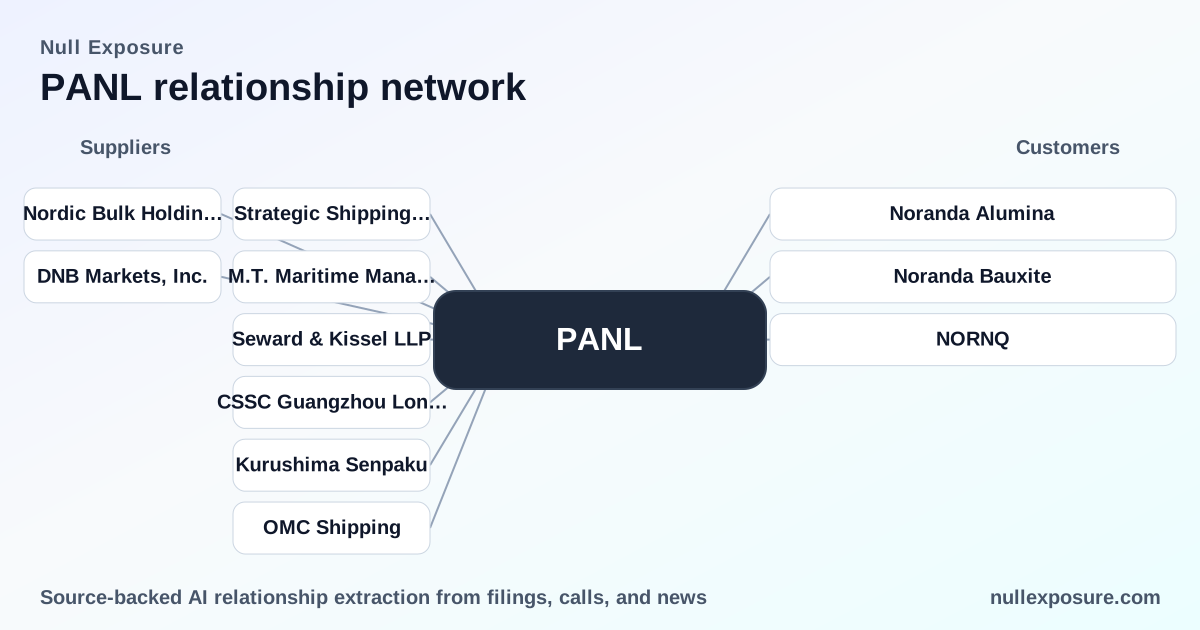
Detailed counterparty map — every relationship in the record
Below are the relationships referenced in public coverage and filings, presented in the same order they appeared in the source results.
- Strategic Shipping Inc. — According to GCaptain (March 10, 2026), Pangaea expanded its fleet by acquiring fifteen handy-size vessels from Strategic Shipping Inc., a privately held company managed by M.T. Maritime Management (https://gcaptain.com/pangaea-logistics-expands-bulk-fleet-with-271m-acquisition/).
- Strategic Shipping Inc. — PR Newswire’s FY2024 release confirms the handy vessels were owned by Strategic Shipping Inc. and managed by MTM, indicating the same transaction described in the company announcement (PR Newswire, FY2024: https://www.prnewswire.com/news-releases/pangaea-logistics-solutions-and-mt-maritime-management-announce-agreement-to-combine-fleets-of-dry-bulk-vessels-in-all-stock-transaction-302256132.html).
- M.T. Maritime Management (USA) LLC — PR Newswire (FY2024) identifies MTM as the manager of the diversified fleet being merged into Pangaea’s operations, underscoring MTM’s role as the operational counterparty for the fifteen handy-size vessels (PR Newswire, FY2024: same release).
- Seward & Kissel LLP — PR Newswire (FY2024) lists Seward & Kissel LLP as legal advisor to Pangaea for the all-stock fleet transaction; later coverage reiterates Seward & Kissel’s role in transaction legal counsel (PR Newswire FY2024; GCaptain March 2026: https://www.prnewswire.com/... and https://gcaptain.com/...).
- CSSC Guangzhou Longxue — Splash247 reported in FY2021 that Pangaea expected two newbuild post-panamax vessels from CSSC Guangzhou Longxue, indicating prior growth through Chinese shipyard build programs (Splash247, FY2021: https://splash247.com/pangaea-continues-fleet-growth-with-secondhand-panamax-buy/).
- Kurushima Senpaku — Splash247 (FY2021) reported that Pangaea paid $18.3m for a secondhand Panamax previously associated with Kurushima Senpaku, demonstrating active secondhand market purchases to supplement newbuilds (Splash247 FY2021: https://splash247.com/pangaea-continues-fleet-growth-with-secondhand-panamax-buy/).
- OMC Shipping — Splash247 (FY2021) noted a $16.45m acquisition from OMC Shipping of a 2013-built Japanese ultramax, illustrating Pangaea’s strategy of mixing secondhand acquisitions with newbuild deliveries (Splash247 FY2021: https://splash247.com/pangaea-continues-fleet-growth-with-secondhand-panamax-buy/).
- Nordic Bulk Holding Company Ltd. — Offshore-Energy.biz (FY2020) reported Pangaea’s time-chartered operation of six 1-A ice-class Panamax bulk carriers owned by NBHC, which are critical to its Arctic/ice trade and spot deployments (Offshore-Energy.biz FY2020: https://www.offshore-energy.biz/pangaea-takes-additional-stake-in-nordic-bulk-holding/).
- DNB Markets, Inc. — PR Newswire (FY2024) names DNB Markets as Pangaea’s financial advisor for the MTM/SSI fleet transaction; GCaptain coverage (Mar 2026) repeats DNB’s advisory role on the $271m acquisition narrative (PR Newswire FY2024; GCaptain Mar 2026: https://www.prnewswire.com/... and https://gcaptain.com/...).
- Seward & Kissel LLP — GCaptain (Mar 2026) reiterated Seward & Kissel’s legal counsel role in the fleet merger, confirming consistent advisor engagement across reporting outlets (GCaptain Mar 2026: https://gcaptain.com/pangaea-logistics-expands-bulk-fleet-with-271m-acquisition/).
- DNB Markets, Inc. — GCaptain (Mar 2026) again reports DNB Markets as the financial advisor that facilitated the merger, underscoring the advisor’s central role in transaction execution and investor communications (GCaptain Mar 2026: https://gcaptain.com/...).
Investment implications and risk checklist
- Revenue upside through scale: The 15-vessel consolidation is accretive to route coverage and charter supply optionality.
- Volatility exposure: Short-term charter posture amplifies spot-rate sensitivity and potential covenant strain when markets dislocate.
- Advisor continuity: Engagement of DNB Markets and Seward & Kissel indicates structured financial and legal support for deal execution and disclosure.
- Operational diversity: Mix of owned, secondhand buys, newbuilds and time-chartered ice-class vessels reduces single-source concentration but increases counterparty management workload.
If you underwrite risk or model covenant scenarios for PANL, incorporate shorter charter roll schedules and advisor-led transaction costs into liquidity stress-tests. For counterparty mapping and premium finance intelligence on PANL and similar suppliers, visit https://nullexposure.com/.
Bottom line for operators and investors
Pangaea is executing a capacity-focused consolidation strategy while keeping charter flexibility through short-duration third-party hires. The combination of fleet purchases, time-chartered ice-class tonnage, and repeat advisor engagement positions Pangaea to scale revenue quickly but leaves it exposed to spot-market swings and short-term charter cost volatility. For more detailed counterparty analytics and to monitor how these relationships evolve, return to https://nullexposure.com/ — the resource for supplier-level exposure analysis.