Palo Alto Networks (PANW): supplier relationships that shape margins, supply risk and AI go‑to‑market
Palo Alto Networks operates a cloud-first security platform business that monetizes through recurring software and subscription services, complemented by hardware sales and managed security offerings; the company centralizes R&D, outsources manufacturing, and leverages partnerships to accelerate AI and edge security adoption. For investors and operators, the commercial model is subscription-heavy, capital-light on manufacturing, and strategically dependent on a small set of manufacturing and ecosystem partners that enable product delivery and AI integration. Learn more and track supplier exposure at https://nullexposure.com/.
What to know in one paragraph: how PANW makes money and allocates risk
Palo Alto generates the majority of revenue from recurring security subscriptions and cloud services, while hardware contributes a smaller but strategically important portion of revenue that requires outsourced assembly and logistics. That mixed revenue profile concentrates cash flow durability in software while exposing gross margin and fulfillment to manufacturing and cloud hosting relationships; corporate disclosures show multi‑billion dollar purchase commitments that reflect both subscription obligations and substantial cloud and manufacturing spend.
Supplier map — who supplies Palo Alto (on the record)
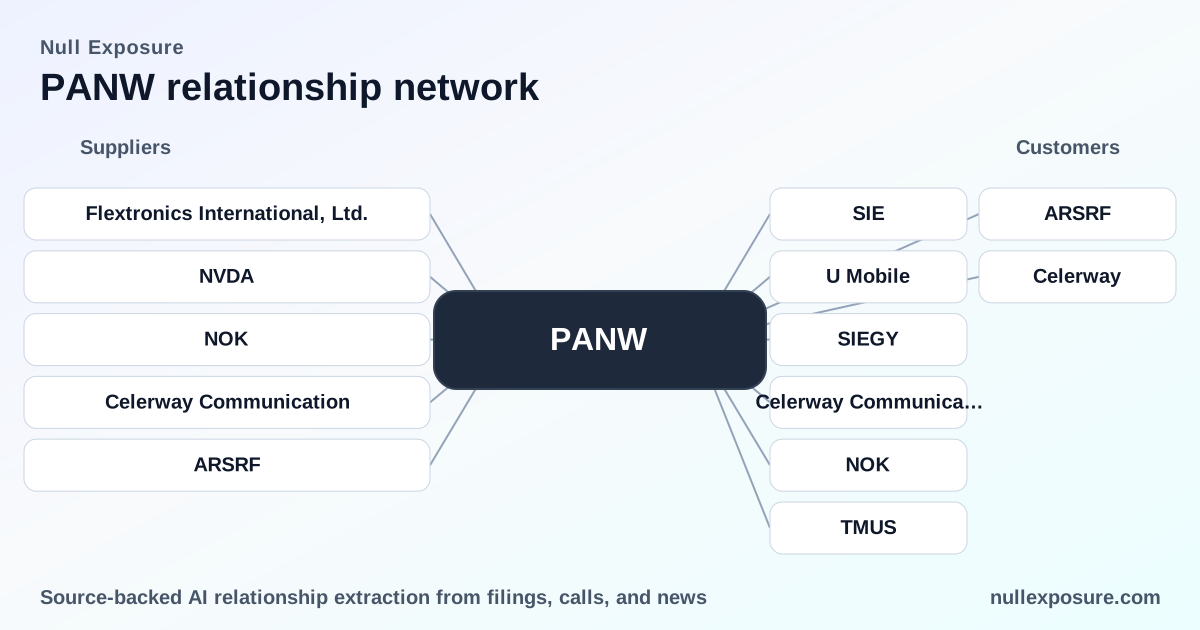
Below are every supplier relationship disclosed in the available results, with a concise, investor‑oriented plain‑English takeaway and a primary source citation.
-
Flextronics International, Ltd.
Flex is identified as Palo Alto’s electronics manufacturing services (EMS) provider that assembles products to Palo Alto’s specifications and procures components based on the company’s demand forecasts, confirming the use of outsourced assembly for hardware. This role underpins manufacturing concentration and logistics dependence. Source: Palo Alto Networks FY2025 10‑K (filed July 31, 2025). -
Nvidia (NVDA)
Palo Alto expanded Nvidia integration and launched Unit 42 Managed XSIAM 2.0 to push AI‑driven cybersecurity capabilities, making Nvidia a critical AI technology partner for high‑performance workloads and analytics. Source: SimplyWallSt news summary, March 2026. -
Nokia (NOK)
Palo Alto partnered with Nokia to combine the company’s AI security platforms with Nokia’s AI data‑center infrastructure, targeting sovereign AI and “secure‑by‑design” data centers for customers requiring data locality and scale. This relationship supports enterprise and telecom go‑to‑market reach in regulated regions. Source: Data Centre Magazine and related March 2026 coverage. -
Celerway Communication
Integration with Celerway’s edge connectivity and Palo Alto’s VM‑Series firewalls enables secure, encrypted edge communications for first responders and remote teams, extending Prisma/VM‑Series capabilities to 5G edge use cases. This expands device and field connectivity use cases for Prisma SASE and VM‑Series. Source: IndustrialCyber and Data Centre Magazine, March 2026. -
Aeris (ARSRF)
Aeris is integrating its IoT Watchtower with Prisma SASE 5G to give enterprises unified visibility and control over large wireless device fleets, allowing policy enforcement and DLP across IoT estates from a single control point. This strengthens Prisma’s positioning for IoT and mission‑critical verticals. Source: SDxCentral and Data Centre Magazine, March 2026.
What the company disclosures say about procurement posture and constraints
Palo Alto’s supplier signals are consistent and instructive for investors:
-
Contracting posture: Manufacturing partners typically operate on short‑term purchase orders rather than long‑term capacity contracts, while Palo Alto also carries non‑cancellable subscription commitments in the ordinary course. The company states manufacturing is fulfilled via individual purchase orders rather than guaranteed long‑term pricing or capacity. This structure improves flexibility but increases exposure to spot price and capacity volatility.
-
Geographic concentration: Component supplier operations are concentrated in Asia, creating vulnerability to regional disruptions, while assembly and final hardware assembly are performed primarily in the United States — a two‑region reliance that combines APAC component risk with NA assembly resilience.
-
Role and criticality: Palo Alto is both a buyer of cloud hosting and manufacturing services and a principal manufacturer outsourcer; dependence on external manufacturing partners is explicitly called out as a source of potential shipping delays and cost volatility.
-
Scale of commitments: As of July 31, 2025, Palo Alto disclosed $7.1 billion in commitments to purchase products, components, cloud hosting and other services (including cloud commitments of approximately $6,580.5 million), signaling material spend concentration in cloud and manufacturing categories that will shape future margin and cash‑flow dynamics.
These constraints combine into a clear operating profile: subscription revenue stabilizes top line, but outsized cloud and manufacturing commitments create concentrated vendor exposure that can influence gross margins, delivery timelines, and capital allocation.
Investment implications: risks, optionality and where to watch
-
Margin sensitivity to supplier cost and capacity: Because hardware is outsourced and purchased via short‑term orders, hardware margin and delivery timing will be sensitive to component cost inflation and capacity shocks. The $7.1bn commitments show the company actively hedges capacity via procurement but not via long‑dated manufacturer contracts.
-
Strategic upside via AI and ecosystem partners: Partnerships with Nvidia and Nokia accelerate higher‑margin AI security services and sovereign‑AI product positioning, which supports premium subscription pricing and enterprise stickiness.
-
Edge and IoT growth vectors: Integrations with Aeris and Celerway extend Prisma SASE and VM‑Series into IoT and 5G edge markets—areas that cross‑sell subscriptions and managed services into verticals with elevated security budgets.
-
Concentration and geopolitical exposure: The dual geography signal (APAC component concentration, NA assembly) implies geopolitical and logistics risk layering; investors should monitor supplier location shifts and inventory strategies.
If you want ongoing supplier intelligence and exposure tracking for PANW, start here: https://nullexposure.com/.
How this informs operational diligence and engagement
For procurement and vendor‑management teams evaluating PANW partner risk, prioritize:
- Documentation of procurement terms (short‑term PO exposure vs. capacity guarantees).
- Cloud hosting commitments and how they translate to forward cash requirements.
- Contingency plans for APAC supply disruptions and the on‑shore assembly footprint.
Operational diligence will require parsing the company’s purchase obligation breakdowns and reconciling them with contract end‑dates and renewal mechanics to understand true flexibility versus committed spend.
Mid‑analysis reminder: if you are benchmarking counterparty concentration or preparing vendor risk scenarios, get continuous updates at https://nullexposure.com/.
Bottom line for investors
Palo Alto Networks combines durable subscription economics with vendor concentration risk that is manageable but material. AI and ecosystem partnerships with Nvidia and Nokia enhance product differentiation and revenue mix upside, while outsourcing manufacturing to partners like Flextronics and leveraging cloud hosting creates direct operational exposure that will influence margins and execution. Monitor the company’s cloud and manufacturing commitments, supplier geography, and the pace of AI product monetization for the clearest read on earnings leverage and downside risk.
For a deeper look at supplier relationships and to build scenario analyses for PANW, visit https://nullexposure.com/ and see how supplier exposures connect to financial outcomes.