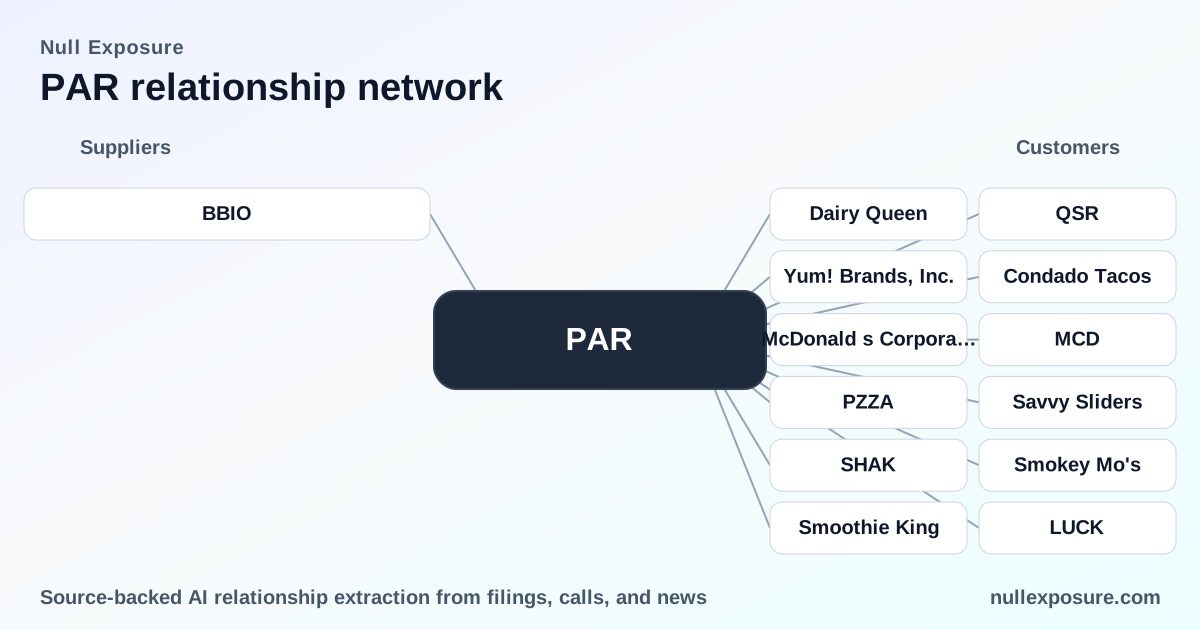
PAR Technology: supplier footprint, acquisition strategy, and where operational risk concentrates
PAR Technology builds and sells point-of-sale (POS) hardware and software for restaurants and retailers and monetizes through a mix of hardware sales, recurring software/transaction services, and installation/support contracts. The company is scaling its addressable data and services layer by acquiring customer-identity capabilities while remaining operationally tied to a concentrated hardware supply chain. Investors evaluating PAR should weigh the growth upside from services and identity-data plays against negative EBITDA, a leverage on hardware suppliers in APAC, and near-term integration and margin risks. Learn more about supplier intelligence and vendor risk at https://nullexposure.com/.
How PAR makes money and why suppliers matter
PAR sells physical POS terminals and licenses software that runs on them; it captures recurring revenue through software subscriptions, transaction processing, and support contracts. Hardware is a critical input: the company sources components and finished terminals internationally, then drives services monetization by embedding software and data capabilities on those devices. The business model is therefore hybrid: hardware-dependent at the front end, services-driven at the back end, which concentrates operational risk in the supplier base while expanding long-term revenue via software and data offerings.
Financially, PAR reports roughly $455.5 million in trailing revenue with a negative EPS (-$2.09) and EBITDA of -$40.05 million (latest TTM), underscoring that scale and margin recovery depend on product mix and cost of goods. Analysts position the stock toward the buy side, but the company’s margin recovery is contingent on supply continuity, component pricing, and successful integration of higher-margin services.
Recent supplier-related transaction you need to track: Bridg acquisition
PAR is acquiring Bridg, an identity-resolution platform that connects in-store transactions to privacy-safe customer profiles. According to a report in CSP Daily News on March 10, 2026, PAR is purchasing Bridg to strengthen its ability to link POS events to customer-level insights and drive higher-margin services. This move signals a strategic shift to monetize first-party retail data and to increase the recurring, high-margin portion of PAR’s revenue while leveraging existing POS distribution. (Source: CSP Daily News, March 10, 2026.)
What every disclosed supplier relationship tells investors (all relationships covered)
- Bridg — PAR is acquiring Bridg to anonymously connect in-store transactions to privacy-safe customer profiles and thereby enhance PAR’s data and services offerings; this transaction is a clear push to raise software and services ARPU for customers who run PAR POS solutions. (CSP Daily News, March 10, 2026.)
Supplier constraints that shape PAR’s operating posture
PAR’s public disclosures and excerpts indicate two supplier-related constraints that shape the company’s operating model:
-
Long-term contracting posture: PAR maintains long-term or volume-based purchase agreements for hardware and components. This is a company-level signal that supplier relationships are structured, durable and operationally embedded, which supports manufacturing continuity and predictable cost of goods but also creates lock-in that reduces short-term sourcing flexibility. (Evidence from company disclosures on supplier agreements.)
-
Geographic concentration in APAC: A large share of hardware suppliers are located in South Korea, China, and Taiwan; these relationships expose PAR to geopolitical or trade disruptions and tariff risk. This concentration is a company-level signal that supply-chain shocks in APAC translate directly into production cost and availability risk for PAR’s hardware-dependent revenue. (Evidence from supplier geography disclosures.)
These constraints imply a specific supplier profile: mature, contract-heavy relationships that are strategically critical but geographically concentrated. For investors, that translates into predictability of supply in normal conditions and elevated vulnerability to regional shocks.
Risk and opportunity implications for investors and operators
PAR’s supplier and deal-making posture produces a distinctive risk/return profile:
-
Opportunity: The Bridg acquisition accelerates PAR’s shift toward higher-margin, recurring software and identity-enabled services, which improves revenue quality and the company’s valuation multiple potential if integration succeeds. The deal leverages PAR’s installed base and expands addressability for marketing and analytics services.
-
Risk: Hardware dependency and APAC supplier concentration create a direct link between component cost/availability and gross margins; long-term supplier contracts reduce near-term flexibility to re-source rapidly if tariffs or hostilities affect suppliers in Korea, China, or Taiwan. Given PAR’s negative EBITDA and sub-0.74 price-to-book ratio, margin pressure would materially affect profitability and the path to recovery.
-
Execution: Integration risk is both technological (embedding identity resolution into POS workflows) and contractual (ensuring data privacy compliance across jurisdictions). Successfully converting Bridg capabilities into recurring revenue requires sales motion alignment and retention of key merchant relationships.
Practical diligence checklist for investors and procurement teams
When evaluating PAR as a supplier partner or investment, focus on these operational items:
- Review the scope and duration of long-term hardware supply agreements to understand contractual exit costs and minimum volume commitments.
- Assess APAC supplier concentration and company contingency plans for alternate sourcing or inventory buffers.
- Monitor integration KPIs for Bridg: time-to-market for bundled offerings, incremental ARPU on existing customers, and churn on legacy hardware-supported contracts.
- Validate privacy and regulatory controls around customer identity resolution, especially for international merchant customers.
If you want tailored supplier risk profiles or a vendor health review of PAR’s relationships, get started at https://nullexposure.com/.
Bottom line: strategic pivot with concentrated supply risk
PAR is executing a strategic pivot: moving up the stack into identity-enabled services via the Bridg acquisition while remaining operationally reliant on APAC-based hardware suppliers under long-term contracts. That combination amplifies upside—improved margins and recurring revenue potential—if execution and integration succeed, but it also concentrates downside through supply disruption and integration missteps. Investors should value the company with a two-part view: the trajectory of services monetization and the resilience of the hardware supply chain.
For deeper analysis of supplier networks and transaction-level impacts on enterprise value, visit https://nullexposure.com/ for vendor intelligence and scenario modeling.