Park Dental Partners (PARK): supplier relationships that shape operational leverage and runway
Park Dental Partners operates as a dental resource organization providing business support services to affiliated dental practices in Minnesota and Wisconsin. The company monetizes by capturing recurring practice-management revenue and shared-service fees from its affiliated clinics, leveraging scale to centralize back-office, clinical support and technology investments. For investors, supplier relationships anchor both the company’s ability to standardize care and its cost structure — and they are central to judging execution risk and margin recovery. Learn more about supplier intelligence and relationship risk at https://nullexposure.com/.
Financial context that frames supplier importance
Park’s scale and near-term valuation profile matter for how supplier obligations translate into cash-flow risk. Revenue TTM of $244.5M against EBITDA of $12.3M implies thin operating leverage, and the company’s Price-to-Sales of 0.30 and EV/EBITDA of 11.2 indicate a modest market multiple. Operational suppliers that drive productivity or capital access therefore have outsized influence on margin recovery and growth funding.
Who Park works with — and what investors should know
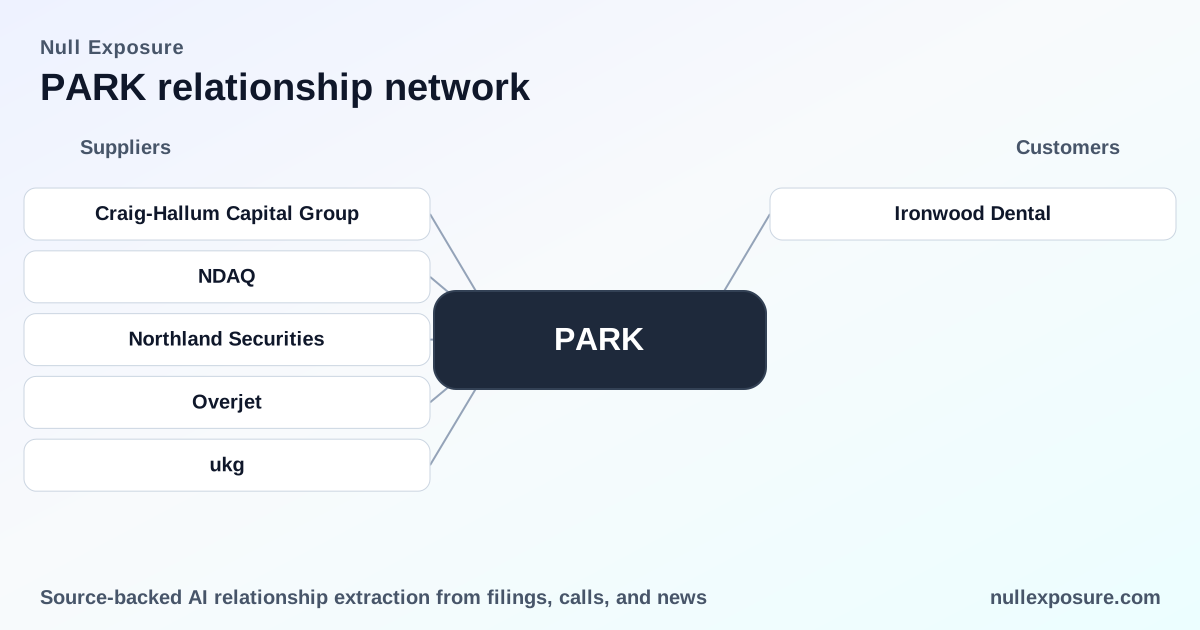
Below are every supplier relationship noted in the coverage set, with concise takeaways and source context.
Craig‑Hallum Capital Group
Park engaged Craig‑Hallum as a joint bookrunner for its public offering, positioning the firm as an underwriter in the capital markets process. This relationship is transactional and critical to access equity financing and public liquidity. — Renaissance Capital, IPO Center (March 10, 2026).
Northland Securities
Northland Securities served alongside Craig‑Hallum as a joint bookrunner on Park’s IPO, supporting distribution and pricing of the offering. Underwriter selection affects market reception and the cost of capital; Northland’s participation signals regional investment-banking support for the transaction. — Renaissance Capital, IPO Center (March 10, 2026).
Nasdaq
Park elected to list on the Nasdaq under the ticker PARK, establishing its primary public-market venue and associated listing compliance relationships. Exchange listing defines reporting cadence, investor access and secondary liquidity for holders. — Renaissance Capital, IPO Center (March 10, 2026).
Overjet
Park completed implementation of Overjet’s AI radiograph-reading tool to assist doctors with reading images and diagnosing care, marking a push to embed clinical AI into practice workflows. Clinical-AI vendors like Overjet are operationally critical for standardizing diagnostic consistency and can drive utilization, but they also concentrate clinical dependency on third-party algorithms. — Q4 2025 earnings call transcript, Sahm Capital (February 26, 2026).
UKG (workforce management)
Park upgraded its workforce management system to UKG to improve productivity and workforce planning, reflecting investment in labor-scheduling technology. Workforce-management platforms directly affect utilization and clinic-level cost efficiency, making UKG an important enabler of margin improvement. — Q4 2025 earnings call transcript, Sahm Capital (February 26, 2026).
What the supplier mix tells investors about operating posture
- Contracting posture: Park’s supplier set combines capital-market providers (underwriters, exchange) with operational SaaS vendors (Overjet, UKG), indicating an operating posture that balances access to public capital with continuous investment in productivity tools.
- Concentration: While the publicly identified suppliers are limited in number, they span distinct domains (capital, clinical AI, workforce), implying low single-vendor concentration but high functional concentration — losing a clinical or scheduling platform would have outsized operational impact.
- Criticality: Clinical AI and workforce-management tools are operationally critical for standardization and margin expansion; underwriters and the Nasdaq connection are financially critical for capital access.
- Maturity: The partnerships cited are execution-stage relationships (IPO execution and post‑IPO operational upgrades), which indicates a transition from private to public corporate governance and a maturing vendor portfolio aligned to scaled operations.
Note: no supplier-level contractual constraints were provided in the coverage set. As a company-level signal, the absence of reported constraints suggests there are no publicized supply covenants or material vendor limitations disclosed in these sources; investors should therefore treat supplier risk as operational rather than covenant-bound unless future filings state otherwise.
Investment implications — risks you cannot ignore
- Margin recovery depends on supplier-driven productivity gains. With negative operating margins and EBITDA modest relative to revenue, the returns from UKG-driven scheduling and Overjet-enabled diagnostic efficiency are determinative for free-cash-flow improvement.
- Capital access is configured for growth but compresses optionality. The involvement of Craig‑Hallum and Northland in the IPO and the Nasdaq listing provide immediate equity-access channels, but also impose public-market scrutiny and quarterly performance pressure.
- Operational vendor dependence creates single‑point execution risk. Overreliance on a handful of third-party platforms increases operational risk during integration or rollout phases; failure to scale vendor implementations rapidly would delay margin expansion.
For further diligence on supplier exposure and to monitor relationship evolution in real time, visit https://nullexposure.com/.
How to think about next steps as an investor
- Validate how Overjet and UKG rollouts are tracked in management’s KPIs: look for measures of diagnostic throughput, claim acceptance lift and clinician adoption rates in the next few quarters.
- Monitor cash flow and capital markets activity post-IPO; underwriter-supported offerings reduce near-term liquidity stress but increase expectations for growth and margin improvement.
- Watch insider and institutional ownership dynamics (insiders ~21.3%, institutions ~20.1%) to gauge confidence from management and larger investors.
Bottom line — an operational story driven by a small set of high‑impact suppliers
Park’s supplier relationships combine capital-market partners that enabled public listing with operational technology vendors that drive productivity. Given the company’s scale and thin margins, these relationships are disproportionately important to execution and valuation. Investors should treat vendor implementation success and public-market discipline as the two axes that will determine whether Park converts revenue scale into sustainable cash flow.
For a deeper read on supplier risk and counterparties across mid‑cap healthcare operators, explore our research hub at https://nullexposure.com/.