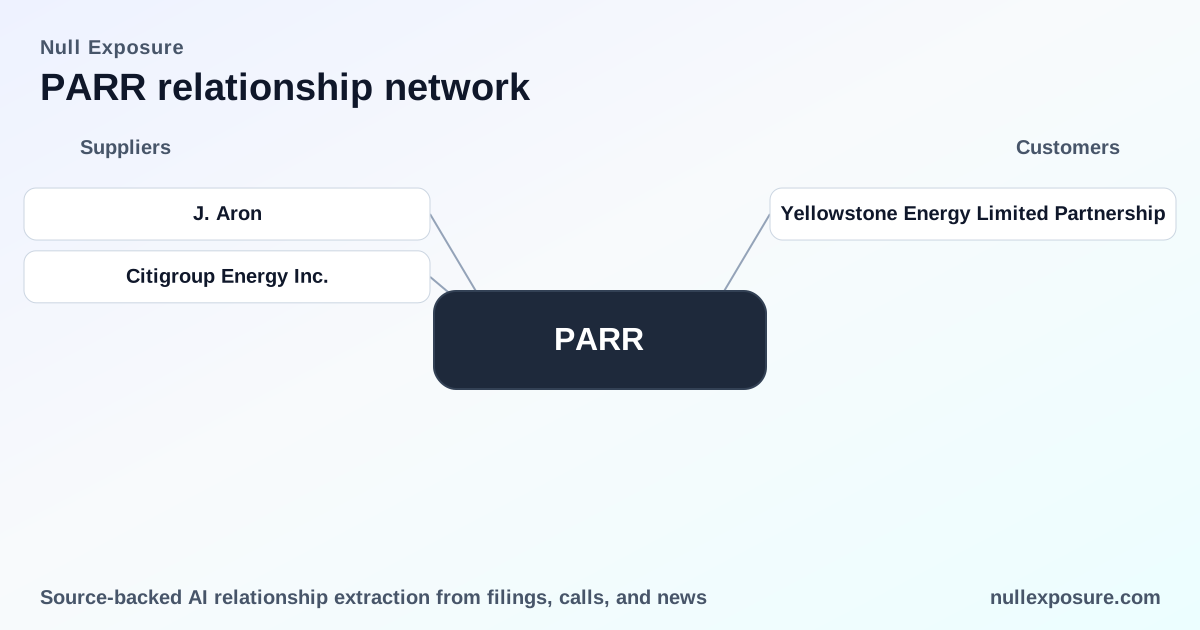
Par Pacific (PARR): Counterparty Update — Citi Steps In, J. Aron Steps Out
Par Pacific operates and monetizes through integrated refining, marketing and logistics businesses, capturing margin on crude procurement, refining throughput and product sales while leveraging inventory and structured financing to smooth working capital. The company internally sources and moves crude into its Hawaii refinery, then monetizes refined products and arbitrages value through financing and intermediation arrangements that reduce working capital friction. For investors, supplier-counterparty shifts materially change counterparty concentration and working capital dynamics; this note summarizes the active supplier relationships disclosed in Par Pacific’s FY2024 filings and the implications for operators and capital allocators.
Explore more coverage and model-ready signals at https://nullexposure.com/.
Big change: a single program replaces older arrangements
Par Pacific’s FY2024 disclosures document a deliberate shift in how the company lines up inventory financing and crude flows for its Hawaii refining operations. The operative mechanics are simple and cash-centric: inventory intermediation supports refinery feedstock availability while moving price and settlement obligations off the refinery’s immediate balance sheet. That structure reduces day-to-day procurement friction but concentrates financing and operational exposure with the chosen intermediary.
Company-level constraints that shape how this operates are instructive:
- Inventory Intermediation Agreement has a defined term of three years with a one-year extension option, indicating medium-term stability in how inventory is financed and handled.
- Par Pacific reports material purchase commitments of $3.4 billion, with the majority of related cash outlays expected within the next 12 months, underscoring short-term working capital intensity.
- The company’s secured liquidity position includes an ABL credit facility with $483 million outstanding and a borrowing base near $1.0 billion that matures April 26, 2028; that facility remains a core backstop for operational credit needs.
These constraints reflect a contracting posture that mixes multi-year structured supplier arrangements with sizable near-term purchase commitments, which increases the criticality of counterparties used to intermediate inventory and cash flows.
Citigroup Energy Inc.: the new inventory intermediary
Par Hawaii Refining, LLC entered into an Inventory Intermediation Agreement with Citigroup Energy Inc. (Citi) on May 31, 2024 to support Hawaii refining operations. According to Par Pacific’s FY2024 Form 10-K, the agreement formalizes how crude shipments are purchased and moved: Par purchases crude from Citi at the SPM delivery point and sells an equal quantity and quality of crude to Citi at the crude intake point, effectively creating a matched physical/financial flow that supports refinery feedstock and financing needs (Par Pacific FY2024 10-K). This arrangement centralizes inventory financing and operational interaction with a large global bank, trading execution and settlement handled through established Citi channels (Par Pacific FY2024 10-K).
J. Aron: the legacy counterparty that was wound down
Par Pacific terminated its Supply and Offtake Agreement and related repurchase facilities with J. Aron effective May 31, 2024. The FY2024 10-K notes that the J. Aron repurchase obligation was measured for fair value in the period and that the prior Supply and Offtake Agreement between PHR and J. Aron was replaced when the Inventory Intermediation Agreement was executed (Par Pacific FY2024 10-K). This represents a formal re-allocation of inventory financing from a commodity trading counterparty to a bank-led intermediation structure.
Why these relationships matter to investors and operators
The supplier shift from J. Aron to Citi and the structure of the Inventory Intermediation Agreement create a set of clear, investable implications:
- Concentration and counterparty risk: Moving inventory intermediation to a single large financial institution simplifies execution and likely improves settlement reliability, but it increases concentration risk at a single counterparty. Counterparty credit is therefore a first-order operational risk.
- Working capital profile: The company’s disclosed $3.4 billion of purchase commitments and a material ABL facility outstanding indicate that refining and inventory management remain capital intensive, even with intermediation in place. Expect working capital volatility tied to crude and product price swings.
- Contracting posture and maturity: The three-year term on the Inventory Intermediation Agreement (with a one-year extension option) signals a medium-term operational commitment to the new model and allows planning for refinery uptime and crude sourcing under a stable framework.
- Operational criticality: The intermediation arrangement is critical to Hawaii refinery feedstock continuity—disruption or termination would create immediate procurement pressure given the short-term purchase commitments.
These conclusions align with Par Pacific’s capital structure and operating metrics: EV/EBITDA of 5.25 and trailing EBITDA around $661.6 million provide a valuation backdrop where operational continuity and access to credit lines meaningfully affect downside risk and upside optionality (company financials, FY2025/LatestQuarter).
Explore sourcing and counterparty intelligence at https://nullexposure.com/.
Relationship-by-relationship summary (concise, documented)
-
Citigroup Energy Inc. — Par Hawaii Refining, LLC entered an Inventory Intermediation Agreement with Citigroup Energy Inc. on May 31, 2024 to support Hawaii refinery operations; the company purchases crude from Citi at the SPM delivery point and sells an equal quantity and quality of crude to Citi at the intake point, formalizing matched physical and financial flows (Par Pacific FY2024 10-K).
-
J. Aron — The prior Supply and Offtake Agreement and certain repurchase obligations with J. Aron were terminated on May 31, 2024, and the related obligations were replaced by the new Inventory Intermediation Agreement, with fair value of the terminated repurchase obligation measured at the end of the reporting period (Par Pacific FY2024 10-K).
Bottom line and recommended next steps
Par Pacific has intentionally restructured how it sources and finances refinery inventory in Hawaii by replacing a commodity trading counterparty with a bank-led intermediation program. That improves operational simplicity and settlement reliability while concentrating counterparty credit exposure and keeping short-term working capital requirements substantial. For investors and operators, priorities are:
- Monitor counterparty credit and contractual detail around the Inventory Intermediation Agreement as it impacts settlement and collateral triggers.
- Stress-test working capital under commodity price scenarios against the $3.4 billion purchase commitment profile and existing ABL availability.
- Track any public amendments or exercises of the one-year extension option in the intermediation agreement, as extension decisions reveal management’s confidence in the arrangement.
For deeper counterparty matrices and ongoing monitoring tools, visit https://nullexposure.com/.
Overall, Par Pacific’s move centralizes operational execution and financing with a large bank counterparty; that is an efficient operational choice, but one that elevates the importance of counterparty monitoring and liquidity planning for stakeholders.