PAVmed (PAVM) supplier map: academic licenses, outsourced manufacturing, and what that means for investors
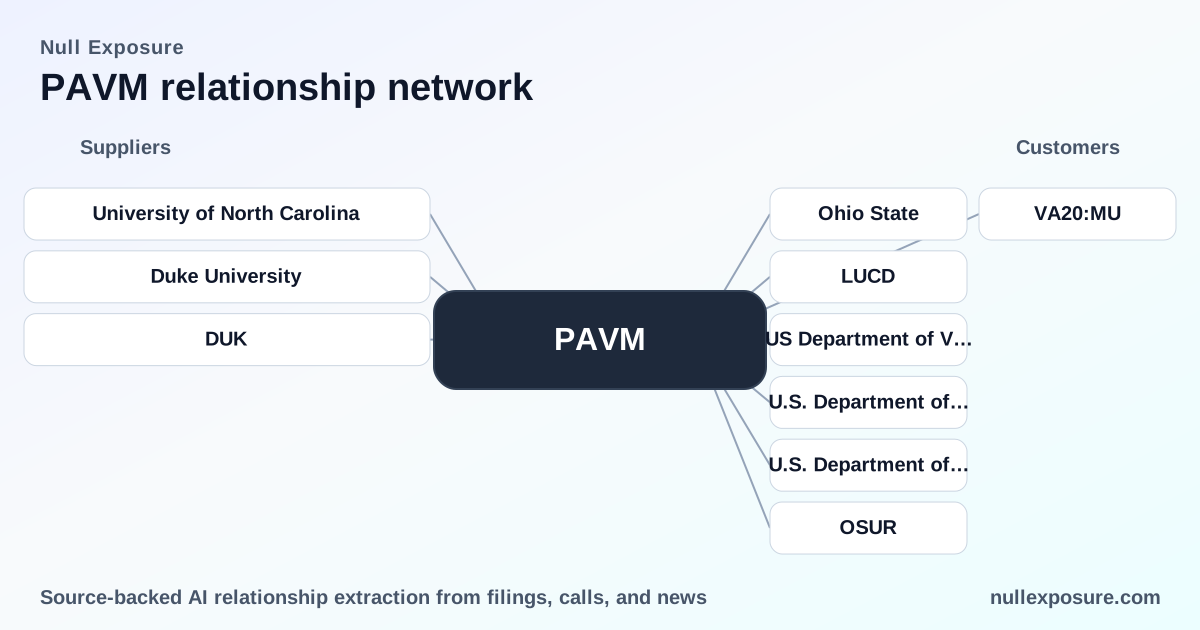
PAVmed monetizes by licensing clinical-stage imaging technology from academic inventors, forming subsidiaries to own those licenses, and outsourcing manufacturing and fulfillment while it advances regulatory and commercial milestones. The company's revenue base is tiny today, but its operating model is deliberately partner-centric: academic licenses supply the intellectual property; third-party manufacturers and service providers supply scale; PAVmed captures value through licensing, product sales, and downstream commercial rollouts. For an institutional view of supplier relationships and commercial risks, see https://nullexposure.com/.
Why the Duke/UNC relationships matter for valuation and execution
PAVmed has structured its near-term product pathway around licensed academic technology rather than in-house device development. That contracting posture accelerates technical access but creates concentration and execution risk: a small number of academic partners control core IP, and third-party manufacturers and service providers control the production and fulfillment capabilities that will determine commercial delivery.
According to an MPO Magazine report, PAVmed executed a non‑binding letter of intent with Duke University to license endoscopic esophageal imaging technology into a newly formed subsidiary to identify and facilitate treatment of advanced esophageal precancer (FY2025 reporting). This is the most consequential supplier relationship to date because the license underpins PAVmed’s product road map and potential future revenues. (MPO Magazine, March 10, 2026)
In the company’s 2025 Q3 earnings call, management reiterated the partnership model—citing Dr. Adam Wax at Duke and Dr. Nick Shaheen at the University of North Carolina as clinical collaborators—and positioned these academic ties alongside prior initiatives such as Lucid and Veris. The earnings call frames these relationships as strategic supply-side inputs to product development and clinical validation, not as simple vendor contracts. (PAVmed 2025 Q3 earnings call, first seen March 7, 2026)
For deeper supplier intelligence and a consolidated supplier-risk view of PAVmed, visit https://nullexposure.com/.
Duke University — non-binding LOI to license endoscopic imaging tech
PAVmed has executed a non‑binding letter of intent with Duke to license endoscopic esophageal imaging technology and intends to hold that license in a newly-formed subsidiary; this LOI is the transactional vehicle that will convert academic IP into a commercial asset. (MPO Magazine, FY2025 / March 10, 2026)
Duke University — confirmation in the earnings call
Management referenced Dr. Adam Wax at Duke during the 2025 Q3 earnings call, presenting Duke as the originator of the technology and confirming that the collaboration fits PAVmed’s partnership model used for Lucid and Veris. (PAVmed 2025 Q3 earnings call, first seen March 7, 2026)
University of North Carolina — clinical collaborator through Dr. Nick Shaheen
PAVmed cited Dr. Nick Shaheen from UNC as a close collaborator with Duke in clinical work tied to the same technology, positioning UNC as a clinical research partner supporting validation and potential adoption. (PAVmed 2025 Q3 earnings call, first seen March 7, 2026)
How supplier constraints shape day‑to‑day execution
PAVmed’s public disclosures and excerpts show two persistent company‑level supplier patterns: reliance on third‑party manufacturers and dependence on service providers for logistics, lab processing, and cybersecurity. These are company-level signals, not assigned to any single university or licensee.
- PAVmed states explicitly: “Initially, we will not directly manufacture our products and will rely on third parties to do so for us,” which makes manufacturing capacity and quality control a gateway risk for any commercialization timetable.
- The company cites named contract manufacturers and suppliers across its product lines—Coastline International and Sage Product Development for device manufacture, Path‑Tec for specimen kits and fulfillment, and TransTek/Mio Labs for components—illustrating an operating model that outsources production and downstream logistics.
- On the services side, PAVmed retains vendors such as CyberTeam for cybersecurity and relies on third parties to manage warehousing, logistics, fulfillment and customer support for Lucid products; Lucid’s lab throughput is noted as adequate at current volumes but will need scalability for broader commercial adoption.
The practical implication: PAVmed’s ability to convert an academic license into revenue depends on external contractual relationships that must scale, stay on spec, and meet regulatory requirements. Given the company’s tiny trailing revenue ($29,000 TTM) and negative EBITDA (‑$20.0M), vendor performance is a material determinant of runway and investor returns. (Company financials, latest quarter 2025‑09‑30)
For institutional subscribers who need detailed supplier risk matrices and vendor counterparty histories, NullExposure maintains deeper dossiers at https://nullexposure.com/.
Investment implications — risk concentrated, upside binary
- Concentration risk is high. A successful commercial outcome hinges on the Duke license and clinical validation supported by UNC, plus several third‑party manufacturers and service providers to turn that IP into product and revenue.
- Execution / operational risk is immediate. Small revenue today and a negative operating margin make PAVmed funding‑sensitive; any delay in licensing, manufacturing agreements, or regulatory clearance will magnify dilution and downside.
- Upside is binary but meaningful. If the Duke license converts to a regulated, reimbursable product and PAVmed secures reliable manufacturing and fulfillment, the revenue trajectory could shift materially from the current base. Market data shows a wide divergence between market capitalization (~$9.26M) and an analyst target price of 510.0, reflecting speculative upside priced by at least one analyst cohort.
Key risk drivers to watch: definitive terms of the Duke license, execution of manufacturing agreements and quality control, lab and fulfillment capacity scaling (Path‑Tec and Lucid), and the company’s cash runway given negative EBITDA.
What investors and operators should track next
- Monitor the transition from non‑binding LOI to a signed license agreement with Duke and any financial or milestone terms disclosed; that document will redefine counterparty obligations and royalty economics.
- Confirm third‑party manufacturing agreements—names, lead times, capacity commitments, and quality certifications—for devices associated with the Duke technology.
- Verify lab throughput and fulfillment scalability for Lucid/Veris products and whether Path‑Tec’s current processes are contractually committed to higher volumes.
- Track near-term regulatory milestones and clinical trial readouts from the Duke/UNC collaborations; clinical validation is the gating item for commercialization.
For a tailored supplier-risk briefing and ongoing monitoring of PAVmed counterparties, visit NullExposure at https://nullexposure.com/ and request the PAVmed supplier dossier.
Bottom line
PAVmed’s model is partnership-first and outsource-heavy: academic licenses provide the IP, while third-party manufacturers and service providers shoulder production and commercialization execution. That structure reduces upfront R&D outlay but concentrates risk in a handful of counterparties. Investors should treat the Duke license and the company’s manufacturing/fulfillment agreements as the primary catalysts and single largest operational risks to value realization. For ongoing surveillance of these counterparties and a consolidated risk view, see https://nullexposure.com/.