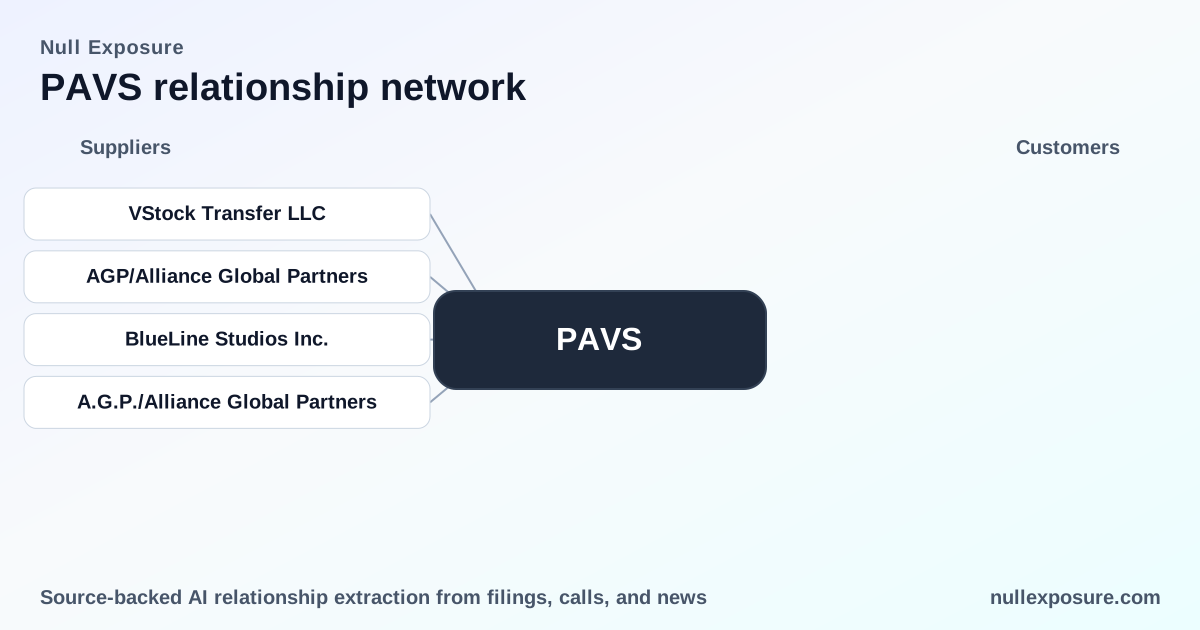
PAVS supplier map: who Paranovus is doing business with and why it matters
Paranovus Entertainment Technology Ltd. operates principally as a developer and seller of nutraceutical and dietary supplement products in China and abroad, while also pursuing entertainment- and AI-driven content projects; the company monetizes through product sales and strategic partnerships that unlock capital and content distribution. Recent supplier and service contracts show a company focused on liquidity management and content development rather than large, long-term manufacturing outsourcing. If you are evaluating PAVS as a counterparty or investment, prioritize counterparties that control financing, corporate actions, and content delivery. Learn more on our homepage: https://nullexposure.com/
Executive takeaways for investors
Paranovus is small by market capitalization and loss-making: revenue TTM roughly $12.4m, gross profit ~$2.48m, and negative EPS, consistent with a firm raising capital and buying technology/content capabilities rather than scaling high-margin consumer brands. Publicly visible supplier relationships fall into three categories: capital markets agents (ATM sales and transfer agents) and software/content developers — each carrying different commercial leverage and counterparty risk. Continue reading for a relationship-by-relationship breakdown and practical risk signals.
The relationships you need on your radar
VStock Transfer LLC — exchange agent / paying agent for the reverse split
VStock is acting as the exchange agent and paying agent for Paranovus’s 1-for-100 reverse share split, a corporate action intended to consolidate the register and manage share mechanics following dilutive activity. This role is administrative but critical to shareholder recordkeeping and the mechanics of corporate recapitalization; the arrangement was reported in company announcements in late 2025 and summarized by market outlets in December 2025 and March 2026. (See Barchart and SahmCapital reporting, FY2025–FY2026.)
AGP / Alliance Global Partners — at‑the‑market sales agent
Paranovus executed an at‑the‑market (ATM) equity sales agreement with AGP/Alliance Global Partners on October 28, 2025, authorizing the sale of up to $100 million of Class A ordinary shares “from time to time.” AGP is compensated on a commission basis (reported at a 3.5% fee on gross proceeds), positioning AGP as the company’s go-to liquidity provider for ongoing equity raises. This relationship is financially material to capital availability and dilution trajectory. (See company filing summary reported by TS2/Tech and related coverage, FY2025.)
BlueLine Studios Inc. — software development partner for Hollywood Sunshine
Paranovus signed a software development agreement with BlueLine Studios Inc. (a Caravan Digital portfolio company) to develop the AI-driven game application "Hollywood Sunshine." That contract reflects the company’s push into AI-generated content and entertainment IP rather than pure consumer product manufacturing, and it ties Paranovus to a specialized creative/technology vendor for product roadmap execution. (See PR Newswire release, FY2023.)
What these relationships imply about operating posture and vendor risk
There are no supplier-level constraints captured in the reporting feed for PAVS; that absence itself is an informative signal at the company level. From the reported engagements you should infer the following operating and business model characteristics:
- Contracting posture: Paranovus contracts selectively and transactionally — it uses capital markets agents for financing and specialty vendors for content development rather than committing to large legacy manufacturing contracts. That posture reduces fixed-cost vendor lock but increases sensitivity to capital-market access.
- Concentration: The public supplier map is sparse and concentrated: a small set of service providers handle corporate actions, capital raising, and development. Concentration increases single-counterparty exposure for liquidity and execution.
- Criticality: Relationships with AGP (ATM agent) and VStock (transfer/exchange agent) are operationally critical—one governs access to cash and the other governs shareholder mechanics—while BlueLine is strategically important to any entertainment/content revenue path.
- Maturity and tenor: Contracts appear short to medium term and tactical (ATM authority, development agreement), indicating early-stage supplier maturity and flexibility but limited long-term supply stability.
Financial context that amplifies supplier risk
Paranovus shows low market capitalization (about $1.67m), scant institutional ownership, and negative profitability metrics (EBITDA and EPS negative). When a company is capital-constrained and loss-making, service providers who control cash flows or shareholder records gain outsized leverage. The AGP ATM arrangement is the primary mechanism for remedial capital; its commission structure directly affects effective dilution and net proceeds.
Practical implications for counterparties and investors
- For counterparties considering commercial deals: insist on clear payment terms and escrow mechanics when dealing with a firm that uses ATMs and corporate actions heavily to manage liquidity.
- For lenders and equity investors: monitor ATM utilization rates and any subsequent reliance on AGP for incremental raises; ATM exhaustion is a near-term liquidity risk trigger.
- For M&A or strategic partners: validate BlueLine deliverables and milestones given content revenue is the optionality for non-core growth.
If you want a consolidated supplier risk briefing or monitoring dashboard for PAVS and similar small-cap, capital-dependent issuers, visit https://nullexposure.com/ to request a tailored report.
Final assessment and next steps
Paranovus’s visible supplier footprint is lean, finance-centric, and content-oriented. That configuration suits a company in a capital-constrained growth phase: it minimizes fixed vendor costs while relying on market-based liquidity and specialist development partners to create future revenue streams. The trade-off for investors is concentration and counterparty dependency — AGP and VStock are single points of failure for liquidity and corporate mechanics while BlueLine determines the viability of entertainment-led monetization.
For investors and operators tracking counterparties, allocate attention to ATM drawdowns, transfer agent confirmations around corporate actions, and milestone delivery from content partners. For more in-depth supplier exposure analysis and alerts, go to https://nullexposure.com/ and request a briefing.
Bold action: prioritize monitoring of AGP ATM usage and VStock exchange processes as leading indicators of corporate health, and verify BlueLine development milestones before underwriting content-based revenue assumptions.