Patria Investments (PAX): supplier map and operational signals for investors and operators
Patria Investments is a Latin America–focused private markets investment firm that monetizes through management fees and performance (carry) on deployed capital, plus recurring fee income reported through its asset management platform. Its public metrics show a profitable, mid-cap asset manager with steady margins and institutional ownership that supports deal execution and capital raising. For a concise supplier-risk view and connective diligence, review the relationships below and follow our platform for ongoing supplier intelligence: https://nullexposure.com/
Why suppliers matter for a private-markets manager
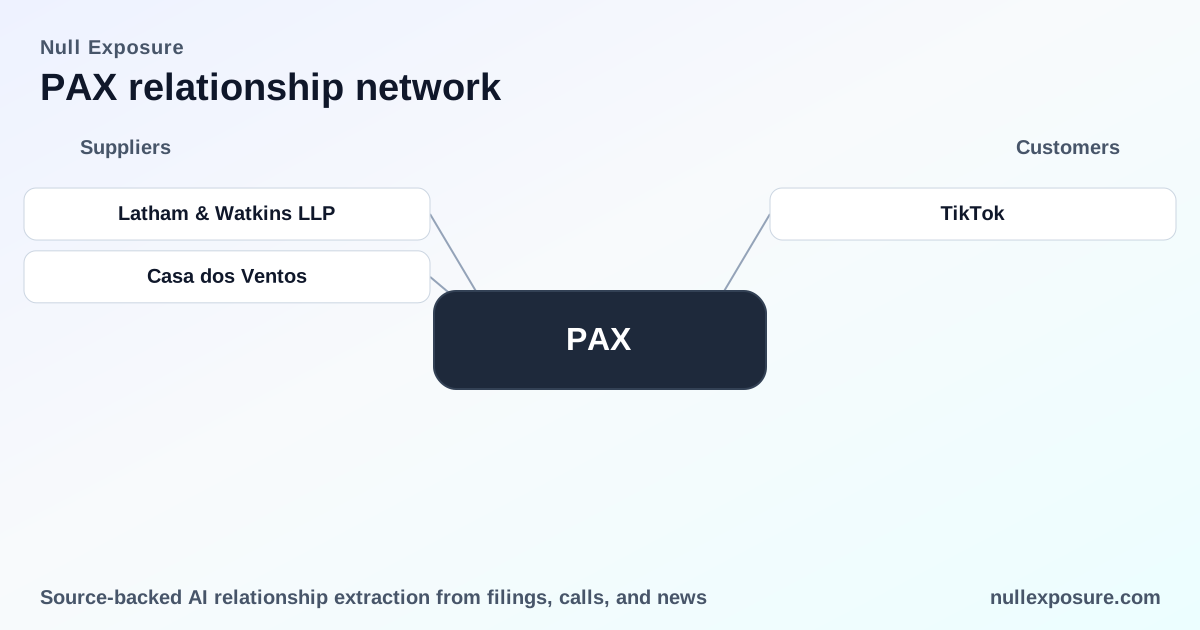
Patria’s business converts deal flow into fee streams; that conversion depends on transactional advisers and operating partners. Legal counsel, strategic industry counterparts, and large operational sponsors directly affect speed to close, regulatory clearance, and the operational performance of portfolio companies. The two supplier relationships surfaced in public reporting are focused on deal execution and energy infrastructure for a major Brazilian data-center project — both high-impact, high-criticality supplier roles.
Quick company snapshot that frames supplier risk
Patria (PAX) is listed on NASDAQ and headquartered in Grand Cayman. Key public signals: Market cap ~$1.82B, Revenue (TTM) $381.7M, Operating margin ~36%, Profit margin ~22%, and a Dividend Yield ~5.34%. Institutional investors own roughly 87% of shares, concentrating the shareholder base. Quarterly revenue and earnings showed year‑over‑year declines (quarterly revenue growth -15.4%, quarterly earnings growth -37.6%), which underscores the importance of execution on new investments and fee‑generating exits to sustain public valuation. These financial and ownership signals shape how Patria contracts and prioritizes supplier relationships: partner quality, legal certainty, and project execution are central to value realization.
Supplier relationships surfaced in public reporting
Below I cover every supplier relationship returned in the source results and what each implies for diligence.
Latham & Watkins LLP — legal advisor on a 2026 acquisition
Latham & Watkins acted as legal advisor to Patria in connection with the acquisition of WP Global Partners, reflecting Patria’s use of top-tier international law firms to execute cross-border transactions and complex M&A structures. This engagement was reported in a Sahm Capital news release on February 2, 2026, describing Latham’s advisory role on the transaction.
Casa dos Ventos — renewables partner for a Brazilian data-center project tied to Patria-backed Omnia
Casa dos Ventos committed to invest an additional R$3.5 billion to build new wind farms that will power the TikTok data-center project in Brazil in which a Patria-backed company, Omnia, participates; this ties Patria‑backed platform activity to large renewable infrastructure suppliers in Brazil. The relationship and the planned wind investment were described in a Sahm Capital report published November 4, 2025, quoting Casa dos Ventos’ executive director Lucas Araripe.
What these relationships reveal about Patria’s operating model
- Contracting posture: Patria contracts top‑tier external advisers for transactional execution (example: Latham & Watkins), indicating a preference for established professional-service suppliers to de‑risk deals and meet cross-border legal requirements.
- Supplier concentration and criticality: The mix of legal advisory and large renewable developers indicates supplier roles that are concentrated and critical — legal counsel is essential to closing, and large-scale power suppliers are essential to the operational viability of energy-intensive portfolio assets (data centers).
- Maturity and sophistication: Engagements with global firms and institutional-scale renewable sponsors are consistent with a mature private markets platform that pursues sizeable, infrastructure-like transactions.
- Company-level signal (no supplier constraints disclosed): There are no supplier-level constraints reported in the dataset; this absence itself is a signal that Patria’s disclosed supplier footprint in public reporting is narrow and focused on strategic transactions rather than operational vendor breadth.
Operational and investment implications for diligence
Investors and operators should treat these supplier types as strategic counterparty checks during diligence:
- Confirm scope and terms of legal engagements, including indemnities, escrow mechanics, and regulatory risk allocation in cross-border deals handled by Latham & Watkins.
- For energy-linked platforms, obtain direct access to off‑take agreements, construction schedules, and financing commitments with renewable partners such as Casa dos Ventos to validate projected EBITDA contribution and timetables.
- Evaluate the concentration risk implied by using a small number of high‑impact suppliers; disruption or contract disputes can materially affect exit timing and fee realization.
For a deeper supplier-risk screen and ongoing monitoring of Patria’s counterparty relationships, visit our platform: https://nullexposure.com/
Risk factors highlighted by the supplier footprint
- Execution risk on strategic projects: The Casa dos Ventos engagement underscores that Patria’s platform returns depend on third‑party execution for infrastructure projects that are capital and schedule intensive.
- Transaction dependency: Use of elite legal counsel signals that complex M&A is a core driver of deal flow; litigation, regulatory delay, or renegotiation in these processes could delay fee recognition.
- Revenue and earnings volatility: The company’s recent negative quarterly growth metrics increase reliance on successful execution of new investments and portfolio exits — supplier failure would amplify downside.
Practical next steps for investors and operators
- Request copies of recent engagement letters and key transactional documents with primary advisers (law firms and lead developers).
- Extract milestone-based protections and fee waterfalls from portfolio company contracts where renewable generation underpins projected cash flows.
- Map counterparty concentration across the platform and stress‑test cash flows against supplier delays and cost overruns.
Bottom line and where to go next
Patria runs a mature private‑markets platform that monetizes via recurring management fees and carry; its supplier footprint — represented publicly by Latham & Watkins (legal advisor) and Casa dos Ventos (renewable sponsor) — points to deal execution and project delivery as the two most consequential supplier risks. Active diligence should focus on contract terms, supplier performance guarantees, and the timelines that underpin expected fee recognition. Track these supplier relationships as a core part of investment monitoring via our intelligence hub: https://nullexposure.com/