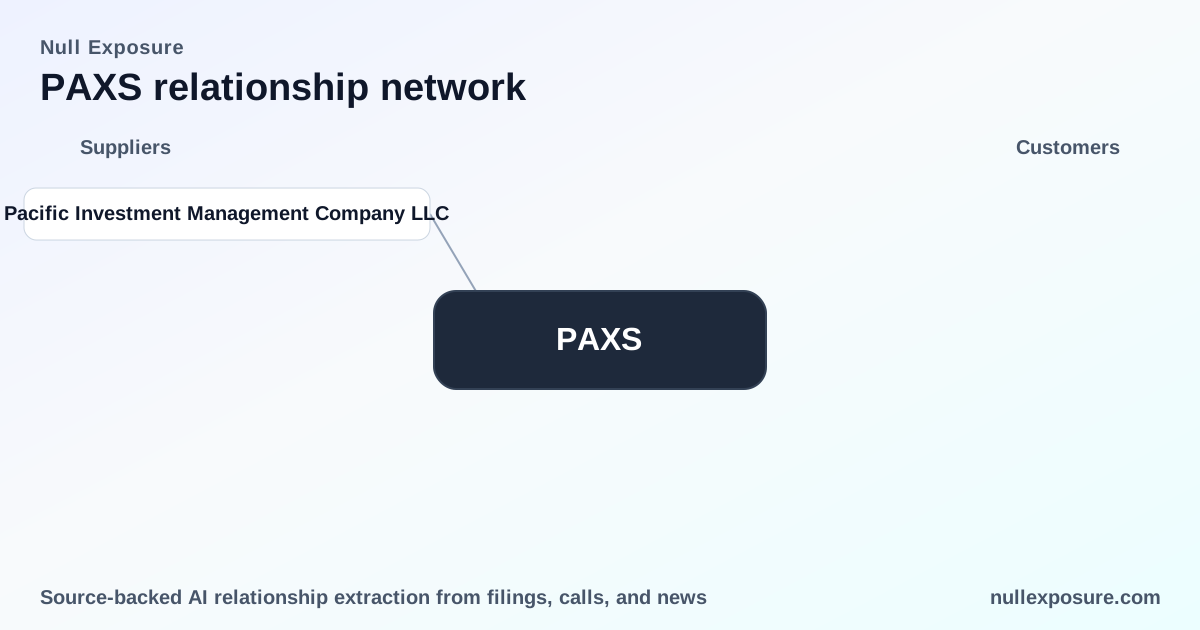
PAXS (PIMCO Access Income Fund): Supplier relationships and what they mean for investors
PAXS is a closed-end income fund that monetizes investor capital by holding a diversified portfolio of income-producing securities (mortgage-backed securities, corporate credit, and related instruments) while outsourcing portfolio management to an external manager. The fund generates returns for shareholders via coupon income, realized gains, and distribution policies, and its economics are driven by portfolio yield relative to the cost of capital and management fees paid to the investment manager. For investors and operators evaluating supplier risk, the central question is how dependent the fund is on its service providers and how contract terms, concentration, and operational maturity influence performance and resilience.
For a concise supplier-risk briefing and ongoing monitoring, see https://nullexposure.com/.
How PAXS operates in plain English
PAXS operates as a closed-end fund listed on the NYSE that leverages PIMCO’s investment platform to source and manage income assets. Shareholder returns come from interest and principal payments on portfolio securities, plus capital appreciation; the fund pays an investment manager for portfolio and risk governance services. The fund structure gives managers discretion over leverage, portfolio duration, and credit exposure within board-approved mandates, which directly affects distribution sustainability and NAV volatility.
Key corporate facts: the fund lists as PAXS on the NYSE, reports a market capitalization around $665 million (latest snapshot), and closes fiscal years in June. These characteristics signal a mid-sized closed-end vehicle with active portfolio management at the center of performance outcomes.
Explore supplier coverage and analysis at https://nullexposure.com/.
The crucial supplier: Pacific Investment Management Company LLC
Pacific Investment Management Company LLC (PIMCO) is the investment manager to PAXS and therefore the primary operational supplier. According to an Intellectia news item dated March 10, 2026, PIMCO is explicitly identified as the Fund’s investment manager and is referenced in communications about the Fund’s monthly distributions. This confirms that portfolio construction, risk management, and day‑to‑day trading are delegated to PIMCO under a formal management agreement (Intellectia, news, 2026-03-10).
- Pacific Investment Management Company LLC: PIMCO serves as the delegated portfolio manager for PAXS; the manager is responsible for security selection, duration positioning, and implementing leverage and hedging decisions that drive income and NAV outcomes (Intellectia, March 10, 2026).
What the single listed relationship implies for investors and operators
The supplier map for PAXS is concentrated: a single, large asset manager (PIMCO) runs the investment mandate. That concentration is commonplace in closed-end funds but is also the principal single point of operational and investment risk for PAXS.
- Concentration: Having a single named manager concentrates execution and governance risk; investor returns are materially linked to PIMCO’s investment decisions and operational controls. The manager’s capability and continuity matter more than in multi-manager structures.
- Contracting posture: Closed-end funds typically operate under a management agreement detailing fees, termination rights, and notice periods; investors should treat the agreement terms as a core operational risk lever — fee mechanics and termination clauses directly affect cost of capital and options in stress scenarios.
- Criticality: The manager is mission‑critical. Loss of the manager, material changes in the manager’s strategy, or reputational incidents on the manager’s side would have immediate implications for portfolio execution and investor confidence.
- Maturity and oversight: PAXS is run by an established manager with institutional infrastructure; that maturity reduces certain operational risks (trade execution, compliance, custody) but does not eliminate market or governance risk tied to strategy choices.
These signals are company-level assessments based on the fund’s structure and the disclosed manager relationship.
Distribution policy and investor implications
Public communications tied to the fund reference monthly distributions. A March 10, 2026 news piece on PIMCO closed-end funds highlighted declared monthly distributions and reiterated PIMCO as the manager, underscoring that distribution policy is actively set and communicated through the manager’s governance channels (Intellectia, March 10, 2026). For income investors, the linkage between portfolio yield, fee drag, and distribution sustainability should drive due diligence priorities.
Operational diligence checklist for investors and operators
To translate supplier visibility into action, focus on the following operational and commercial checks:
- Confirm the management agreement terms: fee schedule, termination mechanics, side letters, and change-of-control provisions.
- Review governance and oversight: board composition, frequency of manager reporting, and performance attribution granularity.
- Understand distribution mechanics: source of distributions (income vs. return of capital), payout coverage, and historical coverage ratios.
- Assess contingency planning: manager succession plans, emergency trading arrangements, and custody/fund servicing redundancies.
These items guide both investment due diligence and counterparty risk assessment for trading desks, risk teams, and compliance officers.
Explore how supplier signals change investment risk profiles at https://nullexposure.com/.
Final takeaways and actions for investors
- PIMCO is the central supplier to PAXS; investor outcomes are tightly coupled to this relationship. The manager drives portfolio returns, distribution policy, and most operational execution.
- Concentration is a structural risk and a source of alpha; evaluate the management agreement and governance terms before committing capital.
- Operational maturity of the manager reduces certain execution risks but does not substitute for active monitoring of distribution coverage and portfolio positioning.
For a tailored supplier-risk brief or to set up automated monitoring of manager disclosures and distribution notices, visit https://nullexposure.com/ — we provide the focused intelligence investment teams need to translate supplier relationships into portfolio action.