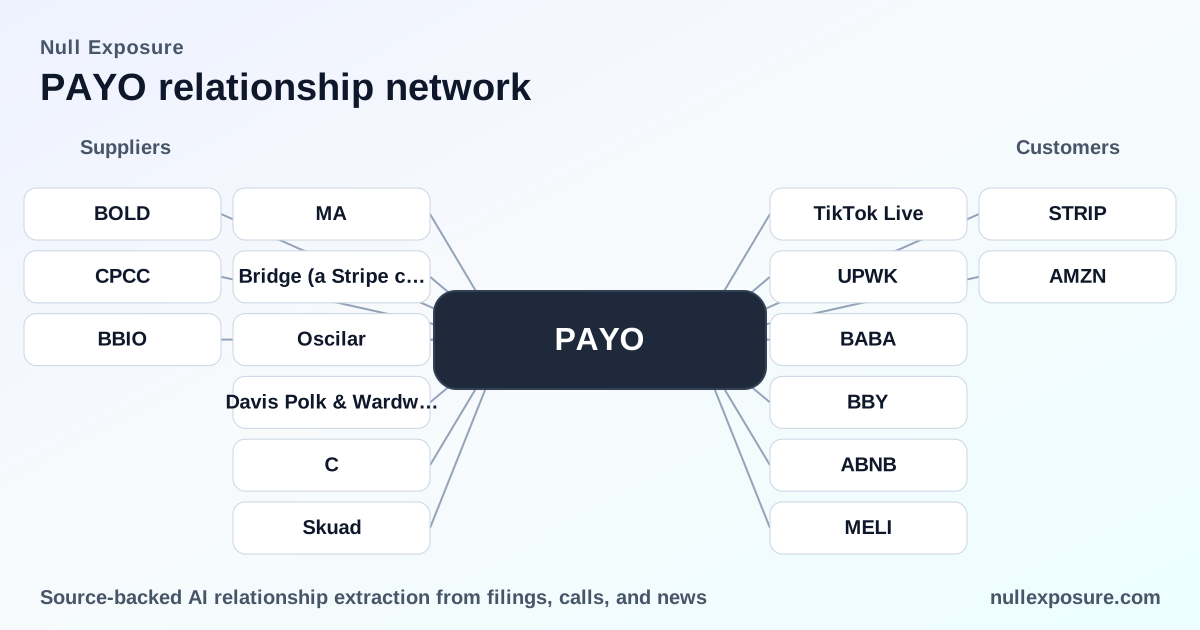
Payoneer (PAYO) supplier relationships: what investors need to know
Payoneer operates a global cross-border payments and commerce platform that monetizes through transaction fees, FX spreads, treasury services, and value-added enterprise products for marketplaces, freelancers, and SMBs. Its commercial strategy relies on partner integrations—card networks, banks, crypto rails, and acquired workflow platforms—to expand payment velocity, reduce unit cost, and move the business up‑market into higher‑ARPU B2B flows. Supplier relationships are therefore core to Payoneer’s economics and execution risk.
Explore deeper supplier intelligence at https://nullexposure.com/.
Why supplier links drive valuation and execution risk
Payoneer is fundamentally a platform business whose unit economics are shaped by third‑party payment rails and legal/treasury partners. Margin expansion requires optimized routing and regulated custody, while new product delivery (for example, stablecoin rails) depends on tight technical and commercial alignment with strategic suppliers. For investors, the signal set to watch is not just revenue growth but the maturity and stability of these supplier arrangements.
Company-level constraints and what they signal about the operating model
- Long-term financing posture. The company disclosed a warehouse facility with a 36‑month revolving period and a 42‑month maturity, indicating Payoneer has used long‑dated, structured financing to fund working capital or merchant settlement operations. The facility reached its scheduled revolving termination and outstanding borrowings were repaid, with automatic termination slated in April 2025. This is a signal of past reliance on structured credit and a completed wind‑down of that particular source.
- Global provider concentration and reach. Payoneer leverages close to 100 banking and payment service providers globally across more than 7,000 trade corridors with same‑day or real‑time settlement in over 150 countries; this is a core scale advantage but also a management complexity and compliance surface.
- Service provider posture. The company treats key suppliers as service providers with ongoing third‑party security assessment and advisory relationships for cybersecurity and operational resilience. That contracting posture reflects standard SaaS/fintech dependency on external rails and vendors.
- Relationship lifecycle signal. The warehouse facility’s scheduled termination and repayment is a concrete example of a supplier/credit relationship that has entered a winding‑down stage, underscoring that some strategic arrangements are time‑boxed and subject to lifecycle risk.
These constraints frame Payoneer as a global payments integrator with long-term contract exposure, broad supplier breadth, and active lifecycle management.
Supplier relationships: who Payoneer works with and why each matters
Mastercard — optimizing card and settlement economics
Payoneer maintains a strategic relationship with Mastercard to optimize network routing and economics; analysts expect this link to support longer‑term margin expansion as Payoneer scales upmarket. Source: Finviz coverage of Payoneer Q4 commentary (March 2026).
Stripe — partnership for payments interoperability and go‑to‑market
Payoneer cites strategic partnerships with providers like Stripe to optimize transaction economics and expand market access, reinforcing the company’s multi‑rail approach to payments. Source: Finviz analysis of Payoneer’s Q4 and B2B expansion (March 2026).
Bridge (a Stripe company) — embedded stablecoin rails
Payoneer announced a partnership with Bridge to add end‑to‑end stablecoin workflows directly embedded into the Payoneer platform, enabling faster, always‑on digital money for cross‑border transfers. This initiative represents a material product pivot toward crypto rails for treasury and settlement. Source: PR Newswire release and multiple news reports (February–March 2026).
Oscilar — AI risk decisioning for payments infrastructure
Payoneer will integrate Oscilar’s AI risk decisioning platform to incorporate predictive analytics and machine learning into its core payment flows, strengthening fraud and credit controls as volumes grow. Source: InsiderMonkey report citing the integration (FY2025/FY2026 commentary).
Davis Polk & Wardwell LLP — legal adviser on regulated banking charter
Payoneer engaged Davis Polk & Wardwell LLP as legal counsel in preparing its application for a U.S. national trust bank charter, a move that underpins the company’s push to solidify regulated custody and treasury capabilities. Source: PR Newswire release about the trust bank charter filing (March 2026).
Citi — blockchain‑enabled treasury and banking integration
Payoneer has an announced collaboration with Citi to enable real‑time, blockchain‑enabled treasury transfers, reflecting bank partnership playbooks that combine regulated custody with new‑rail execution for enterprise clients. Source: SahmCapital coverage (January 2026) and analyst Q&A reported by Finviz (Q4 2026 call notes).
Skuad (now Payoneer Workforce Management) — EOR capability and workforce expansion
Payoneer acquired EOR platform Skuad in 2024 and rebranded it to Payoneer Workforce Management, adding employer‑of‑record capabilities to address cross‑border payroll, benefits, and contractor compliance. This acquisition extends product scope beyond payments into workforce services. Source: InsiderMonkey coverage on the Skuad acquisition (2024–2026 reporting).
Boundless — European EOR foothold
Payoneer’s purchase of Ireland‑based Boundless expands its European footprint and enhances payroll, tax, and compliance services for SMBs, strengthening Payoneer’s proposition to customers requiring localized employment services. Source: InsiderMonkey report on the Boundless acquisition (January 2026).
How to read the relationship map: implications for investors
- Criticality and maturity. Partnerships with card networks (Mastercard), banks (Citi), and legal counsel for a trust charter are strategically critical and higher‑maturity relationships; they directly affect regulatory positioning and settlement economics.
- Concentration and complexity. The company’s reliance on roughly 100 providers across thousands of corridors reduces single‑counterparty concentration risk but amplifies operational complexity and compliance workload.
- Product innovation vector. The Bridge stablecoin integration and Oscilar AI risk stack indicate Payoneer is actively layering new rails and analytics to reduce per‑transaction cost and control risk — both positive for long‑term margin potential if execution is clean.
- Lifecycle management. The wind‑down of the warehouse facility illustrates that Payoneer manages supplier lifecycles and capital structures dynamically; investors should treat financing arrangements as discrete relationship commitments with finite durations.
Want access to curated supplier intelligence and relationship risk scoring? Visit https://nullexposure.com/ to see how these dynamics are tracked and scored.
Bottom line and investor actions
Payoneer’s supplier relationships are not peripheral—they are the operational spine of the business. Strategic tie‑ups with Mastercard, Stripe/Bridge, and Citi, combined with acquisitions like Skuad/Boundless and legal work to secure a bank charter, collectively shift Payoneer from a payments processor toward a vertically integrated global financial services platform. The main risks for investors are execution on stablecoin/tressury rails, regulatory approval complexity tied to the charter, and operational scale management across many providers.
For practitioners and research teams building exposure models, focus on: (1) partner contract tenure and termination clauses, (2) regulatory milestones for custody/charter work, and (3) the operational impact of new rails on unit economics. For more supplier-level insight and benchmarking, review the coverage at https://nullexposure.com/.