PaySign (PAYS) supplier profile: what the Gamma Innovation purchase signals for vendors and investors
PaySign operates a prepaid card and payments processing business that monetizes through transaction and processing fees, card-related spreads, and enterprise service contracts for corporate, consumer and government clients. The company is a small-cap, profitable operator with $74.9M trailing revenue and a market capitalization near $194M, deploying capital both into platform development and inorganic growth to broaden its service footprint. For vendors and sourcing teams, PaySign’s posture is operationally integrative: it combines ongoing product investment with targeted asset purchases that change supplier dynamics and vendor negotiation leverage.
Discover additional supplier intelligence at https://nullexposure.com/.
One-line thesis for commercial counterparties
PaySign is a cash-generative payments integrator that is actively consolidating capability—it funds platform investments and selective asset acquisitions while maintaining shareholder-friendly actions such as stock buybacks; suppliers should treat engagements as strategically important but negotiated with a mid-market buyer that expects integration and scale economics.
The Gamma Innovation LLC relationship — acquisition detail and source
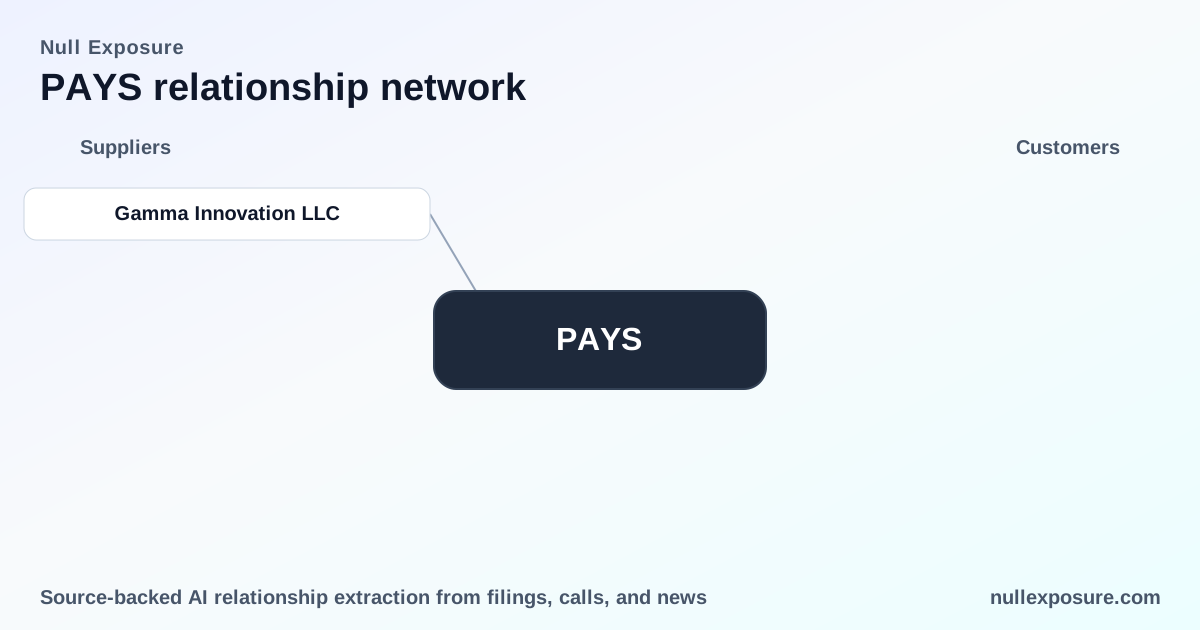
PaySign purchased the assets of Gamma Innovation LLC as a discrete investment in its platform. The company disclosed that the asset purchase reduced unrestricted cash as part of broader investments that also included opening a new customer service contact center and repurchasing 100,000 shares of common stock. This was disclosed in PaySign’s third-quarter 2025 financial results press release, published via The Globe and Mail in March 2026. (Source: PaySign Q3 FY2025 financial results press release, March 2026 — The Globe and Mail.)
Why this single relationship matters to vendors and operators
The Gamma asset purchase is a classic signal of strategic capability enhancement rather than a simple vendor substitution. PaySign is buying intellectual property or operational assets to internalize capabilities, which has three consequences for suppliers:
- Integration demand increases: vendors providing overlapping services will face integration work and tighter performance expectations as PaySign folds the acquired assets into its platform.
- Contracting leverage shifts: PaySign’s willingness to acquire assets suggests it prefers owning critical components, reducing long-term outsourcing for core services and raising competition for suppliers of commoditized capabilities.
- Near-term cash allocation is visible: PaySign explicitly tied the Gamma purchase to a decline in unrestricted cash, signaling prioritization of platform investments over short-term liquidity expansion. (Source: PaySign Q3 FY2025 press release, March 2026 — The Globe and Mail.)
Operating model and business-model constraints — company-level signals
PaySign’s public financials and the transaction disclosures create several actionable company-level signals for potential suppliers and investors:
-
Contracting posture: acquisitive and integration-focused. The company’s asset purchase of Gamma and opening of a new customer service center show a preference for internalizing customer experience and technical capability rather than long-term outsourcing.
-
Concentration and scale: PaySign is a mid-market operator with $74.9M revenue and an EV/Revenue near 2.5; supplier exposure should assume moderate counterparty concentration risk—vendors delivering highly specialized services to PaySign could face material revenue swings if PaySign continues to internalize functions. (Source: PaySign market and financial data, latest quarter 2025-09-30.)
-
Criticality: vendor relationships that touch payments, card issuance, and customer service are strategically critical. PaySign’s profit margins (roughly 10% net, 7.3% operating) and positive ROE indicate the company can invest in mission-critical suppliers, but it will demand efficiency and compliance. (Source: PaySign financial metrics, trailing twelve months.)
-
Maturity and capital allocation: profitable growth with active capital redeployment. PaySign reported buybacks alongside investments in platform and service capacity, indicating a disciplined capital allocation strategy that balances growth and shareholder returns. This profile favors suppliers who can demonstrate rapid ROI or flexible commercial terms. (Source: corporate disclosure in Q3 FY2025 press materials, March 2026.)
Commercial implications for supplier negotiations
Suppliers should structure engagements to reflect PaySign’s profile:
- Propose modular contracts with clear integration milestones and options for transition to in-house operation, recognizing PaySign’s acquisitive view of strategic capabilities.
- Price competitively on recurring services while offering value-adds that are difficult to replicate quickly (compliance tooling, proprietary integrations, or established client references).
- Build flexibility into working capital and termination clauses—PaySign’s willingness to redeploy capital to acquisitions means suppliers must protect margin and cash flow if functions are brought in-house. (Corporate moves disclosed in the Q3 FY2025 press release provide precedent. Source: March 2026 company announcement via The Globe and Mail.)
Explore vendor due-diligence resources and supplier scorecards at https://nullexposure.com/.
Key financial signals that matter to vendors and investors
PaySign’s public metrics clarify counterparty strength:
- Revenue (TTM): $74.9M — mid-market volume supports scale but not immunity to single-source supplier shocks.
- Profit margin: ~10% and Operating margin: 7.3% — profitable and able to fund strategic investments.
- Market cap: ~$194M; EV/EBITDA: ~13.6 — valuations consistent with growth-oriented, high-touch payments providers.
- Insider ownership ~37% and institutions ~47% — concentration of insiders suggests management control and continuity in strategic direction. (Sources: PaySign company financial overview and market data, latest quarter 2025-09-30.)
These signals together imply a reliable but strategic buyer: vendors should treat PaySign as creditworthy yet selective about what it outsources.
Tactical takeaway and suggested next steps
- If you are a vendor providing core payments, card issuance, or contact-center technology, position offerings as partnership-level integrations with clear migration and handoff plans.
- If your service is commoditized, prepare for procurement pressure as PaySign internalizes capabilities demonstrated by the Gamma asset purchase.
- For investors evaluating supplier relationships, the Gamma transaction is a clear indicator that PaySign will continue to invest in platform control—prioritize suppliers with sticky, differentiated services when modeling vendor revenue at risk.
Ready to evaluate supplier risk and build a procurement strategy? Visit https://nullexposure.com/ for tailored supplier intelligence and relationship analyses.
Final note: PaySign’s acquisition of Gamma Innovation LLC is a concrete operational move that changes supplier dynamics; treat future engagements with PaySign as strategic partnership opportunities that require integration-readiness and disciplined commercial terms. (Source: PaySign Q3 FY2025 financial results press release, March 2026 — The Globe and Mail.)