Paychex (PAYX) supplier relationships: what investors need to know
Paychex operates a high-margin, recurring-revenue payroll and HR outsourcing business that monetizes through per-payroll processing fees, subscription services for HR and benefits platforms, and value-added software features. The company's financial profile—steady margins, above-market return on equity, and a reliable dividend—reflects a mature operator that sells mission-critical infrastructure to small- and medium-sized employers and layers incremental services (payroll, HR, benefits, and now AI-driven workforce tools) on top of that core processing engine. For investors evaluating supplier exposure and partner risk, the question is how Paychex’s external integrations and third‑party dependencies influence operational continuity and competitive scale.
Explore supplier risk and relationship intelligence at Null Exposure: https://nullexposure.com/
How the business actually runs and how that shapes supplier risk
Paychex’s commercial model is built around recurring billing and operational scale. The company reported roughly $6.03 billion in trailing revenue, with an operating margin north of 40% and net profit margins around 26%—metrics consistent with a mature software-enabled services franchise that sells reliability as a product. Paychex is capitalized at about $33.4 billion market value, trades at a forward P/E near 15.6, and returns capital via a 4.56% dividend yield on the most recent figures.
These financials imply a stable contracting posture: Paychex signs long-term, defensive relationships with SMB customers and layers software features that increase switching costs. That posture also creates concentration of operational criticality—payroll processing and fund transfer rails are core dependencies where failure causes immediate customer churn and regulatory risk. Paychex itself acknowledges reliance on third-party rails for banking transfers, cloud infrastructure, and customer-facing systems, which frames supplier risk as a structural, company-level consideration rather than an isolated vendor issue. The company-level disclosure states that it uses banks to electronically transfer funds, cloud-based IT vendors, and other third-party providers to support customer interactions, which signals a managed but material third-party footprint.
What the relationships in the public record show
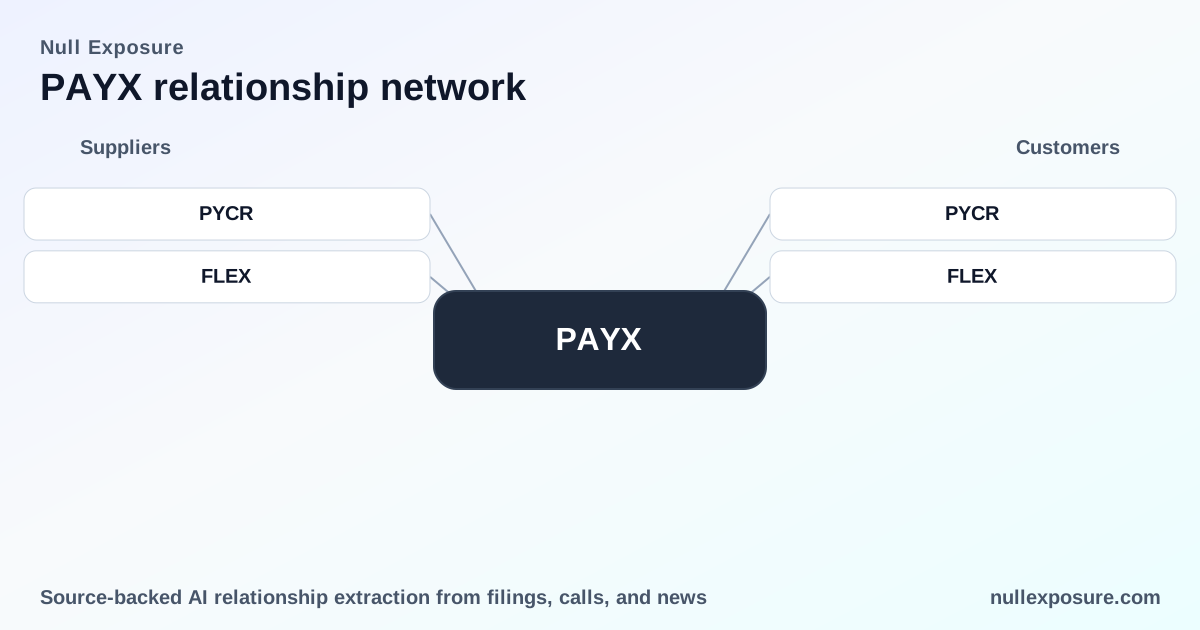
Paychex announced product ties that extend its workforce-management and AI features into other platforms. A Finviz news report on March 10, 2026 described Paychex unveiling AI-driven workforce management tools that integrate with the Paycor and Flex platforms—an example of Paychex exporting IP and capabilities to adjacent software ecosystems. These integrations are distribution and revenue channels: they increase addressable market reach and create platform interdependence with other HR systems.
Detailed look: every partner mentioned in the results
Paycor (PYCR)
Paychex rolled out AI-driven workforce management tools intended for Paycor’s platform, establishing product-level interoperability that positions Paychex features inside a competitor-facing ecosystem and widens distribution. This was reported via a Finviz news item on March 10, 2026. (Finviz, March 10, 2026 — https://finviz.com/news/329126/hr-software-stocks-q4-highlights-paychex-nasdaq-payx)
Flex (FLEX)
Paychex announced the same suite of AI-driven workforce management tools would be available for the Flex platform, signaling an effort to embed Paychex capabilities across multiple vendor channels rather than keeping functionality exclusive. The Finviz notice dated March 10, 2026 covers this deployment. (Finviz, March 10, 2026 — https://finviz.com/news/329126/hr-software-stocks-q4-highlights-paychex-nasdaq-payx)
Contracting posture, concentration, criticality and maturity — practical implications
Paychex’s own disclosure that it “relies on a number of third-party service providers” (banks for fund transfers, cloud IT vendors, and other providers supporting customer interaction) is decisive here. This is a company-level signal that shapes supplier risk in four ways:
- Contracting posture: Paychex operates with vendor reliance for payment rails and cloud services rather than vertically integrating every component. That reduces capital intensity but increases dependency on external SLAs and stability.
- Concentration: The business exhibits concentration in two dimensions—customer-side (SMBs for payroll) and infrastructure-side (key banking rails and cloud vendors). Both concentrations are manageable given Paychex’s scale, but they are single points where disruption would have outsized impact.
- Criticality: Payroll and fund transfers are mission-critical operations with immediate cash and compliance consequences; third-party failures translate directly to customer harm and regulatory exposure.
- Maturity: Paychex is a mature, high-ROE business with stable cash flow and a track record of returning capital; that maturity supports disciplined vendor governance and the resources to remediate supplier incidents quickly.
Investment implications: upside drivers and supplier-related risks
Paychex’s move to embed AI-driven workforce management across Paycor and Flex platforms is an earnings-accretive distribution play that leverages existing product IP without proportional lift in fixed cost. That strategy accelerates reach while preserving margin characteristics.
Key upside drivers:
- Distribution leverage from partner integrations increases software revenue per customer channel.
- High margins and cash generation fund product investment and shareholder returns.
Key supplier-related risks:
- Operational dependency on banks and cloud providers elevates systemic risk for payroll settlement and uptime; a major vendor outage would affect revenue recognition and client trust.
- Platform interoperability raises competitive and contractual complexity—embedding features into third-party platforms creates both new revenue paths and potential for feature cannibalization or contractual disputes.
Practical checklist for investors and operators
- Verify whether partner integrations are white-label deployments or revenue-share partnerships, since economics differ materially between the two.
- Confirm vendor redundancy for payment rails and cloud hosting to assess single‑point-of-failure exposure.
- Monitor regulatory filings and SOC/attestation reports tied to core vendors to gauge ongoing control posture.
- Track product adoption metrics for the Paycor and Flex integrations to see if these partnerships convert into sustainable ARR growth.
Evaluate the supplier landscape for Paychex at Null Exposure: https://nullexposure.com/
Bottom line
Paychex is a mature, high-margin payroll and HR services platform that is expanding distribution through partner integrations while relying on third-party banks and cloud vendors for core operations. The announced Paycor and Flex integrations are strategically aligned with revenue expansion and have favorable margin dynamics, but they increase the company’s surface area for supplier risk—particularly around payment rails and cloud availability. For investors, the signal is clear: this is a cash-generative franchise with disciplined capital allocation, but one where third‑party operational resilience is a central underwriting assumption.
For a deeper look at Paychex supplier risk and other vendor relationships, visit Null Exposure: https://nullexposure.com/