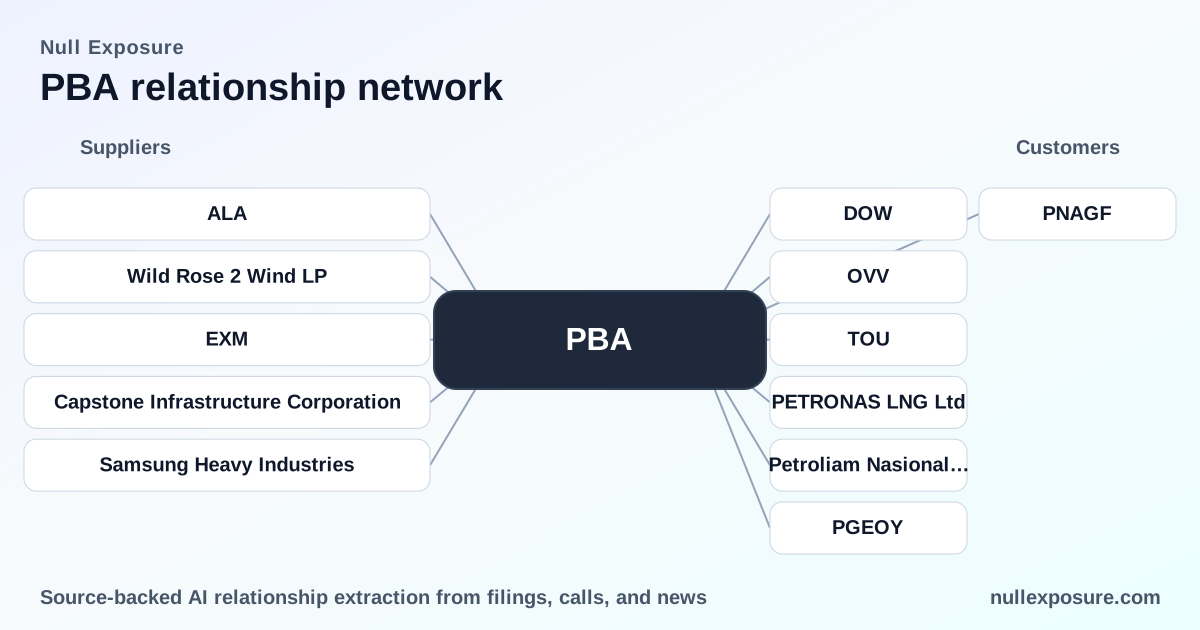
Pembina Pipeline (PBA) — supplier relationships and commercial footprint
Pembina is a North American midstream operator that monetizes fee-based transportation, processing and storage services, supplemented by commodity-linked export agreements and long-term offtake contracts. The company’s scale (market capitalization roughly $25.9 billion, EBITDA about $3.44 billion) supports large-capital projects and strategic partnerships that unlock export capacity and secure input power for operations. Investors should view supplier relationships as strategic enablers—they reduce project execution risk, control operating cost exposure and expand access to global markets. For a structured view of these commercial linkages visit https://nullexposure.com/.
Why supplier counterparties matter for valuation and execution
Pembina operates a capital-intensive, contract-heavy business. Long-term contracting posture is core to the model: the firm relies on multi-year offtake and export agreements to underwrite infrastructure investments, and it routinely partners with third-party engineering, marine and energy suppliers to execute projects. That contracting posture lowers commodity exposure and increases cash-flow visibility, while shifting counterparty risk into counterpart credit and operational performance.
Concentration and criticality are practical considerations. Pembina’s supply relationships span energy-export interfaces (LPG and LNG), renewable power offtake and specialist service providers for floating LNG execution. Counterparties that serve export terminals or FLNG operations are operationally critical; setbacks with those suppliers would directly affect throughput and revenue. Conversely, the inclusion of renewable PPAs and third-party marine operators spreads execution risk across established market players rather than concentrating it internally.
If you want a clean supplier map tied to Pembina’s commercial disclosures and news coverage, see our portal at https://nullexposure.com/.
The supplier relationships investors need to know now
Below are the supplier and partner references surfaced in recent filings and news coverage. Each relationship is summarized in plain English with the originating source.
AltaGas — LPG export agreement and terminal optimization
Pembina signed a 30,000 barrels-per-day LPG export agreement with AltaGas at West Coast terminals and sanctioned a Prince Rupert terminal optimization to enhance export capabilities. This is a direct commercial step to expand Pembina’s export footprint and monetize incremental LPG volumes. According to Pembina’s 2025 Q4 earnings call (first referenced March 2026), the agreement complements the company’s export strategy and terminal investment program.
Takeaway: this is a capacity-expansion, revenue-driving commercial tie to a major midstream counterparty.
Wild Rose 2 Wind LP — renewable power offtake
Pembina entered a power purchase agreement (PPA) to offtake 105 MW of renewable energy from the 192 MW Wild Rose 2 Wind Farm, securing supply to offset consumption or stabilise power costs for operations. The PPA was announced by Capstone’s subsidiary Wild Rose 2 Wind LP and was documented in a legal press release dated May 8, 2022 and cited in FY2026 coverage.
Takeaway: the PPA reduces Pembina’s power-price exposure and supports decarbonization of operations.
Capstone Infrastructure Corporation — counterparty to the Wild Rose 2 PPA
Capstone’s disclosure confirms its subsidiary’s PPA with Pembina for the Wild Rose 2 Wind Farm offtake, establishing Capstone as the commercial sponsor behind that renewable supply. The transaction was publicized in May 2022 and is reflected in FY2026 references.
Takeaway: Capstone acts as the project sponsor that underpins Pembina’s renewable energy procurement.
EXMAR — marine operations and maintenance for Cedar LNG FLNG
EXMAR was selected by Cedar LNG (the Haisla Nation–Pembina partnership) to provide marine operations and maintenance services for the FLNG unit supporting the Cedar LNG project. This outsources specialized maritime operations to a third-party service provider, aligning Pembina with marine expertise for floating liquefaction operations. The selection was reported by OEDigital in March 2026 as part of coverage of the Cedar LNG program.
Takeaway: Pembina uses specialist contractors for FLNG marine ops, reducing in-house operational complexity.
Samsung Heavy Industries — FLNG fabrication partner
The FLNG unit for Cedar LNG, named megúgu, is under construction at Samsung Heavy Industries, confirming a major international shipyard as the fabrication contractor for the floating liquefaction asset. OEDigital’s reporting (March 2026) places Samsung Heavy Industries at the center of physical construction for the Cedar LNG vessel.
Takeaway: global shipyard capacity is locked into Pembina’s export strategy through Cedar LNG.
Constraints and company-level signals for supplier risk analysis
No supplier-specific constraints were extracted from the referenced materials. At the company level, however, the available information signals several business-model characteristics investors must weigh:
- Contracting posture: Pembina relies on long-dated commercial contracts (offtake, PPAs, export agreements) to de-risk capital projects and ensure cash flow visibility.
- Concentration and diversification: suppliers cover distinct roles—export terminal partners, renewable power sponsors, marine O&M and shipbuilders—creating a diversified supplier mix rather than a single-point dependency.
- Criticality: counterparties tied to export capacity and FLNG construction/operations are strategically critical; performance or delays from those parties would have direct revenue implications.
- Maturity and capability: counterparts identified (AltaGas, Capstone, EXMAR, Samsung Heavy Industries) are established industry players, which elevates execution confidence relative to nascent suppliers.
These company-level signals indicate Pembina runs a structured supplier program that leverages third-party expertise while preserving long-term revenue certainty.
Bottom line for investors
Pembina’s supplier relationships show a deliberate mix of export-enabling agreements, renewable power procurement and specialist contractors for FLNG execution. That mix strengthens the company’s ability to convert built capacity into contracted cash flow while managing operating cost exposure. The biggest execution sensitivities will cluster around Cedar LNG construction and marine operations plus the operational ramp of Prince Rupert export capacity.
For a consolidated view of these supplier ties and to track updates as they are reported, visit https://nullexposure.com/.
If you want a supplier-focused lens on Pembina and comparable midstream names, start here: https://nullexposure.com/.