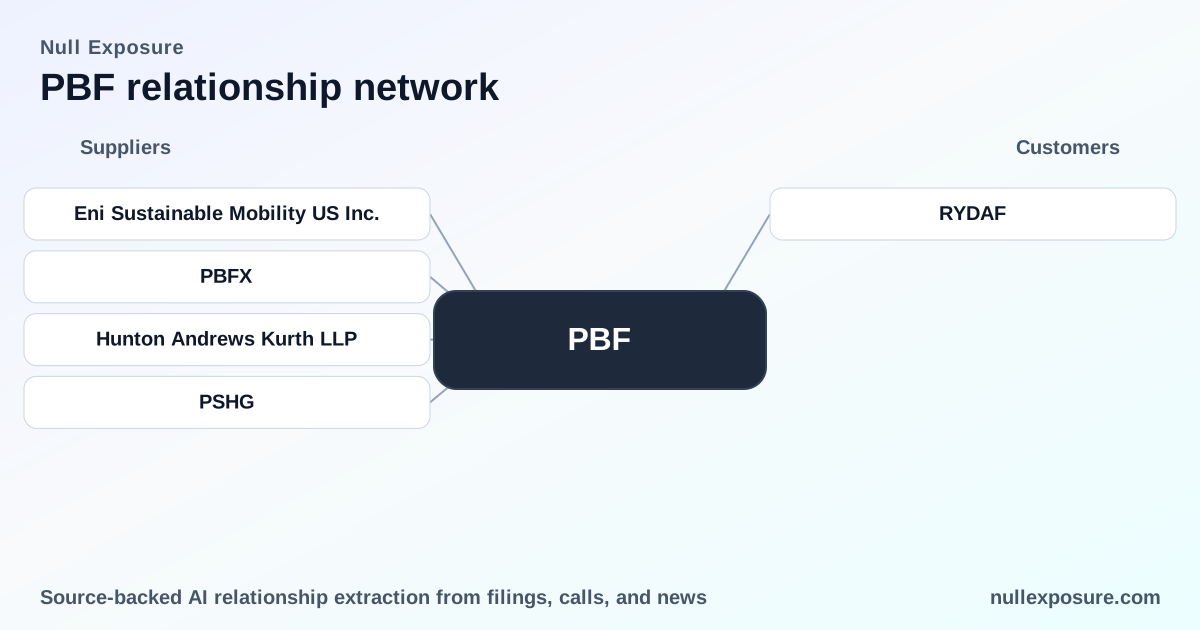
PBF Energy: Supplier relationships, operating constraints, and what they mean for investors
PBF Energy is a downstream refiner that monetizes through refining margins and product sales, complemented by fee-based logistics and storage services after the integration of its logistics arm. The company buys crude and feedstocks on a global basis—largely through short-term and spot contracts—while maintaining longer-term supply commitments for utilities and refinery inputs that underpin operations. For investors and operators, the critical question is how this hybrid contracting posture and the web of supplier/service relationships translate into margin volatility, counterparty risk, and capital allocation choices.
Explore supplier exposure and counterparty detail at https://nullexposure.com/ for a deeper supplier map and historical filings.
Why supplier relationships drive PBF’s earnings sensitivity
PBF’s business is fundamentally about turning raw hydrocarbons into refined products. Crude and feedstock prices drive gross margin swings, while availability and logistics shape throughput. The company’s disclosures show a deliberate split in procurement: short-term/spot crude purchases that allow market responsiveness, alongside multi-year agreements for critical services and utilities—hydrogen, oxygen, steam, wastewater treatment—that create fixed-cost commitments and operational resiliency.
According to PBF’s FY2025 Form 10‑K, the company recorded roughly $139.0 million of purchases under such supply agreements in 2025, and discloses fixed and determinable obligations stretching beyond 2026. That profile reduces immediate supply interruption risk for essential refinery inputs while preserving crude price optionality through spot markets.
Learn more about the supplier landscape and contractual signals at https://nullexposure.com/.
Contracting posture: a hybrid model that stabilizes operations but concentrates spend
- Long‑term contracts for refinery utilities create predictable operating continuity and capex planning; disclosed fixed obligations extend multiple years.
- Short‑term and spot sourcing for crude provides price flexibility and access to global crude grades but increases gross margin volatility.
Both elements are strategic: long-term utility contracts protect throughput, while spot crude exposure captures favorable spreads when market dislocations occur.
Vendor relationships you should model (each relationship in the record)
Eni Sustainable Mobility US Inc.
PBF’s FY2025 Form 10‑K references Eni Sustainable Mobility US Inc. as an identified counterparty, noting its corporate identity as a subsidiary of Eni SpA. This mention is factual and limited to entity identification in the filing. According to PBF’s FY2025 Form 10‑K (filed February 2026), Eni Sustainable Mobility US Inc. is referenced by name in PBF’s supplier/partner disclosures.
PBF Logistics LP ("PBFX")
PBF now operates with PBFX integrated into the corporate structure; PBFX provides rail, truck and marine terminaling, pipeline transportation, and storage services to PBF and third parties through fee-based commercial agreements, though the unit historically generated limited third‑party revenue and intersegment revenues were eliminated on consolidation. This detail comes from PBF’s public earnings release and supporting commentary in a March 2026 press release reporting fourth-quarter and full‑year results.
Hunton Andrews Kurth LLP
Hunton Andrews Kurth LLP served as legal counsel to PBF in the acquisition of PBF Logistics LP, a transaction that closed November 30, 2022. The firm’s announcement documents the legal advisory role during the 2022 acquisition process, confirming a past transaction advisory relationship rather than an ongoing operational supplier commitment.
Performance Shipping (PSHG)
In January 2026, Performance Shipping announced a three‑year time charter agreement with PBF Holding Company for an Aframax tanker (M/T P. Monterey), representing a multi‑year marine transport commitment expected to generate approximately $33 million in gross revenue to the shipowner over the minimum term; the arrangement signals PBF’s use of time charters to secure transport capacity. The charter was reported in market coverage of the January 2026 deal.
Operating constraints and what they signal to investors
PBF’s disclosed constraints collectively describe a mature, hybrid procurement operating model:
- Contract types and maturity: PBF combines long‑term supply agreements for utilities and process chemicals (with fixed and determinable commitments recorded in the 10‑K) and short‑term/spot purchasing for crude and feedstock. This mix stabilizes critical inputs while leaving product margins exposed to crude price swings.
- Geographic sourcing: Crude is sourced on a global basis, requiring robust logistics and flexibility in refinery configuration to handle different grades.
- Role and concentration: PBF is primarily a buyer of crude and utilities, with material spend under long‑term service agreements (the company cites more than $100 million of purchases under such agreements in recent years). That places supplier performance and contract terms squarely in the margin calculus.
- Service dependency and cybersecurity: The company contracts third‑party service providers, including cybersecurity vendors, and requires adherence to its IT policies—an operational control that underscores service criticality for safety and continuity.
- Spend profile: The magnitude of purchases under long‑term agreements positions certain supplier relationships in the >$100 million spend band, elevating strategic importance and negotiation leverage for both parties.
Together, these constraints indicate a supply posture optimized for operational reliability with deliberate exposure to market prices for margin upside and downside.
What investors and operators should track next
For investors evaluating counterparty risk and operational resilience, focus on three areas:
- Refinery feedstock mix and spot exposure. Track changes in the proportion of spot versus contracted crude purchases and how that translates into refining margin sensitivity.
- Utility and service contract roll‑forwards. Monitor the timetable and economics of long‑term utility and chemical agreements; renewal terms will influence fixed cost structure.
- Logistics capacity and ownership structure. The integration of PBFX changes how PBF captures earnings from storage and transport—follow disclosures on third‑party revenue generation and intersegment eliminations.
Actionable steps:
- Review the FY2025 Form 10‑K for obligation schedules and supplier commitments.
- Model scenarios with varying crude spreads to test earnings volatility.
- Map logistics counterparty exposure to regional refinery throughput.
For a consolidated supplier view and filing links, visit https://nullexposure.com/.
Bottom line
PBF’s supplier relationships are purposefully hybrid: long‑term contracts secure essential inputs and operational continuity, while global spot crude sourcing preserves market responsiveness and margin capture. Investors must weigh the stabilizing effect of service contracts against the earnings volatility inherent in spot crude exposure, and operators should prioritize contract renewal timing and logistics capacity. For a grounded supplier map and to track these relationships in filings, go to https://nullexposure.com/.