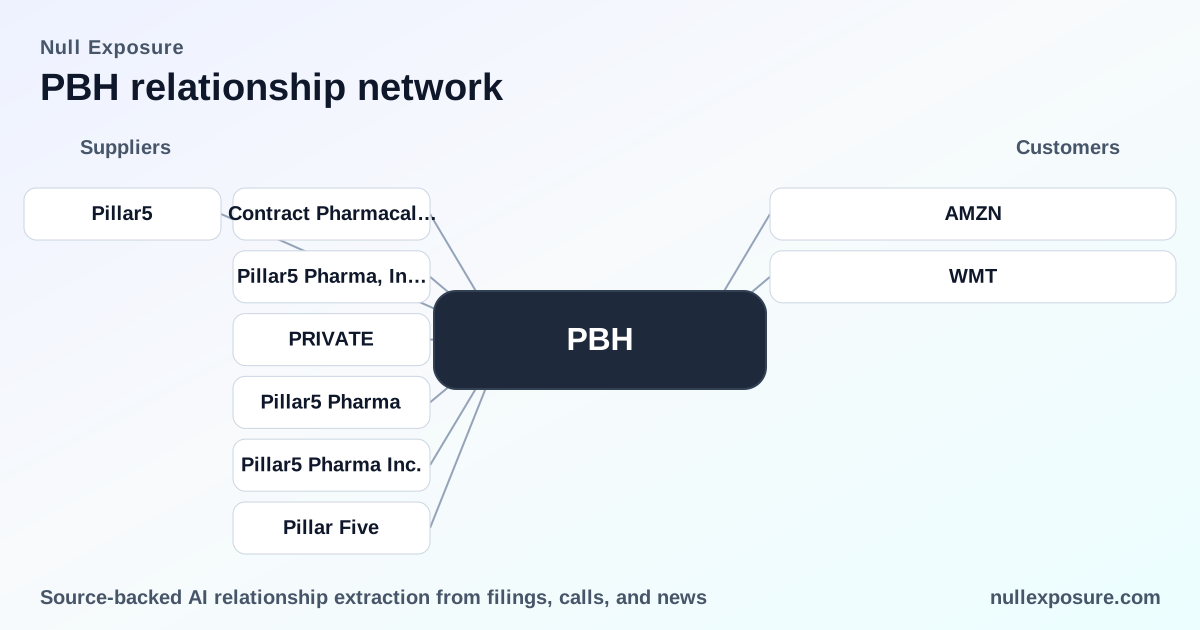
Prestige Brand Holdings (PBH) — supplier relationships, constraints and what investors should price in
Prestige Brand Holdings (PBH) sells and markets branded over‑the‑counter healthcare products and monetizes through shelf sales, category pricing power, and brand management while outsourcing most manufacturing and logistics. The company runs a largely asset‑light model for production, relying on a broad set of third‑party manufacturers and a single primary U.S. distribution center, and it is actively consolidating supply risk through M&A — most recently the acquisition of Pillar5 to bring an important eye‑care supplier in‑house. For investors and operations leads, the core question is whether PBH’s contracting posture and supplier concentration create a durable advantage or an operational liability that will compress margins under stress. Visit https://nullexposure.com/ for a deeper supplier-risk view and tools for diligence.
How PBH structures its supplier relationships and what that means for risk
PBH runs a mixed contracting model: long‑term manufacturing agreements coexist with purchase‑order (spot) manufacturing for less critical SKUs. According to PBH’s FY2025 10‑K, the company had relationships with 98 third‑party manufacturers, with 16 manufacturers on long‑term contracts accounting for roughly 58% of gross sales in 2025, down from 26 long‑term partners that accounted for ~72% in 2024. That shift signals a rebalancing toward fewer committed suppliers for core products and a larger tail of shorter‑term or batch‑based suppliers for other SKUs (PBH FY2025 10‑K).
Several operational constraints stand out as company‑level signals:
- Supplier concentration is material. One privately owned manufacturer represented roughly 21% of gross revenues for 2023–2025, underlining a single counterparty whose service is critical to the business (PBH FY2025 10‑K).
- Geography and compliance are clustered in North America. Most suppliers are based in the U.S. and Canada and are required to comply with PBH’s Supplier Code of Conduct (PBH FY2025 10‑K).
- Logistics are outsourced to a single provider and facility. PBH manages U.S. distribution through one primary third‑party facility in Clayton, Indiana, under an extended Master Logistics Services Agreement with GEODIS (contract extension referenced in FY2025 filings).
- Committed near‑term spend is material but manageable. Purchase commitments reported in PBH’s filings total approximately $12.95 million across the stated annual schedule, consistent with a $10M–$100M spend band for multi‑year supplier commitments.
These characteristics define an operational profile where supply continuity is critical to revenue delivery but where PBH has strategic levers — long‑term contracts and selective acquisitions — to mitigate concentrated risks.
Supplier relationships investors must track
Contract Pharmacal Corporation
PBH’s public filing notes long‑term supply and manufacturing agreements that specify manufacturer obligations, product specs and liability allocation — Contract Pharmacal is named among its manufacturing partners in the FY2025 10‑K. This relationship sits in PBH’s long‑term manufacturer cohort and is governed by explicit contractual terms on production and liability (PBH FY2025 10‑K).
Pillar5 Pharma (Pillar Five / Pillar5 Pharma, Inc.)
PBH completed the acquisition of Pillar5 Pharma in December (reported in FY2026 commentary), bringing a sterile ophthalmic manufacturer and primary Clear Eyes supplier into direct ownership to secure near‑term supply and expand capacity. Management told investors on the Q1 2026 earnings call that owning the facility was the preferred path to secure and scale supply, and multiple press releases and market reports documented the close and strategic rationale (GlobeNewswire Feb 5, 2026; PBH Q1 2026 earnings call; market write‑ups including Sahm Capital and TradingView coverage in 2025–2026).
Why the Pillar5 deal changes the risk calculus
The acquisition of Pillar5 is the clearest example of PBH shifting from dependence on external suppliers toward vertical control of critical capacity. Management explicitly framed the purchase as a supply‑security move on the Q1 2026 call, and company announcements confirm the close in December (earnings call pbh‑2026q1; GlobeNewswire Feb 2026). For investors this is a double‑edged lever:
- Positive: Direct ownership reduces the single‑supplier concentration that previously produced outsized revenue exposure and should improve reliability for the Clear Eyes channel.
- Risk: Operating a sterile ophthalmic manufacturing facility brings operational complexity and fixed‑cost risk that could pressure margins if volume fails to ramp as planned (market commentary from Sahm Capital and coverage on TradingView highlighted this execution risk).
If you are modeling PBH’s next 12–24 months, build scenarios that credit some supply stabilization but stress test margin dilution if the new plant operates below plan. For additional diligence on counterparty exposures and supplier contracts, check https://nullexposure.com/ — the homepage has tools and case studies for supplier‑risk assessment.
Operational constraints that drive valuation and covenant risk
PBH’s operating model has a few quantifiable characteristics that should feed into any valuation or covenant analysis:
- Concentration and criticality: A single manufacturer produced roughly 20–21% of gross revenues across recent years, a structural vulnerability for revenue volatility (PBH FY2025 10‑K).
- Contracting mix and maturity: The company holds a smaller number of long‑term contracts than in prior years, concentrating committed supply but leaving a sizeable portion of manufacturing on purchase‑order terms (PBH FY2025 10‑K).
- Third‑party logistics dependency: Distribution is centralized under GEODIS — PBH extended leasing/operational arrangements tied to that provider, signaling dependency on a single logistics counterparty (FY2025 filing excerpts).
- Committed spend: Minimum future purchase commitments total roughly $12.95 million across the disclosed schedule, consistent with mid‑single digit millions of fixed supplier spend per year.
These are not academic data points — they directly affect free cash flow volatility, capex and working capital needs, and the company’s ability to maintain shelf presence during supplier disruptions.
For operational teams evaluating supplier relationships or investors building downside scenarios, map the percent of gross sales by supplier and overlay contractual tenure and geographic concentration. If you want a structured template and supplier scoring rubric used by institutional analysts, visit https://nullexposure.com/ for a practical guide.
Bottom line and actions for investors and operators
Prestige operates a brand‑driven OTC business with material supplier concentration and a recent pivot toward vertical control of critical eye‑care supply. The Pillar5 acquisition materially reduces one visible concentration risk but introduces operational execution exposure. Key investment questions are whether Pillar5 can sustain required sterile output at acceptable margins and whether PBH holds option value in converting more spot manufacturing to secured, long‑term supply without eroding returns.
Recommended next steps:
- For investors: stress test margins for scenarios where Pillar5 ramps slower than expected and quantify impact on free cash flow and leverage.
- For procurement and ops leads: prioritize a supplier‑risk scorecard for the top 20 manufacturers and validate contingency production plans for the ~58% of gross sales tied to long‑term contracts.
Final note: supplier disclosure in PBH’s filings provides necessary visibility to model concentration, but the Pillar5 acquisition is the single most consequential supply‑side change for the next two years. For further supplier intelligence and templates that institutional teams use, start with https://nullexposure.com/.