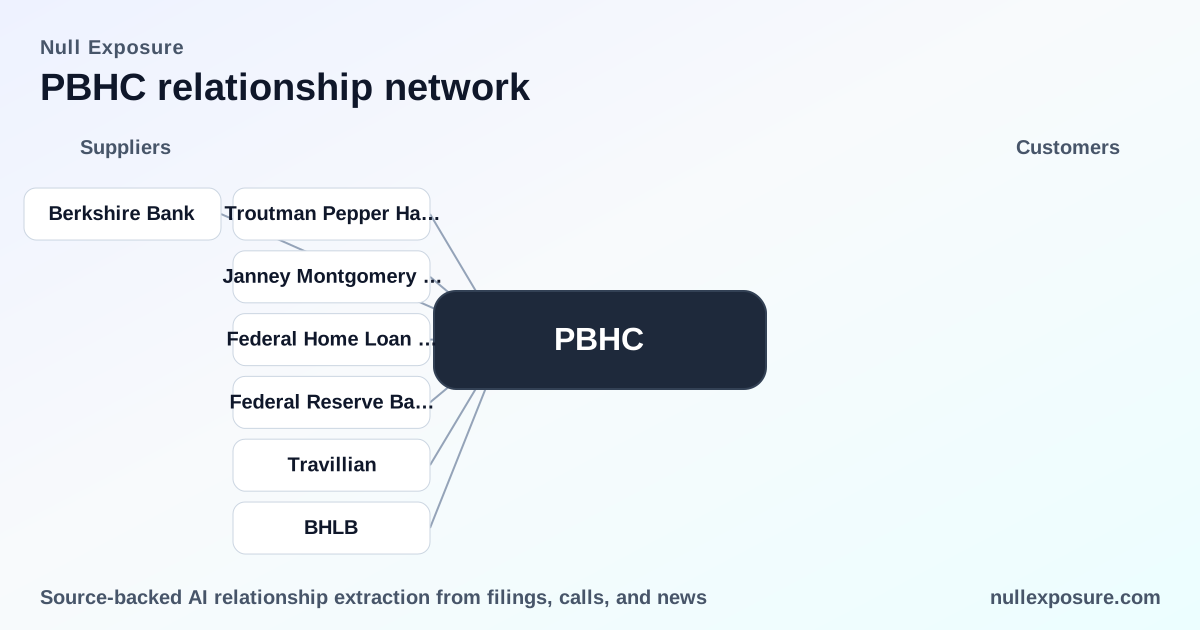
Pathfinder Bancorp (PBHC) — supplier and counterparty map for investors
Pathfinder Bancorp operates as a small regional bank headquartered in Oswego, New York, monetizing primarily through traditional banking channels: net interest income from loan portfolios, fee income from deposit and payment services, and strategic branch acquisitions to grow retail deposits and local market share. The company funds growth and manages interest-rate risk through a combination of wholesale liquidity lines, Federal Home Loan Bank (FHLB) advances, and interest-rate hedge contracts, while engaging external advisors and service firms for transactions and executive hiring.
Explore more on partner exposure and supplier signal analysis at https://nullexposure.com/.
How Pathfinder’s operating model shapes its supplier posture
Pathfinder’s supplier network reflects a banking operator that leverages a small set of high-criticality counterparties and a roster of specialized service providers. The company uses both long-term and short-term contractual instruments: interest-rate swaps and hedges that extend multi-year (some positions expire as late as 2035) sit alongside FHLB and Federal Reserve liquidity lines used to manage day-to-day funding and balance-sheet flexibility. The mix creates a contracting posture that is both strategic (long-dated hedges) and tactical (short-term borrowings).
- Concentration: The firm shows limited counterparty breadth — large exposures center on capital markets counterparties and government-backed liquidity providers (FHLB, Federal Reserve). This concentrates critical operational risk but simplifies counterparty management.
- Criticality: Lines with FHLBNY and the Federal Reserve are mission-critical for liquidity management; hedges with multi‑million-dollar notional sizes are material to interest-rate risk posture.
- Maturity and spend: Active hedging programs are mature—designated hedges notional reached $73.9 million at December 31, 2024, and recent swap notional figures are in the tens of millions, placing these relationships in the $10m–$100m spend band.
- Contracting posture: A mix of long-term swaps (some contracts extend to 2035) and shorter-term FHLB advances indicates a deliberate pairing of duration management and liquidity buffers.
If you’re evaluating counterparty risk or supplier concentration for Pathfinder, start with their liquidity and hedging counterparties — the contacts that control funding capacity and interest‑rate risk. For a deeper supplier exposure view visit https://nullexposure.com/.
Counterparty-by-counterparty: the relationships that matter
Below are every relationship identified in recent coverage, presented with concise, source-linked summaries.
- Troutman Pepper Hamilton Sanders LLP — Pathfinder retained Troutman Pepper as legal counsel for the purchase and assumption of an East Syracuse branch, supporting transaction documentation and regulatory steps. According to CityBiz coverage of the transaction, Troutman Pepper served as legal counsel (March 2026).
- Janney Montgomery Scott LLC — Janney acted as financial advisor to Pathfinder in the same branch acquisition, providing deal advisory and execution support. CityBiz reported Janney advised Pathfinder on the transaction (March 2026).
- Federal Home Loan Bank of New York (FHLBNY) — Pathfinder reported available additional funding capacity of $157.5 million with the FHLBNY as of December 31, 2025, a primary wholesale liquidity source that the bank uses for advances and collateralized borrowing. This capacity was disclosed in Pathfinder’s financial announcement (reported on Yahoo Finance, March 2026).
- Federal Reserve Bank / Discount Window — The company has access to Federal Reserve facilities: Pathfinder disclosed $13.5 million of available capacity with the Federal Reserve Bank as of December 31, 2025, and earlier filings show a $34.3 million discount-window line at December 31, 2024. Those liquidity line disclosures were included in Pathfinder’s financial disclosures (company filing excerpts and a March 2026 press release).
- Travillian — Pathfinder engaged Travillian, a national executive recruiting firm, to locate and secure its CFO through a nationwide search, reflecting use of specialized human-capital service providers. Oswego County Business noted the firm’s role in sourcing the CFO (reported in early 2026).
- Berkshire Hills Bancorp, Inc. (BHLB) — Pathfinder completed a purchase-and-assumption of an East Syracuse branch from Berkshire Hills Bancorp’s banking subsidiary as part of local footprint expansion, a transaction publicly announced by Pathfinder and covered by CityBiz (March 2026).
- Berkshire Bank — The actual branch seller in the transaction was Berkshire Bank, the banking subsidiary of Berkshire Hills Bancorp; the branch purchase and assumption transferred local deposits and customer relationships to Pathfinder, as reported by CityBiz (March 2026).
What the relationship map implies for investors
- Liquidity backbone is government-linked: The combination of FHLBNY and Federal Reserve access is a structural strength — large, readily available lines reduce short-term funding risk and support deposit replacement after branch acquisitions. (Company filings and press releases, December 31, 2024 and 2025 disclosures.)
- Hedging is substantive and long-dated: Notional hedges in the tens of millions and swaps with expirations through 2035 indicate active interest-rate management that materially affects net interest income volatility. (Company hedge disclosures at year-end 2024.)
- Operational dependencies are limited but concentrated: Pathfinder relies on a small set of high-impact counterparties and specialist advisors (legal, financial, executive search). This creates efficiency in execution but concentrates single-point risks around those providers.
- Supplier roles are mixed: The firm uses counterparties as both service providers (advisory, legal, recruiting) and as financing counterparties (FHLBNY, Federal Reserve), reflecting a typical regional-bank supplier profile where financial counterparties are simultaneously service-critical and balance-sheet critical.
For deeper supplier relationship modeling and exposure visuals, explore https://nullexposure.com/.
Recommended investor actions
- Prioritize monitoring of FHLBNY and Federal Reserve capacity disclosures at each quarter-end; changes in available capacity are an early signal of funding stress or collateral constraints.
- Track notional hedge rollovers and counterparty credit terms—long-dated swap expirations and large notional amounts directly influence interest-rate sensitivity.
- Review transaction execution partners (legal and advisory) after acquisitions to assess integration risk; Pathfinder’s recent use of Janney and Troutman Pepper is consistent with standard M&A playbooks for community banks.
Conclusion: concise keeper points
Pathfinder’s supplier landscape is straightforward: liquidity and hedging counterparties underpin balance-sheet stability, while a small set of professional service firms support M&A and executive hires. For investors, the critical signals are available funding capacity with FHLBNY and the Fed, and the scale and duration of hedges. Monitor those data points each quarter to understand funding flexibility and interest‑rate risk exposure.
Stay informed on supplier exposure and counterparty risk at https://nullexposure.com/.