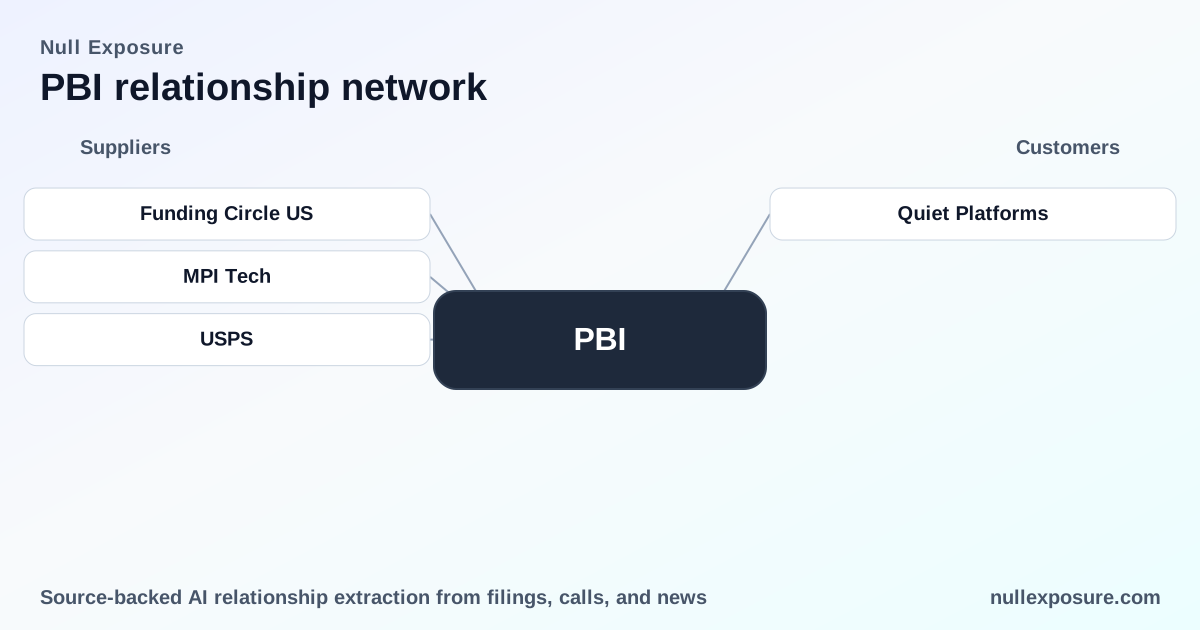
Pitney Bowes (PBI) — supplier relationships that shape recurring revenue and distribution economics
Pitney Bowes monetizes a legacy of physical mail and shipping hardware while pushing toward higher-margin software and financial services: hardware sales and supplies, postage and shipping transaction fees, subscription software for logistics and customer information management, and partner-driven lending/financial services for SMB customers. The company’s supplier and partner relationships act as distribution levers and capability multipliers—they determine access to postal networks, specialized IPDS printing tech, and embedded finance that converts one-time equipment buyers into recurring-revenue accounts. For deeper relationship mapping and risk scoring, visit the NullExposure homepage: https://nullexposure.com/.
Quick read for investors: what matters now
Pitney Bowes is a mid-cap incumbent (market cap ~ $1.66B) with roughly $1.9B revenue and an EBITDA margin that supports reinvestment in services. Key financial signals: institutional ownership is high (~87%), operating margin is robust (~24%), and valuation multiples (trailing PE ~12x, forward PE ~7x) imply the market is pricing a near-term earnings recovery. Capital allocation and partner selection will dictate whether recurring software revenue can widen margins and reduce dependence on hardware cycles.
How the recorded supplier relationships fit into the strategy
Below I summarize each supplier/partner mention surfaced in the results and cite the originating source. Each relationship is short and operational — they are not speculative, and each supports either distribution, integration, or embedded services.
Funding Circle US — embedded lending for SMB customers
Funding Circle US announced a partnership with Pitney Bowes to provide loans to Pitney Bowes’ small business customers, creating a financing channel tied to the company’s SMB installed base. According to a Funding Circle announcement (published on FundingCircle.com), the collaboration positions Pitney Bowes to convert equipment and services customers into financed accounts, supporting sales and stickiness (FY2022 context in the record). This is an explicit move into embedded finance that turns product sales into cross-sell revenue and lowers upfront purchase friction. (Source: Funding Circle press release on fundingcircle.com.)
MPI Tech — IPDS printing/stream management integration
A collaboration described on Yahoo News detailed a technical integration where Pitney Bowes leveraged a customized IS/3-compliant version of MPI Tech’s MIPS (MPI IPDS Portable Software) to manage IPDS data streams. The Yahoo-hosted report (originally published in 2012) documents how Pitney Bowes integrates third‑party print-stream software to support enterprise printing environments and large-scale transactional output. This reflects a pragmatic approach to interoperability: Pitney Bowes layers third-party IP to serve enterprise customers that require complex print and output controls. (Source: Yahoo News report on MPI Tech collaboration.)
USPS — discounted label and postage distribution
Trade reporting in Supply & Demand Chain Executive highlighted that Pitney Bowes hardware and software support printing discounted USPS shipping labels and first-class stamps, a direct distribution channel into the U.S. postal system. The SDCExec article notes the company’s compact shipping label printers with built-in scales enable customers to access USPS discounts at point of shipping. Access to postal discounts and formal USPS integration is a structural advantage for Pitney Bowes’ shipping solutions and a recurring-revenue driver through postage and transaction fees. (Source: Supply & Demand Chain Executive article.)
What these partnerships reveal about Pitney Bowes’ operating model
The three relationships collectively show a company operating on three commercial axes: distribution partnerships (USPS), capability integrations (MPI Tech), and monetization extensions (Funding Circle).
- Contracting posture: Pitney Bowes behaves as an integrator and channel partner. It signs commercial distribution and technology integration agreements rather than relying solely on in‑house development. This reduces time-to-market for enterprise features and allows the company to offer bundled services.
- Concentration and criticality: Relationships with postal networks and financing partners are strategically critical—the USPS connection drives transaction economics and customer lock-in, while finance partners enable higher conversion on equipment sales. High institutional ownership suggests investors are watching these partnership transitions closely.
- Maturity and transition: Pitney Bowes is a mature provider moving from hardware-centric revenues to higher-margin recurring services; partnerships are used to accelerate transformation without over‑stretching R&D. Financial metrics (solid operating margin, positive EBITDA) give the company runway to invest in these integrations.
These are company-level signals informed by the relationship map and financial profile; they are not tied to an individual supplier unless explicitly named.
If you want a relationship-level impact analysis or partner-risk scorecard, see our tools and coverage at https://nullexposure.com/.
Investor takeaways and risk framework
- Positive: recurring levers exist. Embedded finance (Funding Circle) and USPS transaction flows both create recurring cash generation opportunities beyond one-time hardware sales. These partnerships directly address conversion and retention.
- Operational risk: partner execution and concentration. Heavy reliance on a small set of strategic partners increases external dependency—changes in postal pricing, regulatory shifts, or lender economics can affect margins and customer economics.
- Strategic posture: pragmatic integration. MPI Tech evidence shows Pitney Bowes prefers targeted integrations to solve customer problems quickly rather than full internal reinvention, which is capital-efficient but raises supplier-management complexity.
- Valuation implication: current multiples (forward PE ~7x) discount execution risk and assume successful revenue mix shift; investors should monitor partnership contract terms, revenue attribution, and margin progression.
Final recommendation and actions for operators and investors
For investors, monitor partner revenue disclosure, the share of recurring revenue, and any changes in USPS contractual access or postage discounting rules—those are the most direct profit drivers. For operators, prioritize contract governance and data/integration standards with lenders and print-stream providers to protect margins and customer experience.
Explore deeper relationship maps and partner-risk analysis on the NullExposure platform: https://nullexposure.com/. For vendor diligence workflows and supplier exposure reporting tied to Pitney Bowes, see our research hub: https://nullexposure.com/.
Bottom line: Pitney Bowes leverages supplier partnerships to convert hardware into recurring, service-driven economics; success hinges on execution with postal networks and finance partners while managing supplier concentration and integration complexity. For a tailored partner-risk assessment or to subscribe to ongoing coverage, visit https://nullexposure.com/.