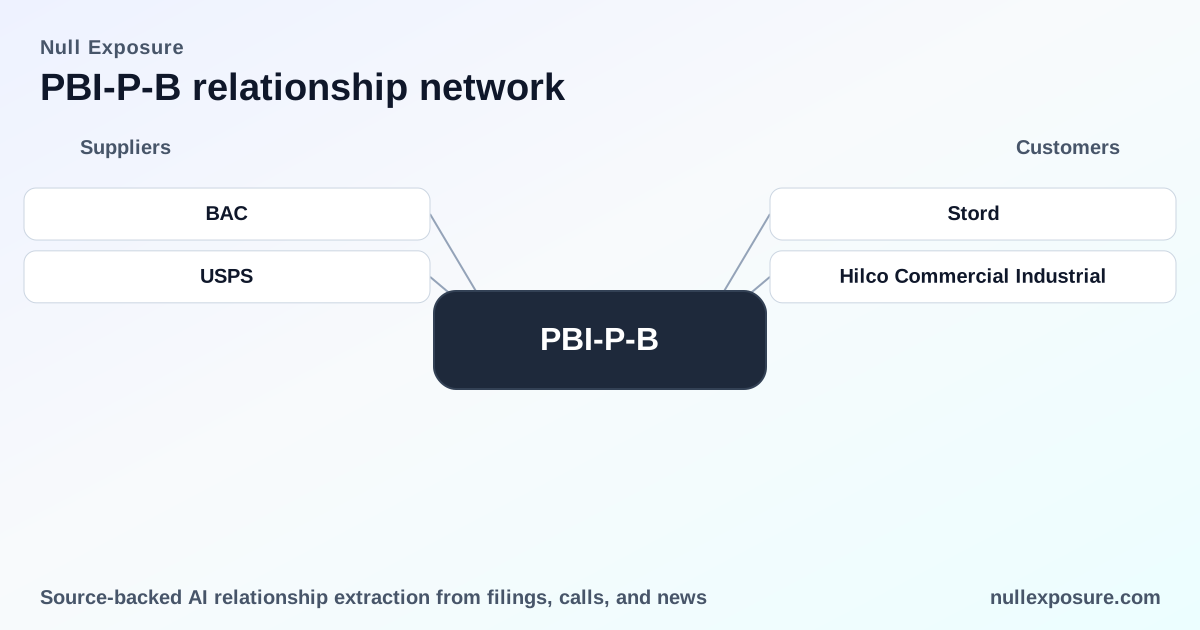
Pitney Bowes Inc (PBI-P-B): Strategic supplier touchpoints that shape capital and operational risk
Pitney Bowes Inc. issues the PBI-P-B 6.70% preferred notes due 2043, a fixed-income instrument that reflects the company’s ongoing roll of capital markets relationships and its exposure to legacy postal and logistics contract dynamics. The company monetizes through a mix of shipping and mailing services, equipment leases and sales, and transaction-based logistics solutions; the preferred security sits squarely inside capital structure management decisions driven by liquidity needs and refinancing activity. For investors and operators evaluating supplier relationships, the critical lenses are capital markets counterparties that influence liability management and carrier contracts that determine revenue volatility.
Explore further analysis and supplier mappings at https://nullexposure.com/.
Why supplier relationships matter for PBI-P-B investors
The PBI-P-B security is not just a coupon and maturity; it is an instrument sensitive to two supplier-facing domains: (1) capital markets counterparties that execute tender offers, underwriting and balance-sheet reshaping, and (2) logistics/carrier counterparties whose commercial terms and regulatory environment drive core revenue streams. Both domains directly affect credit spreads, prepayment or tender dynamics, and operational profitability — key inputs for preferred security valuation. Understanding which counterparties act in those domains and how they engage with Pitney Bowes is essential for assessing downside risk and refinancing pathways.
Capital markets counterparty: BofA Securities — active dealer manager role
BofA Securities served as Dealer Manager for Pitney Bowes’ cash tender offers, a direct link between the company and its capital markets execution capability. This relationship indicates Pitney Bowes uses major investment banks to structure, market and execute liability-management actions, which is material for liquidity and refinancing execution.
According to TradingView’s coverage of Pitney Bowes’ tender-offer announcement (reported March 10, 2026), BofA acted in the dealer-manager capacity for the offers. Source: TradingView news item, March 10, 2026 — https://www.tradingview.com/news/tradingview:2ce829a6979be:0-pitney-bowes-inc-announces-results-and-upsize-of-cash-tender-offers/.
Operational counterparty: USPS — contract exposure and sector headwinds
Pitney Bowes lists changes in postal regulation, declining mail volumes, and contractual relationships with carriers such as the United States Postal Service (USPS) as factors that could adversely affect financial performance, highlighting that carrier commercial terms and regulatory shifts are firm-level risk drivers. For holders of PBI-P-B, exposure to USPS-driven demand erosion and pricing pressure translates into earnings and cash-flow sensitivity that underwrites credit risk.
This assessment comes from the company’s regulatory disclosures as summarized in a TradingView recap of Pitney Bowes’ SEC 10-K material (reported March 10, 2026). Source: TradingView news item, March 10, 2026 — https://www.tradingview.com/news/tradingview:a237a0733490e:0-pitney-bowes-inc-de-sec-10-k-report/.
What the absence of recorded supplier constraints signals about the company
Our records show no explicit supplier-side contractual constraints captured in the available reporting for PBI-P-B. Company-level signal: there are no disclosed supplier contractual encumbrances or exclusivity provisions flagged in the sources we reviewed. That absence is an actionable piece of context for risk modeling: it suggests the supplier base, as captured by public disclosures, is not formalized into restrictive arrangements that would lock Pitney Bowes into adverse supplier terms visible to investors. This is not an endorsement of unlimited flexibility — rather, it is a neutral indicator that public filings and the news coverage in our sample did not reveal supplier-imposed operational constraints.
How these relationships shape operating model characteristics
- Contracting posture: The use of a major dealer manager like BofA indicates Pitney Bowes takes an institutionally orthodox approach to liability management, leaning on large banks for execution and investor placement. This supports predictable access to markets when conditions are normal.
- Concentration: Carrier relationships, notably with USPS, show commercial concentration risks; reliance on a handful of mail and delivery channels leaves revenue exposed to sector-specific secular change.
- Criticality: Carrier contracts are credit-critical because they influence top-line cash flow; capital markets counterparties are execution-critical because they determine the company’s ability to manage outstanding liabilities like preferred notes.
- Maturity and predictability: The capital markets linkage is transactional and episodic (tender offers, exchanges), while carrier relationships produce recurring operational cash flow; both require different monitoring cadences from investors and operators.
If you want a mapped view of Pitney Bowes’ supplier and counterparty ecosystem tailored for credit analysis, see our platform: https://nullexposure.com/.
Risk implications for PBI-P-B investors
- Liquidity and execution risk: Active use of dealer managers signals reliance on third-party execution for liability management; adverse market conditions in a refinancing window could widen spreads and impair tender outcomes.
- Revenue durability: Contract exposure to USPS and the structural decline in mail volumes represents a secular revenue risk that compresses margins and increases the probability of credit-sensitive events.
- Event sensitivity: Tender offers and other capital actions are discrete events that can materially shift the capital stack; investors must monitor dealer-manager engagement and public notices closely.
Bottom line and recommended next steps
Pitney Bowes’ supplier footprint for PBI-P-B centers on deep capital markets engagement (BofA Securities) and essential operational counterparties (USPS). Both relationship types materially influence preferred-holders’ risk: one through balance-sheet mechanics, the other through revenue sensitivity. Given the absence of disclosed supplier constraints in the reviewed materials, focus your diligence on (1) upcoming liability-management actions and dealer-manager disclosures, and (2) carrier contract renewals and regulatory developments affecting postal services. For ongoing monitoring and a consolidated supplier risk view, visit https://nullexposure.com/.
If you’d like a tailored brief on how these counterparties impact scenario-based valuation for PBI-P-B, our advisory tools can produce that analysis quickly — start here: https://nullexposure.com/.