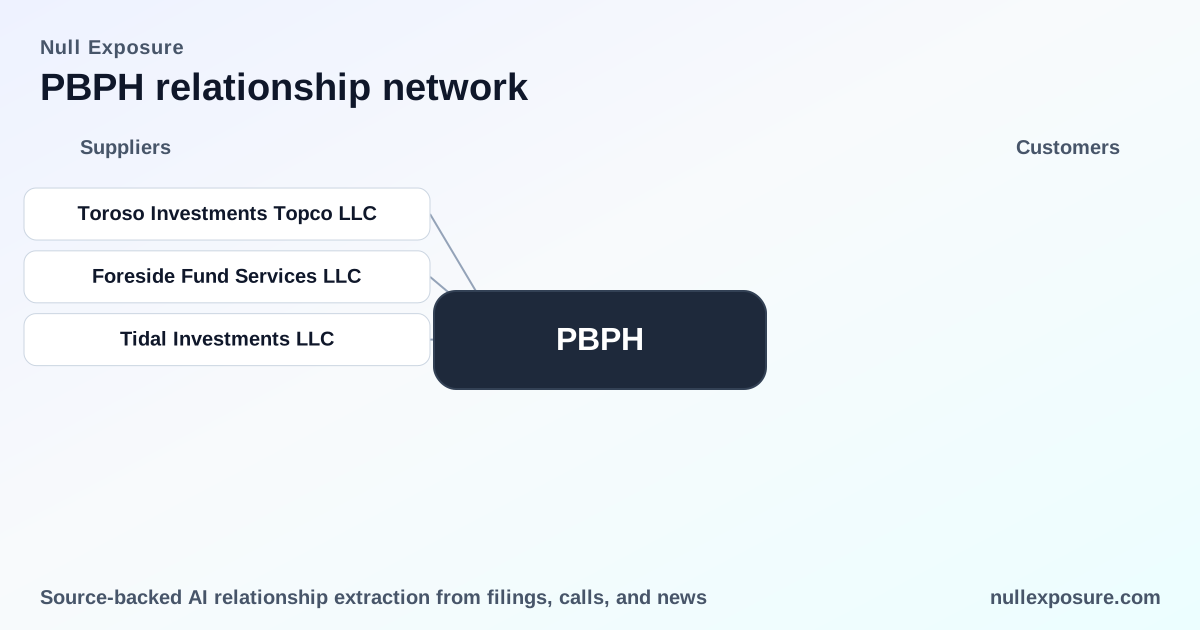
PBPH supplier relationships: who matters, how value flows, and what to watch
PBPH operates as an investment vehicle whose shares are issued, distributed, and advised through a small set of third-party firms, and the company monetizes through the standard investment-product channels — advisory/management fees and distribution fees tied to the product’s assets and share issuance. For investors and operators evaluating PBPH supplier relationships, the critical observation is structural: this is a classic fund/product operating model with clearly delegated issuer, distributor, and advisor roles, which concentrates operational dependency into a few counterparties with outsized influence on distribution, compliance, and portfolio management execution.
If you want a structured supplier risk view or ongoing monitoring, start here: https://nullexposure.com/
What the relationship map looks like in plain English
The public records available for PBPH identify three named counterparties that together cover issuance, distribution, and advisory functions. Each relationship is short and explicit in the public note reviewed; collectively they form the operational backbone of the product:
-
Toroso Investments Topco LLC — listed as the issuer of PBPH shares. According to TradingView’s NASDAQ:PBPH page (first observed March 10, 2026), “PBPH shares are issued by Toroso Investments Topco LLC.” This positions Toroso as the legal vehicle through which shares are created and formally held. (TradingView, NASDAQ:PBPH page, Mar 10, 2026.)
-
Foreside Fund Services LLC — noted as the distributor. TradingView’s PBPH page identifies “Distributor Foreside Fund Services LLC,” indicating Foreside handles placement, regulatory filing support, and possibly fund servicing tasks related to distribution and transfer agent coordination. (TradingView, NASDAQ:PBPH page, Mar 10, 2026.)
-
Tidal Investments LLC — identified as the primary advisor. The TradingView note states “Primary advisor Tidal Investments LLC,” which locates portfolio decision-making and advisory fee capture with Tidal. This is the supplier responsible for investment strategy and day-to-day portfolio management. (TradingView, NASDAQ:PBPH page, Mar 10, 2026.)
Each of the three relationships is recorded in the same public snippet and collectively describes the typical tripartite structure of an issued fund or investment product.
Why those three names matter to investors
Each named supplier plays a discrete, highly leveraged role in PBPH’s operating economics:
- Issuance (Toroso) governs legal ownership and share creation; control here affects capital structure and corporate governance levers.
- Distribution (Foreside) drives market access and investor onboarding; distribution directly impacts assets under management and recurring fee revenue.
- Advisory (Tidal) determines investment performance and therefore fee justification and client retention.
Together, these relationships are critical to product success — failure or contract disruption with any of the three would degrade monetization and market access simultaneously.
Relationship-by-relationship notes (concise)
Toroso Investments Topco LLC: PBPH shares are issued by Toroso Investments Topco LLC, making it the legal issuer and primary structural counterparty for shareholder registration and capital issuance. (TradingView, NASDAQ:PBPH page, first seen Mar 10, 2026.)
Foreside Fund Services LLC: Foreside is listed as the distributor, indicating responsibility for marketing, distribution logistics, and likely some fund administration support tied to investor servicing. (TradingView, NASDAQ:PBPH page, first seen Mar 10, 2026.)
Tidal Investments LLC: Tidal Investments is identified as the primary advisor, placing portfolio management and strategy execution — and associated advisory fees — squarely with Tidal. (TradingView, NASDAQ:PBPH page, first seen Mar 10, 2026.)
Constraints and what the absence of explicit constraints signals
There are no supplier-level contractual constraints surfaced in the reviewed records. That absence is itself a meaningful, company-level signal: publicly available materials do not flag supplier-side constraints such as exclusive long-term lockups, penalty-heavy termination clauses, or regulatory encumbrances attached to named counterparties. For operating model assessment, interpret this as:
- Contracting posture: Standard third-party engagements rather than unusually restrictive or captive contracts.
- Concentration: High concentration in three firms — issuance, distribution, and advisory are each delegated to a single named supplier, increasing single-counterparty risk despite the absence of explicit contractual constraints.
- Criticality: All three suppliers are critical to PBPH’s ability to issue shares, distribute them to investors, and manage the underlying strategy; any operational disruption would be immediately material.
- Maturity: The relationships read as established service roles rather than ad hoc vendors, but public records do not indicate multi-year tenure or proprietary integration details.
These inferences derive from the lack of explicit constraints in available reporting and the functional labels attached to the named entities.
If you want systematic monitoring of these supplier relationships and early-warning signals, access more detailed counterparty profiling at https://nullexposure.com/
Operational and investment implications
- Concentration risk is the primary supplier-level exposure. With issuance, distribution, and advisory concentrated in single counterparties, investors should demand clarity on fallback arrangements, termination triggers, and continuity plans.
- Commercial leverage is asymmetric. Distributor and advisor firms typically capture recurring fee streams; their commercial incentives directly affect asset flows and fee economics.
- Regulatory and reputational transmission is direct. Any compliance issue involving Foreside or Tidal would transmit to PBPH quickly because of how distribution and advisory roles interface with investors and regulators.
Key takeaway: the structure optimizes operational simplicity but amplifies counterparty dependence.
What to ask next — practical diligence questions
- Are there written contingency plans for advisor or distributor replacement, and what are the timelines for a seamless transition?
- What fee-split and revenue-sharing arrangements exist between the advisor and distributor, and how do they influence distribution incentives?
- What governance rights does Toroso maintain over share issuances and corporate actions?
For investor-ready monitoring, consider subscribing to continuous supplier surveillance at https://nullexposure.com/ to ensure changes to any of these named counterparties are captured in real time.
Final verdict for investors and operators
PBPH’s public supplier map is compact and conventional: issuer (Toroso), distributor (Foreside), advisor (Tidal) — a clean structure that simplifies operations but concentrates risk. For investors, the priority is not discovering additional suppliers but interrogating contractual robustness, continuity planning, and the commercial incentives that drive distribution and advisory behavior. Operators should document transition playbooks and disclose counterparty risk mitigants to preserve investor confidence.
Bold conclusion: PBPH’s monetization is effective so long as these three counterparties perform; the product’s single-point dependencies are the dominant operational risk.