Petrobras (PBR) — supplier footprint and what recent shipbuilding and charter deals mean for investors
Petrobras is Brazil’s integrated oil & gas champion: it explores and produces hydrocarbons, refines and markets fuel domestically and internationally, and captures margins through integrated operations and commodity sales. The company monetizes by selling crude and refined products, realizing refining and trading margins, and returning cash via dividends; Petrobras reported Revenue TTM of $491.4 billion and EBITDA of $191.0 billion, underscoring a high-cash-flow operating base that supports large capital programs and long-term supplier commitments.
If you evaluate supplier risk or sourcing strategy for energy portfolios, Petrobras’ recent supplier moves are a direct read on its operational cadence and capital allocation priorities. Explore a structured supplier map at https://nullexposure.com/ to align deal diligence with counterparty risk.
Recent supplier activity — why these names matter now
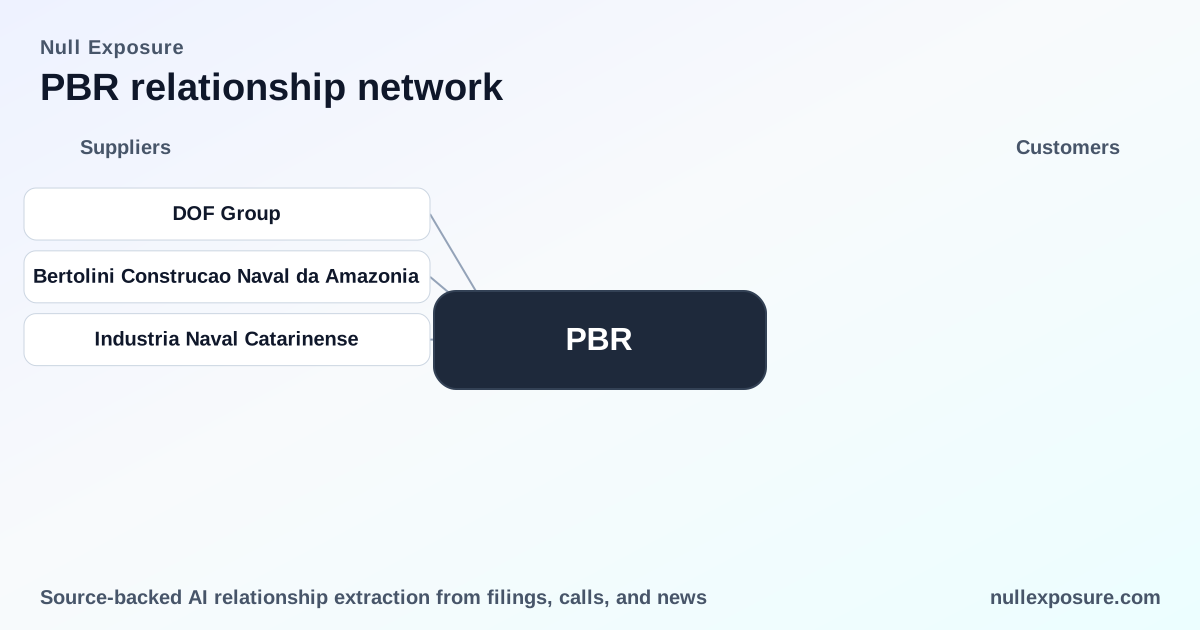
Petrobras has accelerated fleet renewal and contracted external tonnage to support offshore logistics and production expansion. The public reporting on three supplier relationships in early 2026 highlights two concurrent approaches: domestic shipbuilding under the Mar Aberto program and external charters to bridge capacity or provide flexible lift. Each relationship signals different procurement and risk-management postures.
- DOF Group: a charter partner providing immediate vessel capacity for offshore operations.
- Bertolini Construcao Naval da Amazonia: a domestic yard producing barges under a large fleet order.
- Industria Naval Catarinense: a domestic shipbuilder focused on push-boats for the same fleet program.
Together, these relationships speak to Petrobras’ mix of short-term chartering and medium-term domestic build programs — a combination that stabilizes near-term operations while securing localized industrial capacity for the medium term. For a complete supplier map and relationship-level analytics, visit https://nullexposure.com/.
DOF Group — chartered lift for offshore operations
DOF Group secured approximately $200 million in charter deals with Petrobras in Brazil, supplying chartered vessels that expand Petrobras’ operational capacity without immediate capital expenditure. This was reported in a Futunn news post on March 10, 2026. (Source: Futunn news coverage, March 10, 2026).
Bertolini Construcao Naval da Amazonia — barges under Mar Aberto
Petrobras signed a 28 billion reais fleet package under its Mar Aberto programme that includes barges produced by Bertolini Construcao Naval da Amazonia in Amazonas, indicating large-scale domestic construction commitments to support logistics and field development. IndexBox documented this fleet deal and the yard’s role in March 2026. (Source: IndexBox blog, March 2026).
Industria Naval Catarinense — push-boats for fleet renewal
As part of the same Mar Aberto fleet program, Industria Naval Catarinense in Santa Catarina was named to manufacture push-boats, reflecting Petrobras’ preference to concentrate certain craft builds with regional yards to meet specialized offshore and coastal transport needs. This was reported by IndexBox in March 2026. (Source: IndexBox blog, March 2026).
What these supplier ties reveal about Petrobras’ operating model
Petrobras’ supplier choices reflect several company-level signals that matter to investors and operators evaluating counterparty exposure and program execution.
-
Contracting posture — hybrid and staged: Petrobras is combining short-term charters (e.g., DOF Group) with multi-year domestic build programs (Mar Aberto), signaling a deliberate staging: preserve operational continuity now while securing local industrial capacity over the medium term. This reduces immediate capex strain while locking in long-term supply chain resilience.
-
Concentration and supplier mix — diversified by role: the supplier set spans international service providers for flexible lift and local yards for purpose-built assets, suggesting role-based supplier diversification rather than reliance on a single vendor class. This lowers single-vendor concentration risk but raises program management complexity.
-
Criticality — operationally essential: vessels and barges are mission-critical for offshore production and logistics; delays or quality issues translate directly to field downtime or increased operating cost, elevating supplier criticality above typical commodity supply chains.
-
Maturity of relationship and execution risk: the Mar Aberto program is a large-scale industrial initiative implying multi-year execution and local-content obligations; expect procurement timelines, delivery schedules, and political/regulatory execution to be central risk vectors for investors monitoring cash flow and project timing.
These signals stand at the company level for Petrobras and are not assigned to any single supplier unless explicitly stated in source excerpts.
Investment implications and key risks
-
Cash-flow backing for procurement: Petrobras’ scale — $491.4B revenue and $191.0B EBITDA TTM — supports sizable supplier commitments, reducing counterparty payment risk relative to smaller operators. That said, capital allocation to fleet programs competes with upstream investment and dividends.
-
Operational leverage to logistics execution: the blend of charters and local build programs reduces near-term operational risk but introduces schedule and construction risk that can affect field start-ups or cost profiles.
-
Political and localization dynamics: awarding large orders to Brazilian yards under Mar Aberto reflects strategic industrial policy alignment; investors should monitor local-content requirements, foreign-exchange exposure on contract values (reais vs. USD), and any related execution bottlenecks.
-
Supplier credit and concentration monitoring: while diversification is visible, vessel outages or delivery slippages for critical craft can translate to outsized operational impact; maintain counterparty monitoring for yards and charter operators engaged at scale.
For a deeper supplier risk profile and to benchmark the full supplier roster by category and criticality, visit https://nullexposure.com/ for mapped insights and contact options.
Practical recommendations for investors and operators
- Prioritize due diligence on schedule risk and local-content compliance for domestic build programs; these are the most likely sources of operational lag.
- Treat charter arrangements as financially flexible hedges that protect production in the near term but monitor cumulative charter cost versus owned asset economics over the investment horizon.
- Maintain scenario analyses that stress test production under delayed vessel deliveries or charter rate spikes; the exposure is operationally immediate.
Explore supplier coverage and tailored counterparty reports at https://nullexposure.com/ to align procurement intelligence with portfolio risk.
Bottom line
Petrobras is deploying a two-track supplier strategy: immediate flexibility through charters and longer-term industrial anchoring through the Mar Aberto fleet program. For investors this combination preserves short-term production resilience while embedding medium-term execution and political risks tied to domestic shipbuilding. Track execution milestones for the Mar Aberto program and charter utilization trends closely — these will be the primary drivers of near-term operational performance and supplier exposure.