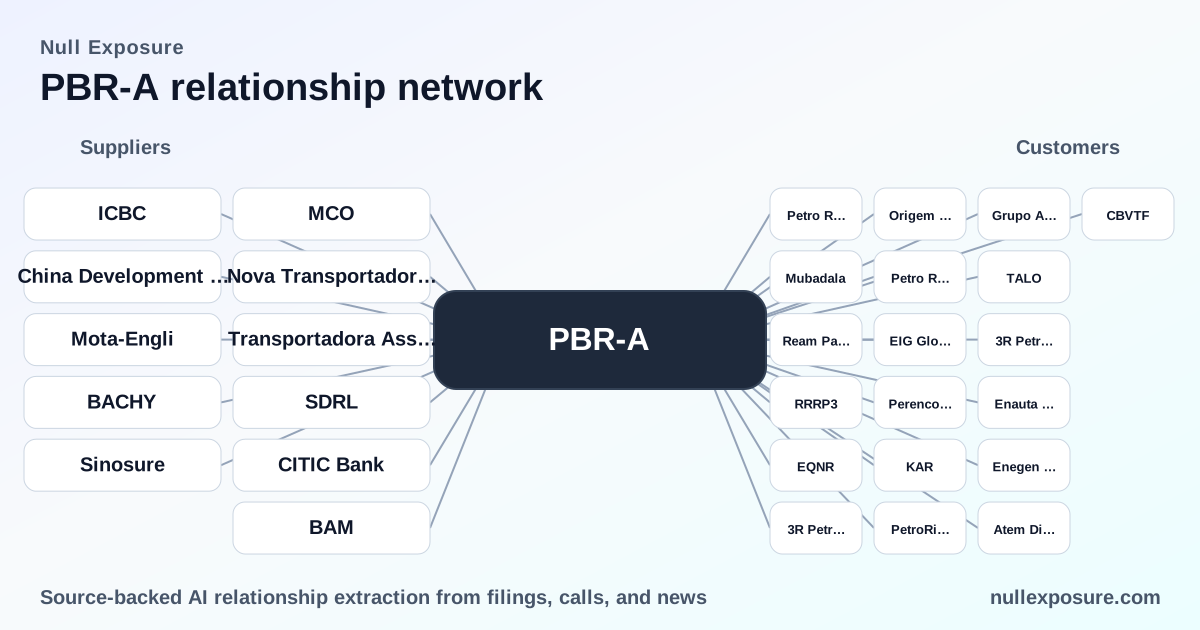
Petrobras (PBR-A) supplier map: who the company contracts with, pays, and relies upon
Petróleo Brasileiro S.A. (Petrobras) operates as an integrated oil & gas producer and refiner that monetizes through upstream production, downstream refining and sales, and long-term commercial arrangements for transport and services; the company converts very large volumes of hydrocarbon sales into free cash flow, funds capital intensity through a mix of operating cash, asset sales and external credit, and returns capital to holders via preferred dividends. For investors and operators evaluating supplier relationships, Petrobras’ counterparties reveal a mix of long-term infrastructure leases, large offshore services contracts, and strategic finance partners—each with direct implications for cost structure and execution risk.
Explore supplier intelligence and counterparty context at https://nullexposure.com/.
Why supplier relationships matter for preferred holders and operators
Petrobras is a cash-generative integrated oil company with FY2025 revenue of roughly $498 billion and EBITDA of about $208 billion, which underpins a highly leveraged contracting posture: it outsources fixed infrastructure and specialized offshore services while keeping commodity exposure on the balance sheet. That posture creates four practical constraints for counterparties and investors:
- Concentration and criticality: Petrobras’ scale makes a small number of infrastructure owners and large contractors economically critical to operations; losing access to a major pipeline or drillship would immediately raise unit costs. (Company operational footprint and pipeline leasing reporting reinforce this.)
- Maturity and fixed obligations: Long-term pipeline leases and multi-year rig contracts create predictable cost lines that persist even through commodity cycles, compressing margin flexibility when crude prices soften.
- Sourcing and geopolitical complexity: Strategic financing memorandums with Chinese banks and use of international contractors diversify funding and services but introduce cross-border political and execution risk.
- Contracting posture: Petrobras leans on third-party operators for specialized assets rather than re-integrating those assets, increasing counterparty importance for uptime and delivery.
These company-level signals are reflected across the counterparties below.
Counterparties and material suppliers — a line-by-line runthrough
Below are every supplier, contractor, financier, insurer/agency and related counterparty flagged in the source record, each summarized in plain English with the documenting source.
Moody’s — Moody’s changed Petrobras’ global credit rating outlook from positive to stable in a notice covering FY2025, signaling a reassessment of credit trajectory that affects cost of capital and counterparty perceptions. (Brazil Energy Insight, June 2025 — https://brazilenergyinsight.com/2025/06/03/petrobras-informs-about-moodys-global-rating-outlook/)
Nova Transportadora do Sudeste (NTS) — NTS, the pipeline company sold during privatization, now transports gas to Petrobras and is part of recurring pipeline rental costs the company pays after divestiture; Petrobras pays significant annual fees to external pipeline owners. (PT.org.br reporting on FY2022 privatizations — https://pt.org.br/petrobras-gasta-r-3-bi-ao-ano-para-alugar-gasodutos-que-privatizou/)
Transportadora Associada de Gás S.A. (TAG) — TAG’s pipeline assets are used by Petrobras under long-term agreements; the company is incurring roughly R$3 billion per year to access these pipelines following the sale to third parties. (PT.org.br coverage of FY2022 arrangements — https://pt.org.br/petrobras-gasta-r-3-bi-ao-ano-para-alugar-gasodutos-que-privatizou/)
Seadrill Limited — Seadrill secured multi-year contracts with Petrobras for drilling services (notably for Brazilian fields such as West Tellus and West Carina), reflecting Petrobras’ reliance on specialist offshore drillers for exploration and production capacity. (VesselFinder report on FY2021 contract awards — https://www.vesselfinder.com/news/22304-Seadrill-Limited-Announces-Contract-Awards-totalling-549m-for-the-West-Tellus-and-West-Carina-in-Brazil)
CITIC Bank — Petrobras engaged with CITIC Bank as part of a broader effort to secure Chinese financing for deepwater exploration, indicating active pursuit of non‑Western funding sources for capex. (InfoMoney reporting on FY2023 financing discussions — https://www.infomoney.com.br/mercados/petrobras-petr4-quer-que-bancos-chineses-financiem-exploracao-em-aguas-profundas-afirma-cfo/)
Brookfield — Brookfield acquired pipeline assets (e.g., stakes in NTS) and is a counterparty that Petrobras now pays for transport capacity; the arrangement implies Petrobras effectively re-rents infrastructure it once owned. (PT.org.br analysis of privatization economics FY2022 — https://pt.org.br/petrobras-gasta-r-3-bi-ao-ano-para-alugar-gasodutos-que-privatizou/)
ICBC (Industrial and Commercial Bank of China) — ICBC was among Chinese financial institutions engaged by Petrobras leadership to explore financing for deepwater projects, demonstrating Petrobras’ outreach to large state-linked lenders. (InfoMoney reporting on FY2023 meetings — https://www.infomoney.com.br/mercados/petrobras-petr4-quer-que-bancos-chineses-financiem-exploracao-em-aguas-profundas-afirma-cfo/)
China Development Bank — Petrobras signed five-year memorandums with China Development Bank during business visits, establishing a multi-year framework for potential credit facilitation and project support. (InfoMoney reporting on FY2023 memoranda — https://www.infomoney.com.br/mercados/petrobras-petr4-quer-que-bancos-chineses-financiem-exploracao-em-aguas-profundas-afirma-cfo/)
Mota-Engil — Mota-Engil secured a R$1.56 billion contract with Petrobras, representing continued reliance on large engineering and construction contractors for onshore and offshore projects. (Brazil Energy Insight, FY2025 contract notice — https://brazilenergyinsight.com/2025/06/03/petrobras-informs-about-moodys-global-rating-outlook/)
Bank of China — Bank of China is another named counterparty in five‑year financing memorandums, reinforcing Petrobras’ active engagement with Chinese state and commercial lenders for exploration financing. (InfoMoney, FY2023 business trip reporting — https://www.infomoney.com.br/mercados/petrobras-petr4-quer-que-bancos-chineses-financiem-exploracao-em-aguas-profundas-afirma-cfo/)
Sinosure — Sinosure (China Export & Credit Insurance Corporation) was part of the conversations with Petrobras leadership, indicating potential export credit insurance or support as part of Chinese financing packages. (InfoMoney coverage of FY2023 meetings — https://www.infomoney.com.br/mercados/petrobras-petr4-quer-que-bancos-chineses-financiem-exploracao-em-aguas-profundas-afirma-cfo/)
What these relationships imply for risk and return
The relationship set points to three actionable investor insights:
- Cost structure vulnerability from privatized pipelines: Paying third parties R$3 billion annually to access pipelines turns a former capital asset into a recurring operating expense, constraining margin downside protection in lower price environments (PT.org.br, FY2022). This is a structural cost risk investors must model into long-term cash flow scenarios.
- Execution dependence on large offshore contractors: Multi-hundred-million-dollar rig contracts with firms like Seadrill mean project schedules and production profiles hinge on contractor performance and availability; any contractor disruption has immediate upstream impact (VesselFinder, FY2021).
- Alternative financing and geopolitical exposure: Memorandums and discussions with China Development Bank, Bank of China, CITIC, ICBC and Sinosure broaden funding options but increase exposure to cross-border political dynamics; this affects credit pricing and strategic optionality (InfoMoney, FY2023).
Assess counterparties and covenant language closely; detailed counterparty clauses and termination triggers are the operational levers that determine how these relationships translate into cash-flow reality. For a focused counterparty risk review, visit https://nullexposure.com/ to map counterparties against your portfolio view.
Practical next steps for investors and operators
- Stress-test Petrobras cash flow with pipeline rental and contractor cost assumptions baked in; treat pipeline access fees as recurring fixed costs.
- Monitor rating agency commentary (Moody’s) for shifts in outlook that will affect Petrobras’ borrowing costs and counterparty confidence. (Brazil Energy Insight, June 2025)
- Track the execution schedules of major contractors (Seadrill, Mota-Engil) and the progress of any China-linked financing memorandums into formal facilities.
For ongoing monitoring and to integrate supplier-level signals into portfolio models, start with a supplier intelligence snapshot at https://nullexposure.com/.
Petrobras’ supplier and financing map describes a company that actively outsources capital assets and sources diversified external finance while retaining core commodity risk; that mix creates predictable operational levers—and concentrated counterparty risks—that investors must price into preferred‑stock valuations and operational counterparties must manage through contract design and contingency planning.