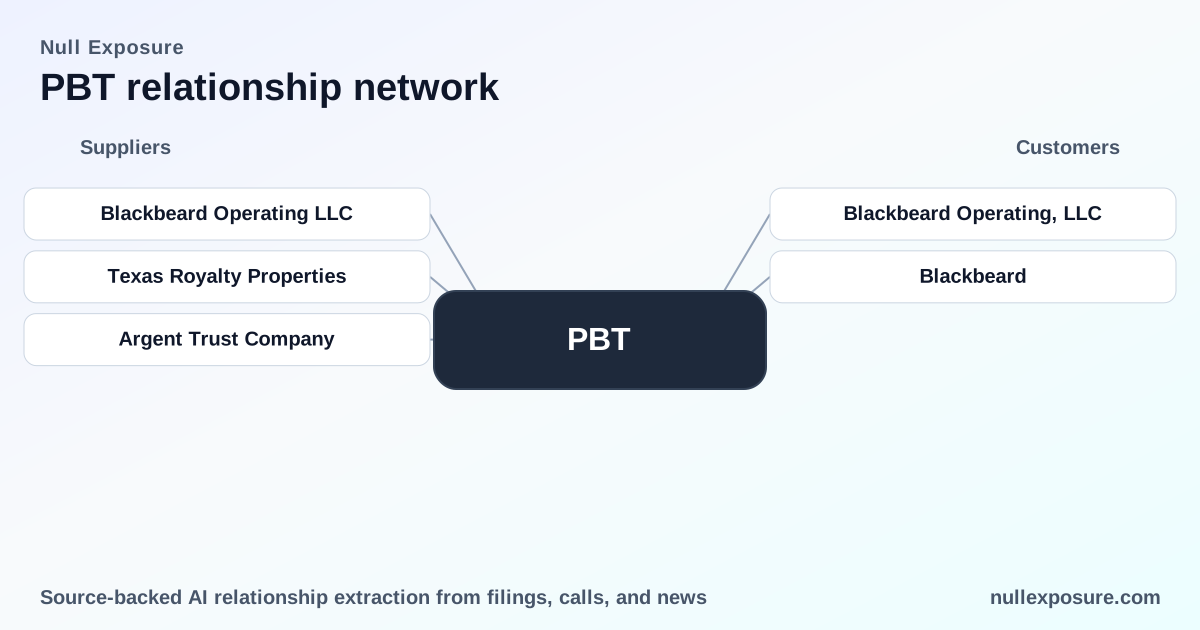
Permian Basin Royalty Trust (PBT): Supplier relationships and what they mean for cash flow stability
The Permian Basin Royalty Trust collects and distributes production-based royalties from overriding interests in Texas oil and gas properties; it monetizes by passing through operating receipts to unitholders after trustee administration and operator settlements. Revenue is driven by a small set of geographically concentrated royalty interests where a handful of counterparties — operators and property owners — determine near-term cash flow and capital activity. For investors evaluating supplier exposure, the key questions are operator competence and capital discipline, concentration of producing assets, and the contractual terms that govern receipts and trustee fees. For deeper supplier-risk signals, visit https://nullexposure.com/.
How PBT’s operating model concentrates counterparty risk
PBT’s assets are concentrated in Texas, with the Waddell Ranch overriding royalty interest and major Texas royalty properties as primary cash generators. The trust structure means PBT is a passive recipient of funds paid by operators and interest owners; those parties run production, pay royalties, and settle accounts with the Trustee. That conduit model creates two structural characteristics: (1) revenue volatility ties directly to operator performance and commodity prices, and (2) the Trustee’s administrative terms impose predictable fixed costs that dilute distributions modestly but reliably.
- Geographic concentration: All revenues originate in Texas, which influences state-level regulatory and tax exposure (no state individual income tax on receipts).
- Contract tenor: The Trust’s receipts reference long‑term crude purchase agreements and conveyances dating back decades, signaling durable contractual frameworks underpinning cash flow.
- Asset criticality: The Waddell Ranch overriding royalty is described as the Trust’s largest asset, making a small number of producing leases highly material to distributions.
Supplier snapshot — who the Trust transacts with now
Blackbeard Operating LLC
Blackbeard is the operator of record for the Waddell Ranch overriding royalty interests and is active in production and capital deployment for those properties. A March 10, 2026 distribution announcement notes that a second settlement payment from Blackbeard affected the month-over-month distribution, and trust disclosures record Blackbeard as the operator with substantial recent capital activity — the trust’s filings show roughly $109 million of gross capital expenditures tied to the Waddell Ranch through November 2024. (Source: March 10, 2026 distribution release on Yahoo Finance; trust quarterly reports referenced in company filings.)
Texas Royalty Properties
Texas Royalty Properties is a large interest owner under PBT’s net profits/overriding royalty structure and contributed 95% NPI on certain underlying properties; the same March 2026 distribution release quantified Texas Royalty Properties’ net contribution to a monthly distribution as $766,506. That contribution demonstrates the direct link between individual interest owners’ production volumes and the Trust’s cash flow. (Source: March 10, 2026 distribution release on Yahoo Finance.)
Argent Trust Company
Argent Trust Company is identified as the Trust’s trustee. Public financial summaries and market pages list the Permian Basin Royalty Trust as a trust of Argent Trust Company, which is the legal entity that receives and distributes royalty income under the Trust Indenture. (Source: company profile referenced on Finviz, March 2026.)
Constraints that shape contracting posture and counterparty risk
The relationship evidence yields actionable operating-model constraints that investors should weigh alongside the supplier roster:
- Long-term contracting posture (company-level signal): The Trust’s revenue language references pipeline connections and long-term crude purchase agreements, and the original conveyance dates to 1980, indicating legal permanence in the royalty structure and long-tenor of sales contracts. This reduces counterparty turnover risk but does not immunize cash flow from commodity or operational shocks.
- Geographic concentration in Texas (company-level signal): All revenues originate from Texas properties; state-level continuity lowers tax and regulatory complexity but increases exposure to basin-level supply/demand and regional infrastructure constraints.
- Materiality of key asset (company-level signal): The Waddell Ranch overriding royalty is documented as the Trust’s largest asset, meaning operator performance on that lease materially drives distributions.
- Trustee economics (company-level signal): Under the Trust Indenture the trustee is entitled to a predictable administrative fee schedule that reduces distributions by a fixed component (trustee fee example noted as ~$122,730 in a recent period).
- Operator as service provider and active counterparty (Blackbeard-specific): Blackbeard is explicitly referenced as operator and an active service provider to PBT; the trust describes contractual duties for prudent operation and records substantial capex undertaken by Blackbeard (c. $109 million gross Jan–Nov 2024), which both supports production growth and concentrates execution risk on a single operator.
Investment implications and risk checklist
PBT’s cash flow profile is simple to model but sensitive to a small number of operational inputs. For investors and operating partners, the thesis breaks down into crisp items:
- Concentrated counterparty exposure: Because the Waddell Ranch and a small set of owners dominate receipts, operator execution (Blackbeard) and owner contributions (Texas Royalty Properties) directly map to distributable cash. Monitor operator reports and settlement timing closely.
- Predictable administrative drag: Trustee fees and the trust’s pass-through mechanics make distributions transparent; administrative spend is modest but recurring and should be factored into yield forecasts.
- Capital intensity and timing: The $109 million of capex reported for Waddell Ranch (Jan–Nov 2024) signals operator-led growth investment that supports future volumes but concentrates execution and capital-return risk on the operator’s ability to convert capex into incremental free cash for the Trust.
- Commodity sensitivity with contractual backstops: Long-term sales arrangements reduce price execution risk for transported volumes, but revenues still move with realized oil and gas prices and monthly settlement flows.
For a practical next step, review the March 2026 distribution statements and operator quarterly reports to reconcile capex timing against production receipts; for supply-side risk monitoring and counterparty analytics, see https://nullexposure.com/.
Trading and monitoring checklist for operators and research teams
- Track monthly settlement notices and the Trustee’s distribution commentary to catch operator settlements that drive volatility.
- Watch Blackbeard’s public disclosures and capital program updates; capex and timing are the dominant operational levers.
- Reconcile contributions from large interest owners such as Texas Royalty Properties on an ongoing basis to model short-term cash flows.
If you want consolidated monitoring of operator settlements, trustee fees, and capex exposure for PBT and similar structures, visit https://nullexposure.com/ to set up tailored alerts.
Bottom line
Permian Basin Royalty Trust is a high‑visibility, pass‑through royalty vehicle whose distribution profile is highly concentrated by geography and assets and dominated operationally by Blackbeard Operating LLC and large interest owners like Texas Royalty Properties, with Argent Trust Company serving as trustee. The combination of long-term contracts, concentrated assets, and recent large operator capex creates an investment case that is straightforward to model but requires active monitoring of operator settlements and capital execution. For ongoing supplier-risk monitoring and to integrate these signals into an investment workflow, start at https://nullexposure.com/.