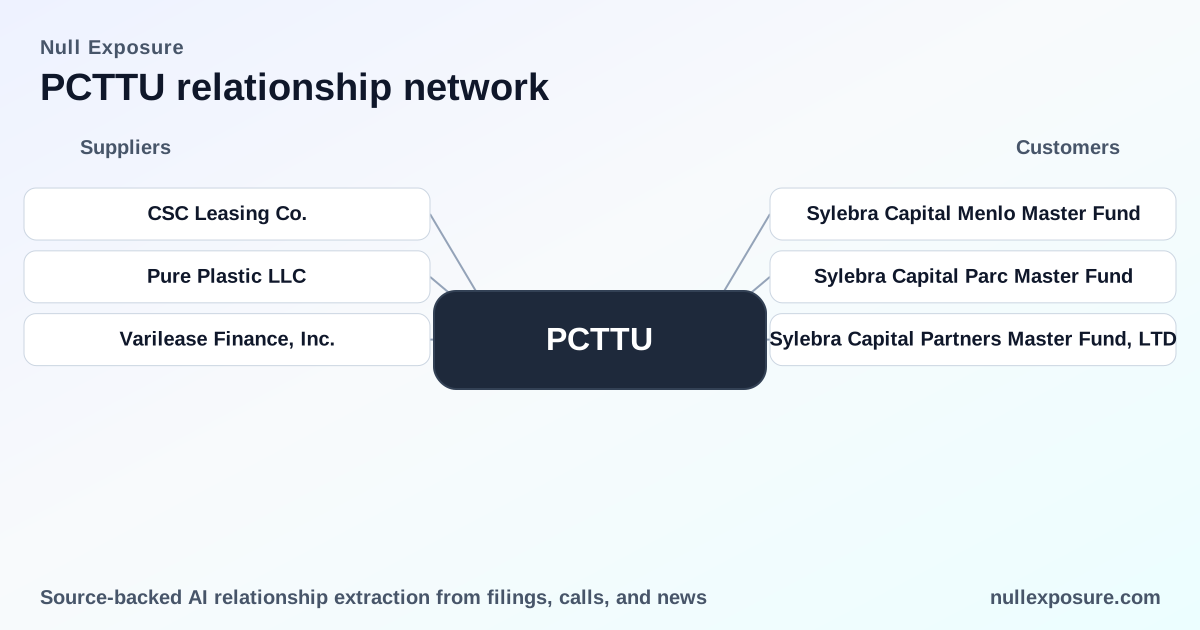
PCTTU: Supplier relationships that underpin PureCycle’s capital and feedstock strategy
PureCycle Technologies operates a capital- and asset-intensive recycling business that converts polypropylene waste into recycled polypropylene (rPP) and sells that resin into industrial channels. The company monetizes through sale of rPP produced at its Feed PreP and purification facilities, while financing the required plant and equipment with a mix of equipment leases and structured debt; revenue remains limited and operating losses persist as ramp and capital-service obligations take priority. Investors should view PureCycle as a production-constrained recycler whose economics are driven as much by financing arrangements and equipment uptime as by resin demand and feedstock sourcing.
Learn more about supplier exposure and counterparty risk at https://nullexposure.com/.
Why these supplier relationships matter for valuation and operational risk
PureCycle’s supplier and financing counterparties are not minor vendors — they are the conduits for equipment delivery, progress funding, and term debt that let plants run. The FY2024 disclosures show a mix of long-term equipment leases, financed equipment purchases, and a direct term lender, which creates a layered capital structure that intersects with near-term cash outflows.
- Contracting posture: The company uses longer-dated equipment leases and multi-year land agreements to deploy capital while preserving liquidity. The CSC lease language explicitly defines a 36‑month lease schedule tied to equipment acceptance, indicating structured, defined payment obligations.
- Concentration and criticality: Equipment lessors and a single term lender carry outsized importance; if financing or lease schedules are disrupted, plant commissioning and production are at risk.
- Maturity profile: Company filings report material debt service and equipment finance payments of roughly $66.2 million due within one year of the FY2024 balance sheet, signaling a near-term liquidity focus and moderate-to-high short-term cash strain.
- Operational maturity: The firm moved from development to early commercial operations in late 2024 with a Feed PreP facility in Denver, Pennsylvania, indicating the company is in early commercialization rather than mature cash generation.
These are company-level signals derived from PureCycle’s FY2024 disclosures — they describe how the business sources and pays for critical equipment and land, not just the existence of vendors.
Counterparty summaries — what each relationship means in plain English
CSC Leasing Co.
PureCycle’s indirect subsidiary entered a Master Lease Agreement with CSC to have CSC finance, acquire and/or purchase equipment from vendors so CSC can lease that equipment back to the company; the lease schedule contemplates a 36‑month lease that begins on equipment acceptance, signaling a structured medium-term financing relationship. According to PureCycle’s FY2024 Form 10‑K, this arrangement is part of the company’s equipment funding strategy and reflects long‑term lease commitments tied to plant commissioning.
Pure Plastic LLC
Pure Plastic LLC acts as lender, administrative agent and security agent for a $40.0 million Term Loan Facility executed May 8, 2023, which provides the company with on-balance-sheet term debt to support capital needs. This loan is disclosed in PureCycle’s FY2024 10‑K as a core element of the firm’s debt profile and a direct source of liquidity for construction and commissioning.
Varilease Finance, Inc.
PureCycle entered a master lease with Varilease Finance, Inc. (VFI) for equipment financing, with progress funding of $7.6 million recorded in 2024, representing another conduit for equipment delivery financing and short‑term cash flow support. The FY2024 10‑K describes the arrangement as equipment financing under a master lease dated June 24, 2024, used to accelerate plant buildout and equipment acceptance.
(Each of the above relationships is sourced to PureCycle’s FY2024 Form 10‑K disclosures.)
What the constraints say about operating risk and capital intensity
PureCycle’s disclosures were parsed for contractual signals that shape supplier exposure. Key company-level signals are:
- Long-term contracting posture for equipment financing where explicit lease terms (e.g., 36 months for CSC) lock in payment schedules and reduce optionality post-delivery.
- Government counterparty involvement in the form of a land lease with The Development Authority of Augusta, Georgia (AEDA) for the Ironton facility, which indicates strategic public‑private ties for site development and non‑dilutive land access as part of Phase One construction.
- North America as an operating geography, with Feed PreP capacity aligned to support U.S. operations and future export ambitions to Europe and Asia.
- Supplier role for feedstock sourcing, with the company both purchasing pre‑sorted polypropylene and feeding non‑sorted waste through its own Feed PreP facilities — a hybrid procurement/sorting model that reduces reliance on any single feed supplier.
- Service‑provider relationships are material: multiple master leases and equipment financiers provide funding and equipment services rather than pure consumable supply.
- Active relationship stage: at least one Feed PreP facility began operating in October 2024, moving the firm into early production and active supplier engagements.
- Spend bands: disclosed near‑term debt service and equipment finance obligations (
$66.2M) suggest material annualized spend with capital service in the $10m–$100m band, while smaller capital commitments ($5.0M) indicate additional $1m–$10m exposure categories.
These constraints together depict a capital-intensive operator with concentrated counterparty exposure and near-term liquidity obligations that are central to operational delivery.
Key risk and opportunity checklist
- Risk — financing concentration: Equipment lessors and the single $40M term lender are critical to plant completion and service; disruption elevates operational risk.
- Risk — short-term cash stress: ~$66.2M in debt and equipment payments due within a year creates a refinancing and cash‑flow priority that weighs on discretionary spend and margins.
- Opportunity — vertical feedstock control: Owning and operating Feed PreP facilities reduces feedstock sourcing risk and supports offtake commitments as production scales.
- Opportunity — public partnerships: AEDA land lease for Ironton provides a predictable development platform and can de‑risk site availability and permitting.
For an investor evaluating supplier-side counterparty risk, these are the structural points that drive valuation sensitivity.
If you want deeper supplier exposure mapping or to track counterparty maturity cliffs and payment flows, start with a focused supplier audit at https://nullexposure.com/.
Bottom line and next steps for investors
PureCycle’s economics are governed as much by its financing and lease relationships as by demand for recycled polypropylene. The financing stack — equipment lessors, a $40M term loan, and progress funding arrangements — is central to the company’s ability to convert capacity into revenue, and the FY2024 filings make clear that near‑term debt service is a priority. Investors should treat supplier counterparties as strategic partners: their contracts define production timing, cash flow cadence, and downside exposure.
For investors and operators wanting continuous monitoring of these supplier contracts and the cash‑service implications, review supplier profiles and alerts at https://nullexposure.com/.