Pearl Diver Credit Company (PDCC): supplier relationships and what they signal for investors
Pearl Diver Credit Company (PDCC) underwrites and originates specialized credit exposures to the marine and shipping sector and packages those exposures into investment products for institutional investors. The firm monetizes through credit interest income and structured financing fees while outsourcing portfolio management and capital markets execution to external partners — an arrangement that concentrates execution risk in a small set of suppliers and underwriters. For investors, focus on advisory alignment, underwriting concentration, and the company's public markets access will drive valuation rehypothecation and activation of liquidity. Learn more about supplier monitoring at https://nullexposure.com/.
How PDCC structures its supplier network and what that implies
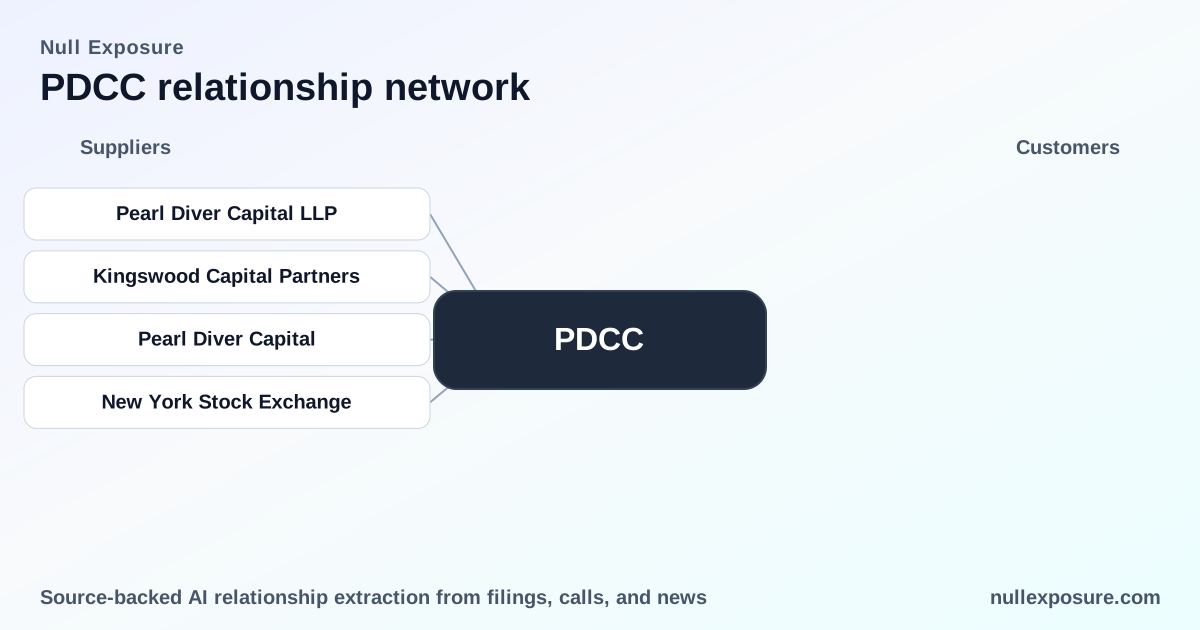
PDCC is a small-cap, NYSE-listed manager with a narrow set of external relationships that are central to its operating model. The company delegates investment advice to Pearl Diver Capital/Pearl Diver Capital LLP and relied on Kingswood Capital Partners as the sole bookrunner for its market debut, while the NYSE provides the public market distribution channel. That architecture implies a contracting posture that is advisory-heavy (outsourced portfolio management), high counterparty concentration, and operational criticality concentrated in a few named partners.
Company-level signals reinforce the supplier risk profile: PDCC lists a market capitalization of roughly $106.5 million and a trailing P/E of 25.66 with median forward leverage implied by a Forward P/E of 5.19, and insider ownership above 62%, which points to strong founder/controller influence over strategic supplier appointments. The company has no recorded supplier constraints in the reviewed records, which functions as a neutral signal on contractual restrictions but increases the importance of qualitative diligence on supplier contracts and service-level commitments.
If you want a concise supplier risk snapshot for PDCC, visit https://nullexposure.com/ for tailored coverage.
Contracting posture and maturity
- Contracting posture: Advisory-led, with the adviser(s) holding delegated discretion and execution responsibilities.
- Concentration: High — a single named bookrunner for the IPO and a single adviser entity dominate the supplier list.
- Criticality: Material — loss or change of the adviser or bookrunner would materially affect origination and capital markets access.
- Maturity: Public since mid-2024, PDCC is an early-stage listed entity with a short public track record and concentrated supplier footprint.
Counterparty-by-counterparty — what the record shows
Pearl Diver Capital LLP (adviser)
Pearl Diver Capital LLP is identified as the company's adviser, which implies the firm is outsourcing investment decision-making and portfolio management to an affiliated or related advisory entity. According to an Intellectia AI news analysis dated March 10, 2026, the filing states that "Pearl Diver Capital LLP is the adviser of the Company" (https://intellectia.ai/news/stock/pearl-diver-credit-q4-earnings-report-analysis).
Pearl Diver Capital (investment adviser)
The company also references Pearl Diver Capital as its investment adviser, indicating either a corporate variation of the adviser name or a related adviser slot performing the investment advisory mandate. Alternatives Watch reported on July 25, 2024 that "Pearl Diver Capital is the investment adviser" in coverage of PDCC's market debut (https://www.alternativeswatch.com/2024/07/25/pearl-diver-credit-company-begins-trading-nyse-invest-equity-clos/).
Kingswood Capital Partners (sole bookrunner for the offering)
Kingswood Capital Partners acted as the sole bookrunner for PDCC's offering, concentrating capital markets execution and underwriting into a single counterparty for the IPO process. Alternatives Watch noted on July 25, 2024 that "Kingswood Capital Partners is acting as the sole bookrunner for the offering," which signals concentrated execution risk for future equity issuances (https://www.alternativeswatch.com/2024/07/25/pearl-diver-credit-company-begins-trading-nyse-invest-equity-clos/).
New York Stock Exchange (listing venue)
PDCC debuted on the New York Stock Exchange and trades under the ticker PDCC, establishing its primary liquidity venue and disclosure regime. Alternatives Watch coverage from July 25, 2024 recorded that "Pearl Diver Credit Company debuted in the public markets last week, trading on the New York Stock Exchange under the ticker PDCC" (https://www.alternativeswatch.com/2024/07/25/pearl-diver-credit-company-begins-trading-nyse-invest-equity-clos/).
What these supplier linkages mean for investors
The supplier map is compact and functionally critical: advisory services and capital markets access sit with named third parties, and that structure shapes PDCC’s execution risk and growth trajectory. Key investor implications:
- Concentration risk is real. A single adviser structure and sole bookrunner for the IPO imply that negotiation leverage and operational continuity depend on a small group of counterparties.
- Execution and credibility are outsourced. The firm’s ability to scale originations and to access follow-on capital will be governed by the appetite and capacity of its adviser and underwriter relationships.
- Insider control amplifies strategic stability but reduces governance diversification. High insider ownership (62.706%) aligns founders with outcomes but also concentrates decision-making about supplier selection.
Investors should track any changes in advisory contracts, underwriting arrangements for future raises, and public disclosures tied to adviser compensation or exclusivity. For a deeper read on supplier exposure and structured-credit counterparties, visit https://nullexposure.com/.
Bottom line — where the risk and opportunity meet
PDCC’s model offers exposure to a specialized maritime credit franchise with the economics of a credit originator plus the scaling potential of public equity, but that upside is tightly coupled to the performance and continuity of a narrow supplier base. Key risks: supplier concentration, dependency on a single bookrunner for capital raises, and limited public operating history. Key operational strengths include clear alignment of advisers with the firm’s strategy and the visibility that comes with an NYSE listing.
Active investors should prioritize monitoring adviser agreements, any new underwriters engaged for follow-on capital, and the company’s disclosures around fee arrangements. For subscription-grade supplier monitoring and tailored counterparty intelligence, see the coverage available at https://nullexposure.com/.