PDD Holdings: supplier map, operating constraints, and what investors should price in
PDD Holdings operates a large Chinese e‑commerce platform and monetizes through merchant services, advertising, and ancillary fees tied to payments and logistics; the company relies on third‑party partners for audit assurance, payment processing and logistics that directly influence cost structure and regulatory exposure. For investors and operators, the interplay between PDD’s platform economics and these supplier relationships determines margin durability, regulatory risk, and operational continuity. Learn more about the supplier intelligence and how it fits into risk workstreams at https://nullexposure.com/.
Why suppliers drive the thesis on margins and risk
PDD’s core margin profile is not purely a function of marketplace GMV; payments, logistics and assurance are where fixed operating leverage meets variable supplier cost. The company outsources critical functions: audit and accounting assurance, clearance and settlement of payments, and parcel logistics for its cross‑border arm TEMU. Those outsourced relationships create both optionality (scalable cost-per-transaction models) and single‑point exposures where pricing, regulatory changes, or reputational events can move operating margins quickly.
From an investor research perspective, key operating characteristics are clear: contracting posture is vendor‑dependent on mission‑critical partners; concentration risk exists where payments routing and major logistics providers are involved; maturity of relationships is mixed (longstanding auditor vs. commercially evolving logistics/payment arrangements); and criticality is high because payments and delivery are core to user experience and cash flow conversion. The supplier scan returned no contract‑level constraints for PDD, which itself is a company‑level signal on available public disclosures and third‑party reporting (see constraints discussion below).
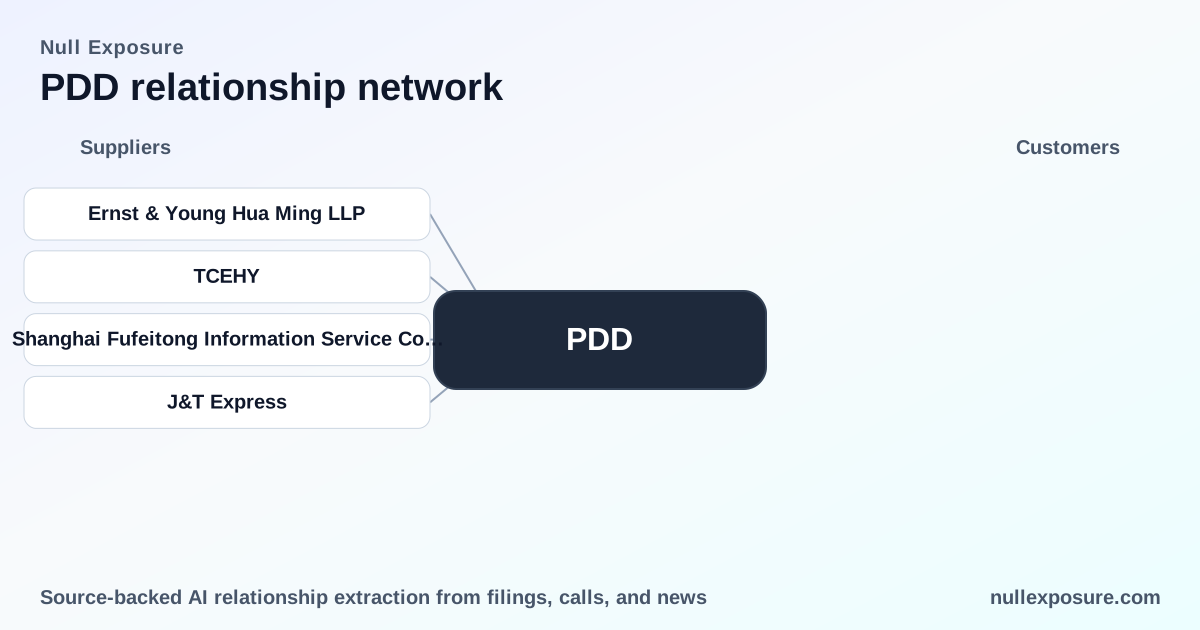
The four supplier relationships investors must track
Ernst & Young Hua Ming LLP — the external assurance anchor
Ernst & Young Hua Ming LLP has served as PDD’s external auditor since the company went public in 2018; that long‑standing engagement is a governance signal for audit continuity and reporting quality. (Source: Grizzly Reports, March 10, 2026.)
Takeaway: Audit continuity reduces a short‑term reporting shock risk, but ongoing scrutiny of audit quality and workpapers remains a core governance metric for investors.
Tencent Group — payment routing and a cut of processing
PDD routes certain payment services through Tencent, which, according to reporting, collects a 0.6% commission fee on payment processing for PDD’s platform. This is a recurring revenue leak by design: a small fee per transaction that aggregates into material cost as volume scales. (Source: Grizzly Reports, March 10, 2026.)
Takeaway: Payment economics are outsourced and priced per transaction; small basis‑point shifts at scale affect margins materially.
Shanghai Fufeitong Information Service Co., Ltd. — a payment cooperation partner
In April 2020 PDD’s VIE subsidiary entered a business cooperation agreement with Shanghai Fufeitong to collaborate on payment services, technical resources and related professional areas, embedding local clearing relationships into the VIE structure that underpins PDD’s Chinese operating footprint. (Source: Grizzly Reports, March 10, 2026.)
Takeaway: Local payment partners are integral to PDD’s Chinese settlement chain, exposing the company to regional payment regulation and operational dependencies.
J&T Express — logistics provider for TEMU and price exposure
TEMU’s parcel economics flow through J&T Express, with reported current payments of $9–$10 per parcel and an assertion that J&T’s planned IPO creates a clearing event that will allow the carrier to raise prices materially. Logistics pricing is a direct lever on gross margins for cross‑border commerce. (Source: Grizzly Reports, March 10, 2026.)
Takeaway: Logistics contract pricing is a lever that can compress TEMU margins rapidly if carriers reprice after corporate events like an IPO.
What the absence of documented constraints signals
The supplier constraints scan returned no explicit constraints for PDD’s supplier relationships. This absence is itself informative: at the company level it signals that no public contractual encumbrances, supplier exclusivity clauses, or regulatory‑imposed restrictions were surfaced in the supplier‑scope scan. For investors, that translates into two operational messages:
- There are public disclosure gaps around detailed contract terms; counterparties and pricing are visible only through piecemeal reporting and disclosures.
- The firmness of supplier commitments (duration, termination rights, change‑of‑control protections) is not in the public record, increasing the value of active counterparty diligence.
These are company‑level signals about disclosure completeness and sourcing risk rather than relationship‑specific legal facts.
Mid‑analysis: what to monitor next
Investors and operators should maintain a short list of monitoring items tied to these suppliers:
- Payment routing fees and any renegotiation with Tencent or changes in clearing partners that change unit economics.
- Contract renewal timelines and commercial terms with Shanghai Fufeitong that could shift settlement risk.
- J&T Express pricing sensitivity and contract terms ahead of, or following, any IPO or corporate action.
- Audit independence, reporting scope and any regulatory feedback around Ernst & Young Hua Ming given the centrality of audit in investor trust.
For direct supplier intelligence and ongoing alerts, visit https://nullexposure.com/ to see how structured supplier signals feed into risk dashboards.
Investment implications and practical actions
PDD’s business model scales rapidly on low unit economics; that model is profitable only if supplier costs remain stable or decline with volume. Investors should price in scenario downside where:
- Payment commissions rise or routing changes increase settlement costs, compressing take‑rate equivalent profits.
- Logistics repricing shocks occur after carrier corporate events, materially reducing TEMU gross margins.
- Audit or regulatory scrutiny intensifies, which could affect disclosure timelines and investor confidence.
Operators building contracts with PDD should insist on durable service‑level agreements, cap escalation clauses in logistics contracts, and visibility into payment routing economics. Investors should require periodic supplier disclosures and incorporate supplier stress tests into valuation sensitivity.
Bottom line and next steps
PDD’s supplier profile is a decisive part of its operating risk: payments and logistics are mission‑critical, outsourced functions where small cost shifts scale into large P&L movements; audit continuity is a governance stabilizer; and public disclosures leave contractual detail thin. Active monitoring of Tencent payment fees, Shanghai Fufeitong cooperation terms, J&T Express pricing, and audit developments is essential to price PDD correctly.
For an operationalized supplier view and to integrate supplier signals into investor workflows, see the engagement options and research tools at https://nullexposure.com/. Revisit supplier clauses and pricing assumptions in your model and prioritize counterparties listed here in due diligence and scenario analyses.