Pro‑Dex (PDEX): Supplier Footprint and the Strategic Move to In‑House Machining
Pro‑Dex designs, develops and manufactures powered surgical instruments for medical device OEMs and monetizes through product sales and contract manufacturing services; recent moves show a deliberate push to internalize critical component supply and extend engineering services capability. Investors should treat the company’s supplier strategy as a mix of vertical integration (to protect margins and delivery) and selective external partnerships for specialized engineering talent. Explore more company-level signals on supplier relationships at https://nullexposure.com/.
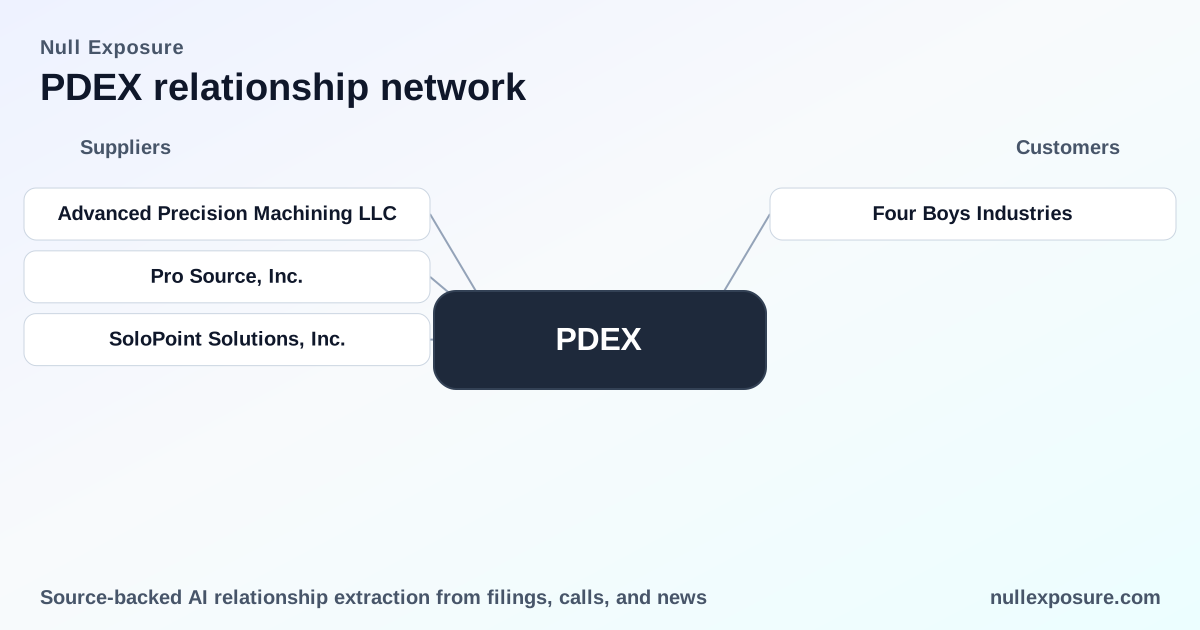
The acquisition that changes the supply map: Advanced Precision Machining
Pro‑Dex completed the acquisition of Advanced Precision Machining LLC (APM) on February 9, 2026, bringing a long‑standing machined‑components supplier in‑house for approximately $8.65 million. The deal was funded largely with a $6.65 million term loan from UMB Bank plus a subordinated seller note, and APM already produced several of Pro‑Dex’s machined sub‑assemblies, which materially reduces external dependency for those parts. According to a press release reported by The Globe and Mail (FY2026), the transaction converts a supplier relationship into a wholly owned manufacturing capability and directly supports supply continuity for mission‑critical assemblies. Source: The Globe and Mail / Pro‑Dex press release (reported March 10, 2026) — https://www.theglobeandmail.com/investing/markets/stocks/PDEX-Q/pressreleases/216625/pro-dex-completes-acquisition-of-advanced-precision-machining/
Engineering partners that shaped capacity: Pro Source and SoloPoint
Pro Source, Inc. — Pro‑Dex named Marvin Gidney to lead a newly launched Engineering Services Division and noted that Gidney previously served as a Branch Manager for Pro Source, a staffing and consulting firm that supplied mechanical engineering and product development resources. This is evidence that Pro‑Dex has historically leaned on specialist staffing providers for engineering breadth and on‑site support. Source: Pro‑Dex press release on PR Newswire (FY2014) — https://www.prnewswire.com/news-releases/pro-dex-inc-announces-launch-of-engineering-services-division-281494841.html
SoloPoint Solutions, Inc. — The same 2014 announcement records that Marvin Gidney was co‑owner of SoloPoint Solutions, another specialist in engineering sales and consulting; Pro‑Dex’s decision to internalize an engineering services division tracks a longer history of relying on niche recruitment/consulting relationships to fill technical capacity. Source: Pro‑Dex press release on PR Newswire (FY2014) — https://www.prnewswire.com/news-releases/pro-dex-inc-announces-launch-of-engineering-services-division-281494841.html
What the relationships collectively tell investors about Pro‑Dex’s operating model
- Contracting posture: The company is shifting from an outsourcer/customer posture for critical machined parts to an owner/operator posture via acquisition. This is a deliberate move toward greater control over lead times and quality on assemblies that are integral to finished instruments.
- Concentration and criticality: Machined sub‑assemblies were previously sourced from a small number of suppliers; acquiring APM reduces concentration risk for those components and elevates their internal criticality to the manufacturing organization.
- Maturity of relationships: The narrative shows long‑standing supplier ties (APM described as “long‑standing”) and multiyear use of specialist engineering firms, indicating mature, historically embedded supplier relationships rather than transactional spot buying.
- Commercial impact: Verticalization supports margin protection and timing control, but also increases balance sheet leverage short term (the acquisition required new debt financing). The funding posture is visible in the $6.65 million term loan from UMB Bank and a seller note tied to the $8.65 million purchase price. Source: The Globe and Mail / Pro‑Dex press release (FY2026) — https://www.theglobeandmail.com/investing/markets/stocks/PDEX-Q/pressreleases/216625/pro-dex-completes-acquisition-of-advanced-precision-machining/
Company‑level constraint signals investors should factor in
- Active supplier relationships: Management stated, “We do not intend to terminate any such relationship at this time, nor does management have knowledge that any supplier or manufacturer intends to terminate its relationship with us,” which is a company‑level commitment to continuity across the supplier base. Confidence: 0.80 (relationship_stage: active).
- Supplier spend band: Independent evidence extracted from supplier spend lines shows multiple suppliers with annual spend figures in the low‑millions (examples: $7,018; $4,554; $4,192 recorded under Supplier 1/2/3 sample lines), supporting a company‑level spend band of $1m–$10m for many supplier relationships. Confidence: 0.90 (spend_band: 1m_10m).
- Implication: These constraints signal moderate supplier spend concentration and active, ongoing supplier contracts, which rationalizes the economics of bringing a key supplier in‑house if it reduces variable cost and delivery risk across that $1m–$10m spend band.
Financial context and implications for bond/equity holders
Pro‑Dex’s latest trailing metrics show Revenue TTM of $72.1 million and Market Capitalization around $161.9 million, with operating margin near 17.5% and net profit margin approximately 15.7%. The APM acquisition is a targeted, capital‑efficient verticalization intended to defend operating margins while improving supply resilience. The acquisition increases leverage modestly via a $6.65 million term loan, but the company’s 2025 metrics (EBITDA ~$12.6 million) provide headroom for servicing that debt while preserving operating flexibility. Use these facts to balance the near‑term financing dilution against longer‑term margin protection. (Company financials: FY2025 latest quarter metrics and trailing twelve months.)
Explore deeper supplier signals and strategic context at https://nullexposure.com/ — stay informed on how supplier moves change enterprise risk and valuation.
Risk and opportunity: what to watch next
- Operational integration risk: Bringing a supplier in‑house accelerates control but creates integration, facility, and people management responsibilities that were previously external.
- Balance sheet and funding discipline: The acquisition structure (term loan + seller note) signals willingness to use leverage for strategic supply chain moves; monitor covenant and cash flow coverage in upcoming quarters.
- Reinvestment versus outsourcing tradeoffs: Pro‑Dex’s launch of an internal Engineering Services Division—building on relationships with firms like Pro Source and SoloPoint—signals a sustained investment in internal capability rather than recurring external consulting spend; this improves IP capture and product development cadence but raises fixed‑cost leverage.
Bottom line: tighter control, modest capital intensity, clearer supply visibility
Pro‑Dex is converting a strategic supplier into an internal manufacturing asset while formalizing engineering capability that was historically supplied by niche firms. That combination reduces external supplier concentration for machined sub‑assemblies, defends margins, and increases operational control, at the cost of modest incremental leverage and integration risk. Investors should track execution on APM integration, the company’s cash flow coverage of the new term loan, and whether in‑house engineering reduces external consulting spend over the next 12–18 months.
For investors and operators tracking supplier exposure and material operational moves, review the full Pro‑Dex supplier timeline and signals at https://nullexposure.com/. If you want a deeper supplier risk briefing or ongoing monitoring, start here: https://nullexposure.com/.