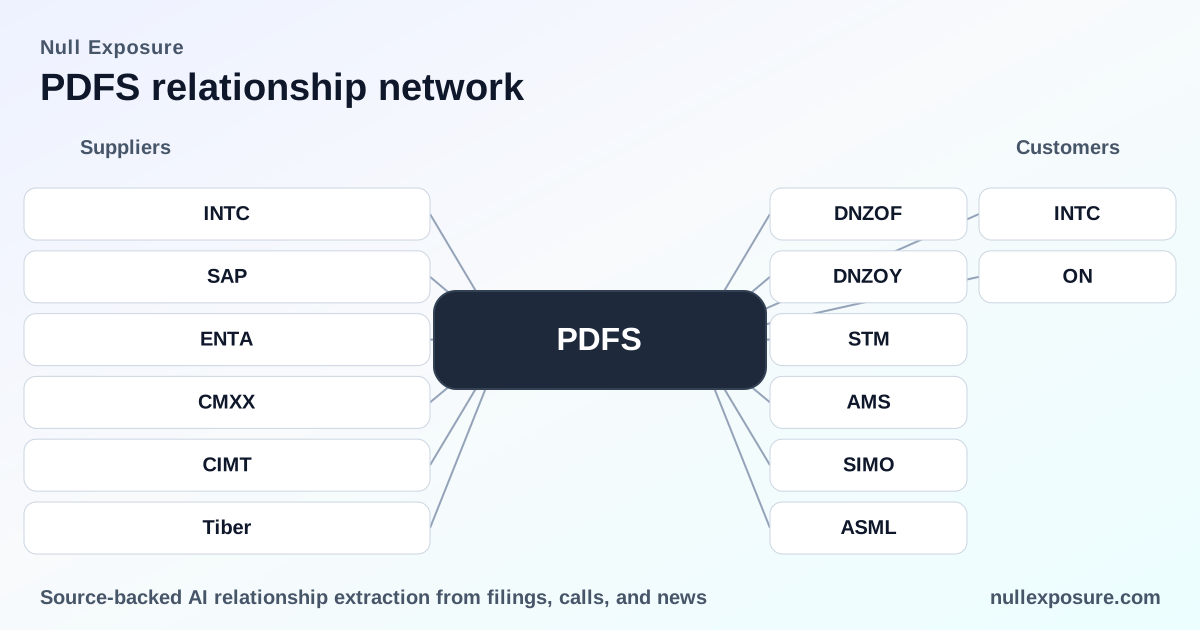
PDF Solutions (PDFS) — supplier footprint and what it means for investors
PDF Solutions sells software, analytics and supporting hardware to semiconductor manufacturers and equipment vendors, monetizing through a mix of software licenses (Exensio and Exensio Studio AI), volume-based runtime licenses, and professional services tied to its eProbe measurement systems and analytics subscriptions. Revenue is driven by platform adoption in fabs and volume-based runtime fees, while growth hinges on partnerships and licensed third‑party IP such as AI tooling and factory connectivity stacks. For investors evaluating supplier relationships, the critical question is how dependent PDFS is on external, specialized providers for core product functionality and how that affects execution risk and negotiating leverage. Explore more company signals at https://nullexposure.com/.
Why suppliers matter to PDF Solutions’ economics
PDF Solutions’ product set is a hybrid of proprietary software (Exensio), licensed code (recently Tiber AI Studio), physical measurement systems (eProbe), and partner-delivered connectivity or database pieces. That structure produces two clear operating characteristics:
- High supplier criticality for specialized components. Key vendors supply differentiated software or hardware modules that are integrated closely into PDFS offerings, creating single‑source risks for delivery and support.
- Volume‑linked revenue and platform stickiness. Growth in Exensio runtime licenses and SecureWISE connectivity translates directly to recurring revenue as customers scale wafer production, which elevates the commercial importance of partner integrations.
PDF Solutions reported roughly $219m revenue TTM with thin overall margins relative to market multiples, so execution on supplier continuity and product integration has a direct impact on profitability and valuation.
Supplier signals pulled from public mentions
Below are the relationship mentions captured in public filings, press and market coverage; each entry is summarized in plain English with the source context cited.
Intel — licensing of Tiber AI Studio into Exensio (Globe and Mail transcript, Mar 10, 2026)
PDFS licensed the source code for Tiber AI Studio (formerly Converge IO) from Intel and began selling it branded as Exensio Studio AI, integrating Intel’s AI tooling into its semiconductor analytics stack. Source: company remarks quoted in the Q4 2025 earnings-call transcript reported by The Globe and Mail on March 10, 2026.
Intel — same licensing detail repeated (press release transcript, Mar 10, 2026)
The company reiterated that the Tiber code license is now part of its Exensio offering, signaling a deliberate strategy to bring external AI IP in‑house for commercial resale. Source: PDF Solutions Q4 2025 earnings-call press release transcript published March 10, 2026.
Intel — analyst commentary on strategic integration (Sahm Capital, Jan 19, 2026)
Market commentary highlighted that integrating Intel’s Tiber AI Studio deepens PDFS’ positioning as an AI-driven semiconductor manufacturing platform, increasing the strategic importance of the Intel relationship. Source: Sahm Capital analysis, January 19, 2026.
Intel — adoption expectation noted in trade coverage (WYY-A press piece, Mar 2026)
Industry press called out that Exensio continues to gain traction and that the Intel Tiber integration is expected to boost adoption of PDFS analytics in fabs. Source: press coverage in a March 2026 computer-services industry piece.
Enanta — large contract for Exensio Enterprise (Globe and Mail transcript, Mar 10, 2026)
PDFS announced a large eight‑figure Exensio Enterprise contract that incorporated Enanta’s database AI operation capabilities and scalable analytics into the delivered solution. Source: Q4 2025 earnings-call transcript, March 10, 2026.
Cimetrix — contribution to revenues via connectivity and SecureWISE (WYY-A industry piece, Mar 2026)
PDFS reported meaningful revenue contributions tied to SecureWISE and Cimetrix connectivity/control software, indicating that third‑party connectivity stacks are revenue drivers. Source: March 2026 industry coverage highlighting growth from these components.
Enanta — contract mention repeated (press release transcript, Mar 10, 2026)
The earnings-call press release again described the same large Exensio Enterprise contract with Enanta, underscoring the deal’s significance to recent bookings. Source: PDF Solutions Q4 2025 press material, March 10, 2026.
Cimetrix — volume-based revenue growth called out (TradingView summary, Mar 2026)
TradingView summarized company results noting that volume-based revenue, which includes Cimetrix runtime licenses and SecureWISE data, showed substantial growth—linking partner runtime licensing directly to top-line acceleration. Source: TradingView report on 2025 Q4 financial results, March 2026.
Tiber — code license (TradingView note, Mar 2026)
A trading note called out the explicit licensing of the Tiber AI Studio code, reinforcing the strategic acquisition of that IP for productization as Exensio Studio AI. Source: TradingView coverage, March 2026.
How these relationships shape operational constraints
PDF Solutions explicitly discloses that some vendors provide highly specialized, differentiated products and key enabling software; replacement would be difficult and could impede delivery of eProbe systems or software. Treat that disclosure as a company‑level signal about supplier posture rather than attribution to any one partner.
- Contracting posture: PDFS combines proprietary development with licensed third‑party code, so supplier relationships are not purely transactional; they are embedded into product roadmaps and go‑to‑market packages.
- Concentration and criticality: The company’s own disclosure frames certain suppliers as single‑point providers of differentiated capabilities, creating concentrated exposure that amplifies operational risk if a supplier discontinues support.
- Maturity and replaceability: Many of the referenced relationships (AI studio licensing, connectivity stacks, database AI) represent mature commercial products, but replacement still requires substantial integration effort and time, increasing switching costs for PDFS and customers.
These constraints make supplier continuity a central governance and execution risk: loss or delay from a key provider would directly disrupt order fulfillment and recurring revenue capture, not just marginally affect costs.
Investment implications and next steps
PDF Solutions has converted strategic external IP into a revenue‑bearing AI product (Exensio Studio AI) and relies on connectivity and runtime partnerships to scale volume revenue. The company’s valuation and margin prospects depend on executing integrations and maintaining supplier continuity.
- If you are tracking operational risk, focus due diligence on contract terms and the breadth of supplier relationships for Exensio, eProbe, SecureWISE and licensed AI code.
- For research teams, quantify how much revenue is tied to volume‑based runtime licenses and partner software to stress‑test exposure to supplier disruption.
Further company signal analysis and supplier mapping are available at https://nullexposure.com/. For portfolio managers ready to deepen vendor diligence or benchmarking, visit https://nullexposure.com/ to request tailored supplier risk views.
Bold final takeaway: PDF Solutions converts licensed third‑party IP and partner connectivity into scalable analytics revenue, but that upside carries concentrated supplier risk that directly affects deliverability and recurring fees. Learn more about supplier risk and how it affects supplier‑dependent technology investments at https://nullexposure.com/.