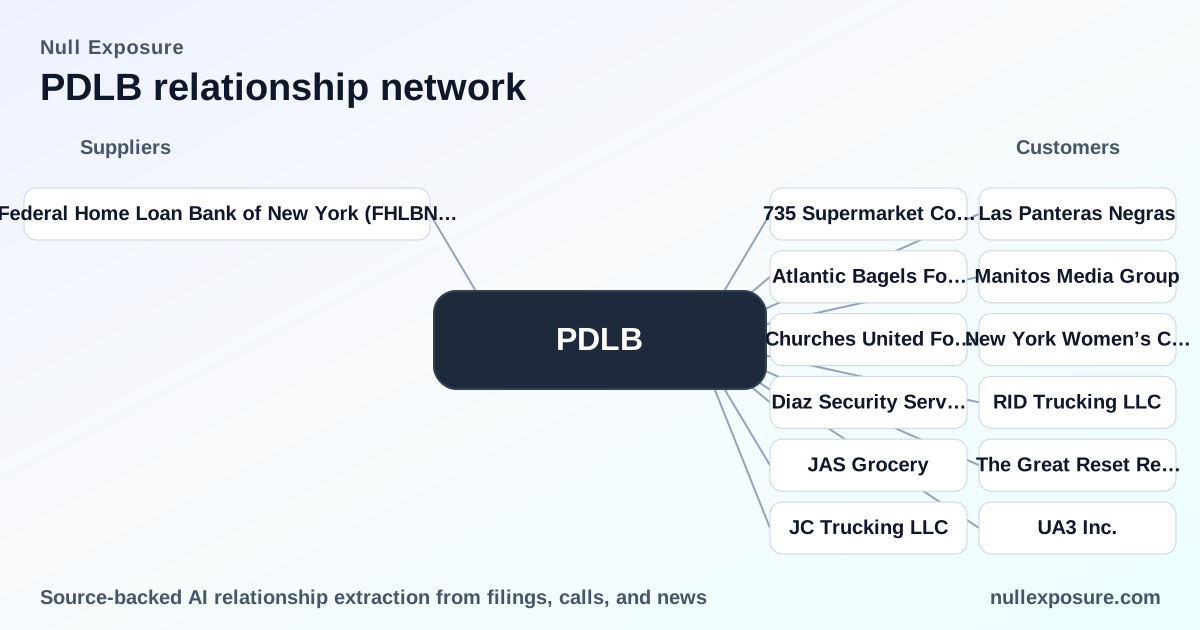
Ponce Financial Group (PDLB): Liquidity strategy anchored in government advances and fintech deposit channels
Ponce Financial Group operates as the holding company for Ponce Bank, monetizing through traditional community-banking economics: capture low-cost deposits, deploy loans and securities, and earn net interest margin plus fee income. The company supplements core deposit funding with sizeable borrowing lines from government-sponsored banks and leverages fintech partnerships to scale deposit sourcing — a hybrid funding model that drives asset growth but concentrates counterparty exposure. For a deeper supplier-risk view and ongoing monitoring, visit https://nullexposure.com/.
What the FHLBNY relationship signals to investors
Ponce’s relationship with the Federal Home Loan Bank of New York (FHLBNY) is both tactical (short-term liquidity) and structural (material outstanding advances). A March 2026 press release noted a $50,000 award through the FHLBNY Small Business Recovery Grant Program, underscoring a programmatic link to the Federal Home Loan Bank system (press release: The Globe and Mail, March 2026 — https://www.theglobeandmail.com/investing/markets/stocks/PDLB/pressreleases/36167140/ponce-bank-awarded-50000-through-fhlbny-small-business-recovery-grant-program/). Company disclosures show hundreds of millions in advances from FHLBNY, which function as a primary wholesale funding source for the bank’s balance sheet (company filings, FY2024/2025).
Key takeaway: FHLBNY is not a peripheral supplier — it is a material liquidity provider that supports Ponce’s lending and funding agility.
The hard numbers and contractual posture
Company disclosures and excerpts in Ponce’s filings detail a mix of short-term and historically long-term borrowings:
- The bank recorded a $25.0 million overnight line-of-credit advance from the FHLBNY at December 31, 2024, which demonstrates active short-term liquidity usage (company filing excerpt).
- Filings also reference term advances from the Federal Reserve Bank of New York (FRBNY) — notably $304.0 million outstanding at December 31, 2023, but none outstanding at December 31, 2024 — signaling rapid maturity management and roll-off of specific term facilities (company filing excerpt).
- Aggregate references show outstanding FHLBNY advances in the high hundreds of millions as of year‑end 2024, placing FHLBNY exposure squarely in the greater-than-$100 million spend band (company filing excerpts).
These points combine to portray a contracting posture that mixes overnight liquidity and previously used term facilities, with sizable outstanding balances that raise counterparty concentration questions.
Every supplier relationship in the record
Federal Home Loan Bank of New York (FHLBNY)
Ponce Bank has an active funding relationship with the FHLBNY that included a public Small Business Recovery Grant of $50,000 and material outstanding advances used for balance-sheet liquidity; corporate filings list significant FHLBNY borrowings as of December 31, 2024 (press release: The Globe and Mail, March 2026; company filings, FY2024/2025 — https://www.theglobeandmail.com/investing/markets/stocks/PDLB/pressreleases/36167140/ponce-bank-awarded-50000-through-fhlbny-small-business-recovery-grant-program/).
Federal Reserve Bank of New York (FRBNY)
Ponce’s filings explicitly document term advances from the FRBNY, with $304.0 million outstanding at December 31, 2023 and no term advances outstanding at December 31, 2024, reflecting either repayment or refinancing actions across the period (company filing excerpts, FY2023–FY2024). This historic access to FRBNY term funding highlights episodic reliance on central‑bank facilities when needed.
Raisin Solutions US LLC (Raisin)
The company established a deposit relationship with Raisin Solutions (formerly SaveBetter), and filings show $574.1 million in deposits sourced through that channel as of December 31, 2024, indicating a strategic fintech partnership that materially scales Ponce’s deposit base (company filing excerpt, FY2024). This relationship functions as a service-provider channel for deposit acquisition rather than a traditional lender.
How these relationships shape risk and opportunity
- Concentration and criticality: FHLBNY advances represent a critical funding pillar. The existence of large outstanding advances places concentration risk on a government-sponsored counterparty; however, that same relationship provides reliable liquidity during funding stress.
- Contract maturity profile: The bank uses short-term overnight lines and has historically used long-term term advances (FRBNY), indicating active maturity management. The shift away from FRBNY term advances between 2023 and 2024 suggests deliberate balance-sheet adjustments rather than unmanaged runway risk.
- Operational complexity: The Raisin partnership shows strategic use of third-party deposit channels to scale funding quickly, reducing reliance on branch-based retail deposits but adding vendor/operational risk and pricing competition for those deposits.
- Financial leverage of supplier funding: The magnitude of FHLBNY and fintech-sourced deposits means supplier terms materially affect net interest margin and liquidity buffers; any change in advance pricing, collateral requirements, or deposit-retention economics would have an outsized earnings impact.
Investment implications and monitoring checklist
For investors evaluating PDLB as a supplier-dependent bank, focus on these items:
- Monitor quarterly disclosures for the scale and trend of FHLBNY advances and any changes to collateral or overnight/term balances.
- Watch for changes in the Raisin deposit balance and repricing behavior, which influence deposit stability and cost of funds.
- Review maturity schedules and contingent liquidity facilities to understand rollover risk and the bank’s ability to substitute funding if a counterparty tightens access.
For a structured supplier-risk view and continuous alerts on these counterparties, check our supplier relationship coverage at https://nullexposure.com/ — it’s designed for investors who need fast, tradeable supplier intelligence.
Final verdict: funding strength with focused risks
Ponce Financial Group’s model leverages hybrid funding — government-sponsored advances plus fintech deposit channels — to fuel lending growth. That structure delivers funding flexibility and scalable deposits, but it also concentrates counterparty exposure and adds third‑party operational dependence. Investors should treat FHLBNY exposure as a material credit/funding lever and track fintech deposit dynamics as a source of both growth and volatility.
To evaluate supplier concentration and track counterparty developments for Ponce and comparable regional banks, start continuous monitoring at https://nullexposure.com/.