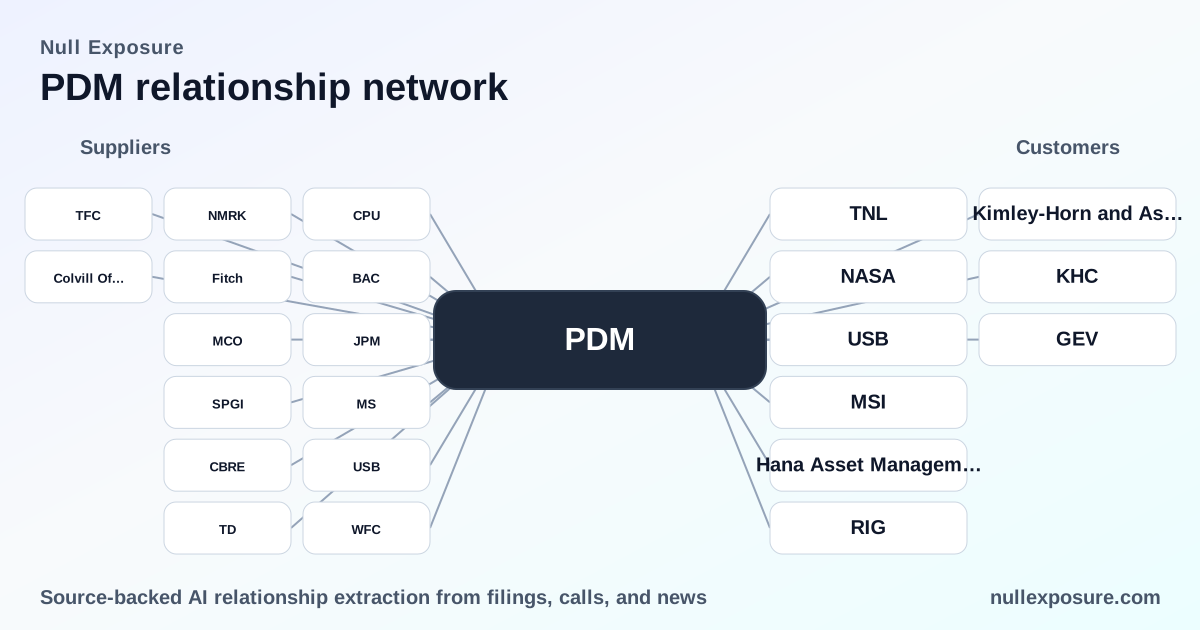
Piedmont Office Realty Trust (PDM): who powers the business and why investors should care
Piedmont Office Realty Trust operates and monetizes as a fully integrated, self-managed REIT that acquires, develops, renovates and operates Class A office properties concentrated in seven eastern U.S. markets with meaningful Sunbelt exposure. Revenue is generated through leasing and property operations; liquidity and balance-sheet flexibility are supported by recurring access to capital markets and formal credit ratings. Key value drivers are property cash flow in high-quality submarkets, tight relationships with capital markets banks and agencies, and an outsourced set of service providers that handle shareholder services and leasing execution. For more supplier intelligence and comparative supplier risk, visit https://nullexposure.com/.
Why the supplier map matters for investors
Piedmont’s supplier relationships reveal how the firm executes leasing, manages investor relations and finances growth. Investment banks and placement agents control funding windows and pricing on debt; transfer agents affect shareholder servicing and governance mechanics; leasing brokers shape occupancy and rent roll outcomes; credit rating agencies drive borrowing costs. These are not operational niceties—each relationship is economically material to cost of capital, liquidity timing and property-level revenue realization.
For comparative supplier intelligence and transaction-level detail, see https://nullexposure.com/.
What the public record shows: counterparty roll call and what each does for Piedmont
-
Computershare, Inc.: Piedmont lists Computershare as its shareholder services and transfer agent for FY2025–FY2026 filings and press releases, indicating centralized handling of shareholder records and proxy services that affect governance and distributions. According to multiple Piedmont press releases (FY2025–FY2026) the company directs investor-service inquiries to Computershare. (Source: Piedmont press releases and investor notices, FY2025–FY2026)
-
BofA Securities: BofA served as a joint book-running manager on Piedmont’s senior notes offering, signalling an active role in distribution and pricing of corporate debt. A GlobeNewswire release covering a November 13, 2025 senior notes pricing lists BofA Securities among the syndicate. (Source: GlobeNewswire, Nov 13, 2025)
-
J.P. Morgan: Named as a joint book-running manager on the same senior notes transaction, J.P. Morgan was part of the syndicate that executed Piedmont’s debt placement and therefore influences spread and investor allocation. (Source: GlobeNewswire, Nov 13, 2025)
-
Morgan Stanley: Morgan Stanley participated as a joint book-running manager on Piedmont’s senior notes offering, contributing distribution reach to institutional debt investors. (Source: GlobeNewswire, Nov 13, 2025)
-
U.S. Bancorp: Appears in the November 2025 syndicate as a joint book-running manager, reflecting commercial bank and underwriting support for debt issuance. (Source: GlobeNewswire, Nov 13, 2025)
-
Wells Fargo Securities: Listed as a joint book-running manager on Piedmont’s senior notes offering and therefore part of the financing syndicate that priced the transaction. (Source: GlobeNewswire, Nov 13, 2025)
-
TD Securities: Included in the November 2025 underwriting group as a joint book-running manager, supporting distribution to North American fixed-income desks. (Source: GlobeNewswire, Nov 13, 2025)
-
Truist Securities: Named among the underwriting banks on the senior notes offering, placing Truist in the debt-distribution network used by Piedmont. (Source: GlobeNewswire, Nov 13, 2025)
-
Newmark Group, Inc.: Newmark acted as an exclusive leasing agent on a major renewal—the US Bancorp headquarters renewal referenced in a PR Newswire release—demonstrating Piedmont’s use of third-party brokerage expertise for large, strategic lease transactions. (Source: PR Newswire, FY2023)
-
CBRE: Piedmont both uses internal leasing teams and externally advises transactions through major brokerages; a transaction disclosure described CBRE advising on a deal where Piedmont was represented internally, indicating selective use of CBRE for external advisory and market reach. (Source: Yahoo Finance/press coverage, FY2024)
-
Colvill Office Properties: Local brokerage representation shows Piedmont will engage regional brokers for localized leasing execution, as referenced in a transaction write-up involving a Houston energy-corridor lease dating to FY2018. (Source: RealtyNewsReport, FY2018)
-
Fitch: Fitch is cited among the credit rating agencies assigning investment-grade ratings to Piedmont (BBB-, per company releases), directly affecting borrowing costs and covenants. (Source: Piedmont investor releases and Q1 2025 reporting, FY2025)
-
Moody’s: Moody’s is identified as the Baa3 rating provider, confirming Piedmont’s access to lower-cost investment-grade debt and influencing lender underwriting standards. (Source: Piedmont filings and press mentions, FY2025)
-
S&P Global Ratings: S&P is also mentioned as an investment-grade rater (BBB-) in Piedmont’s communications, reinforcing multi-agency validation of credit quality. (Source: Company press releases and investor notices, FY2025)
What the mix of suppliers implies about Piedmont’s operating model
Piedmont is a self-managed, vertically integrated REIT that deliberately combines internal property management with selective outsourcing to specialized counterparties. The supplier roster signals these operating characteristics:
- Contracting posture: Strong capital-markets access, evidenced by a multi-bank underwriting syndicate and investment-grade ratings, gives Piedmont flexibility to time debt issuance and manage maturities proactively.
- Concentration: Geographic concentration in eastern U.S. and the Sunbelt increases the importance of localized leasing partners (Newmark, CBRE, Colvill) for tenant retention and market-level pricing power.
- Criticality: Transfer-agent services (Computershare) and rating agency relationships are operationally critical; disruptions would affect shareholder communications and borrowing costs respectively.
- Maturity and depth: The syndicated bank mix and repeat use of major brokers indicate mature, institutionalized supplier relationships rather than ad hoc engagements.
No specific contractual constraints are flagged in the available supplier data, which is a company-level signal that there are no publicly disclosed supplier-side limitations in the examined record.
For an investor-ready supplier risk profile and comparative supplier dashboards, visit https://nullexposure.com/.
Investment takeaway and next steps
Piedmont’s supplier map underlines a financing-first posture: investment-grade ratings and a full syndicate of underwriters reduce refinancing risk and compress cost of capital, while a mix of national and regional leasing partners preserves front-line leasing agility. Operationally, Computershare’s role in shareholder services and the rating agencies’ oversight are the most direct supply-side levers on liquidity and governance.
If you evaluate REIT counterparty risk or need to benchmark Piedmont against peers on supplier concentration, distribution of counterparty criticality, or capital markets dependency, start a focused supplier audit at https://nullexposure.com/.
For bespoke supplier research or to integrate supplier exposure into your credit model, contact the Null Exposure team through the site.