Precision Drilling (PDS): Dual listings reshape supplier dynamics and credit visibility
Precision Drilling Corporation provides oil and gas drilling and related services across North America and the Middle East and monetizes through dayrates, long‑term drilling contracts, equipment rentals and contract services to exploration and production customers. With roughly $1.84 billion in trailing revenue and $476 million of EBITDA (TTM), Precision’s cashflows are generated by fleet utilization and contract mix; the company’s move to broaden its exchange footprint changes the visibility and counterparty surface for suppliers and service partners. For investors and vendor managers evaluating supplier exposure to PDS, the new listing posture amplifies liquidity and regulatory transparency while imposing incremental compliance and settlement considerations.
Learn more at https://nullexposure.com/
Why the exchange changes matter to vendors: a short read for operators and credit teams
Precision announced a formal dual‑listing and exchange posture in late February 2026, increasing the number of market venues that trade its security and, importantly for suppliers, expanding the investor base and the regulatory lines of sight into corporate governance and reporting. That has practical supplier implications: greater public scrutiny tends to accelerate payment discipline and raises the probability that large institutional owners will press for predictable cash conversion and capital allocation policies. Conversely, a broader investor base also signals a potential increase in short‑term volatility, which suppliers must translate into contract protections around credit terms and performance guarantees.
No supplier constraints were recorded in the examined dataset, which is itself a company‑level signal: the data does not flag supplier-specific restrictions or contractual covenants. That absence should be treated as neutral — it does not replace direct counterparty due diligence — but it does mean there are no explicit, documented supplier constraints in the public record we reviewed.
What to watch in the operating model
- Contracting posture: Precision’s business model is service‑contract driven; expect standardized dayrates and master services agreements with centralized negotiation for large accounts. Suppliers should price for standardized payment cycles and include clauses that protect against scope creep and force majeure.
- Concentration: Oilfield services typically present moderate counterparty concentration risk — a relatively small number of large E&P customers can drive meaningful revenue swings — so suppliers should monitor client mix and receivable aging closely.
- Criticality: Rigs and drilling services are mission‑critical for operators; suppliers that provide critical spares or specialized services command pricing power but also higher dependency on contract enforceability.
- Maturity: Precision is an established operator with public reporting and recurring contract flows; expect mature procurement processes and formal dispute resolution channels.
Explore these supplier signals in more depth at https://nullexposure.com/
The three exchange relationships and what they mean for counterparties
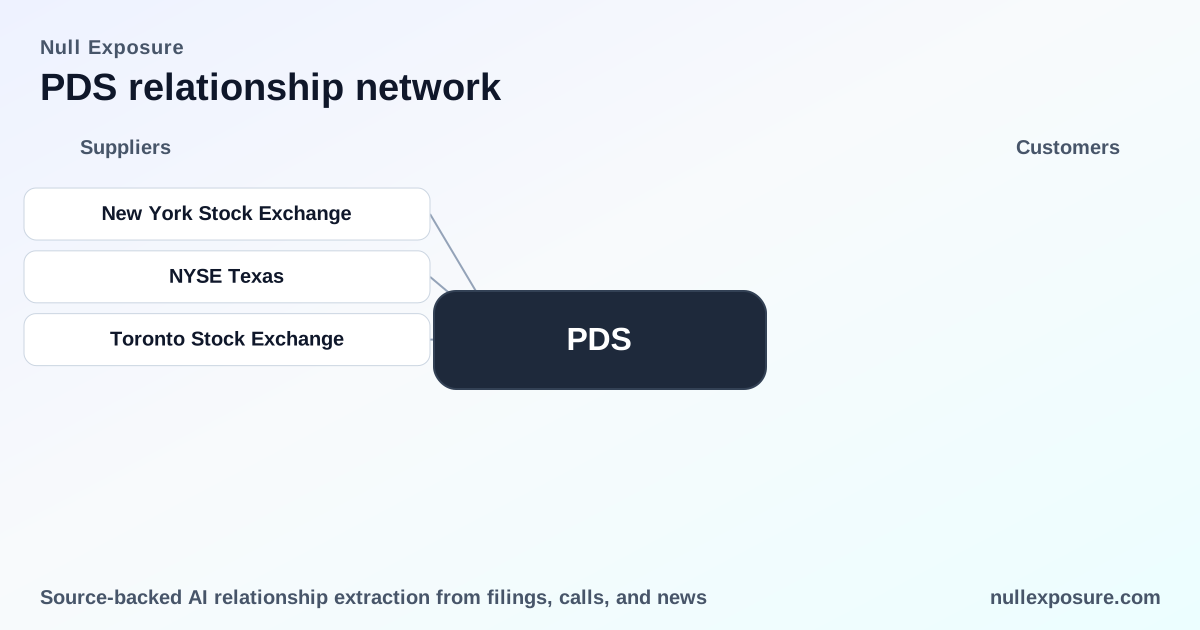
New York Stock Exchange — Precision will maintain its primary listing on the New York Stock Exchange, continuing to trade under the “PDS” ticker; this keeps the company subject to NYSE listing standards and investor scrutiny in the U.S. According to the company’s Feb. 27, 2026 GlobeNewswire announcement, the NYSE remains the firm’s primary venue. (GlobeNewswire, Feb. 27, 2026)
NYSE Texas — Precision’s common shares were approved for a dual listing on NYSE Texas, an all‑electronic U.S. exchange launched in March 2025, and the company will trade there under the same PDS ticker effective March 2, 2026; this increases venue liquidity and introduces a new execution venue for U.S. counterparties and investors. GlobeNewswire reported the approval and effective dual‑listing date in the same February 2026 release. (GlobeNewswire, Feb. 27, 2026)
Toronto Stock Exchange — Precision will continue to trade on the Toronto Stock Exchange under the symbol “PD”, maintaining its Canadian public presence and local investor access; the company hasn’t removed its domestic listing and will retain TSX reporting obligations. The GlobeNewswire release confirms the TSX listing persistence. (GlobeNewswire, Feb. 27, 2026)
Practical implications for supplier contracts, credit and operations
Precision’s broadened listing strategy delivers a set of immediate, actionable implications for suppliers and financial counterparties:
- Liquidity and credit visibility: Broader trading venues generally mean more analyst coverage and faster public reactions to operational results; suppliers should expect more transparent financials and possibly faster covenant enforcement if liquidity squeezes occur.
- Settlement and currency mechanics: Continued TSX listing maintains Canadian capital market linkages; U.S. listings increase the likelihood that counterparties will transact and settle in USD — suppliers must verify invoicing currency and FX pass‑through clauses.
- Regulatory and disclosure expectations: Dual listings raise compliance thresholds; expect more rigorous corporate governance disclosures that can inform supplier credit assessments and counterparty risk models.
- Commercial leverage and negotiation posture: As public investors press for capital discipline, Precision could favor cost optimization and more standardized supplier terms; suppliers providing high‑value or specialized services should contractually protect margins through escalation and minimum volume commitments.
Key takeaway: suppliers should treat PDS as a larger, more scrutinized counterparty post‑dual listing and adjust credit terms, invoicing currency clauses, and performance guarantees accordingly.
Checklist for procurement and credit teams
- Confirm primary settlement currency in contracts and include explicit FX clauses.
- Insert clear payment‑term triggers and late‑payment remedies tied to public covenant events.
- Request updated financial reporting cadence and trigger rights for material adverse changes.
- Insist on contractual protections for scope expansion, equipment redelivery, and termination for convenience.
- Monitor share‑price driven governance actions that could accelerate cash conservation policies.
For deeper supplier exposure analytics and monitoring tools, visit https://nullexposure.com/
Bottom line for investors and operators
Precision Drilling’s dual listing on U.S. venues while maintaining its TSX presence is a strategic move that increases market liquidity and investor access and simultaneously raises the bar on transparency and governance. For suppliers, the practical consequence is a need to translate that public visibility into tightened credit processes, disciplined contract language, and closer monitoring of receivable risk. Treat PDS as a large, mature counterparty with elevated public scrutiny — adjust terms to protect cashflow and operational continuity.
If you manage supplier exposure to PDS or similar oilfield service firms, start by validating settlement currency, updating payment terms, and locking in contractual protections. For tailored exposure reports and ongoing monitoring, see https://nullexposure.com/