Palladyne AI (PDYN): Supplier posture, IR engagement, and what investors should price in
Palladyne AI is a Salt Lake City–based software infrastructure company that commercializes AI-enabled products and services and drives revenue through customer subscriptions, licensing and professional services. The company runs with a relatively small revenue base and significant market capitalization, which means supplier performance and capital markets messaging directly affect valuation. This note distills Palladyne’s supplier posture, the single supplier relationship disclosed in public filings, and the enterprise-level constraints that shape operational risk. For a consolidated view of supplier exposures and disclosures, see https://nullexposure.com/.
How Palladyne monetizes and where supplier risk shows up
Palladyne operates as an AI infrastructure vendor in the software category and monetizes through recurring and project-based commercial arrangements with enterprise customers. The financial profile through the latest quarter (2025-12-31) shows TTM revenue of $5.25M and a market capitalization of ~$310M, while reported EBITDA is negative ($-31.3M), indicating an emerging-growth company that relies on capital markets and efficient supplier execution to scale. Investor relations, procurement timing and component/service availability are therefore economically consequential because execution lapses can compress an already narrow operating margin and shift investor sentiment.
- For more structured supplier intelligence and disclosure tracking, visit https://nullexposure.com/ for tools and reports.
What the company says about suppliers — three company-level signals
Palladyne’s public disclosures include three clear constraints that define the supplier operating model:
- Contracting posture — short-term, purchase-order driven. Management states that most supplier relationships are purchase order based rather than long-term supply contracts, which signals flexible procurement but increases exposure to price and availability volatility.
- Geographic concentration — domestic suppliers. The company discloses that most of its key suppliers are based in the United States, concentrating supply chain risk regionally while reducing cross-border regulatory complexity.
- Criticality — supplier failures are material. Palladyne explicitly warns that inability of suppliers to deliver components or services on acceptable terms could have a material adverse effect on business and operating results.
These are company-level signals about contracting, concentration and operational criticality that investors must fold into valuation and scenario stress tests.
One supplier relationship disclosed publicly: what it means
Palladyne’s supplier-scope disclosures include a single named external partner in publicly available press materials:
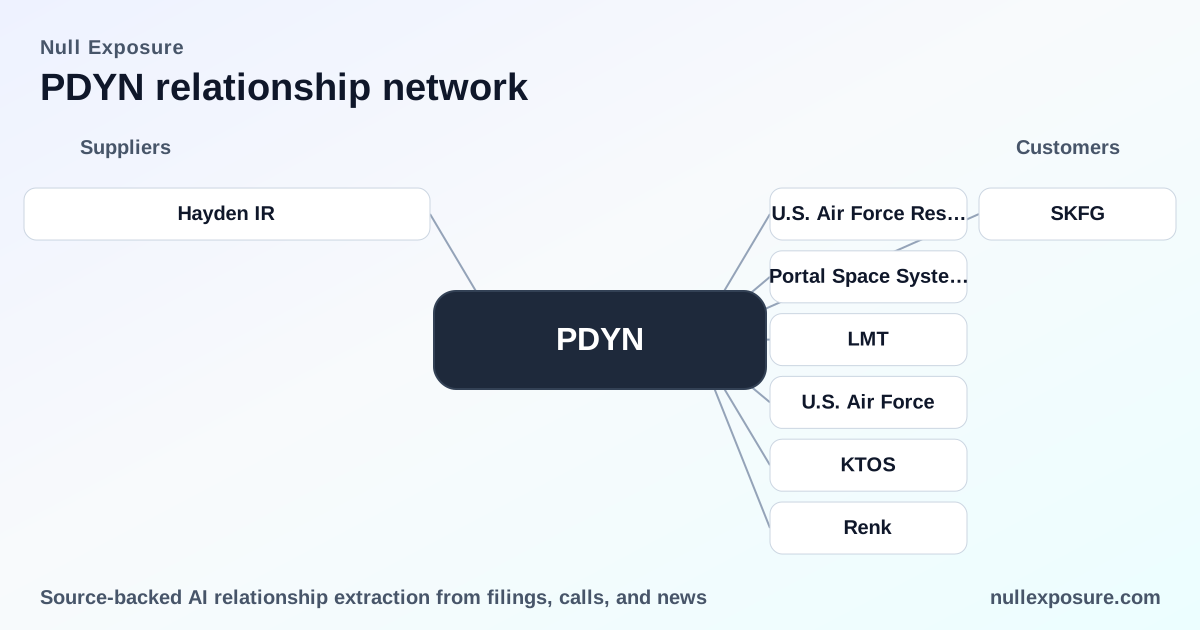
- Hayden IR — Palladyne lists Hayden IR as its investor relations contact, with Brian S. Siegel cited as Senior Managing Director and an investor relations point of contact in a January 5, 2026 press release. According to the company press release via Business Wire (Markets.FinancialContent), Hayden IR provides investor communications and capital markets outreach services for Palladyne. Source: Business Wire press release dated January 5, 2026 (Markets.FinancialContent) — https://markets.financialcontent.com/stocks/article/bizwire-2026-1-5-palladyne-ai-to-present-at-the-28th-annual-needham-growth-conference.
Hayden IR’s role is communications and capital markets support, not product supply. That places Hayden IR outside the supplier streams that deliver engineering inputs, but still squarely within the stack of vendors whose performance affects investor perception and liquidity.
Why these supplier characteristics matter for investors
There are several investor-facing implications from Palladyne’s supplier posture and financial profile:
- Short-term purchasing increases operational elasticity but raises execution risk. With purchase-order relationships rather than long-term contracts, Palladyne can flex spend quickly, but it also faces price shocks, lead-time variability and supplier availability risk when demand scales or component markets tighten.
- Domestic concentration reduces geopolitical exposure but concentrates local disruption risk. Having most suppliers in the U.S. lowers complexity from global trade policy but focuses risk on domestic supply shocks (labor, logistics, component shortages) and limits opportunities to shift sourcing quickly offshore.
- Supplier failures are financially meaningful. The company’s disclosure that supplier problems could have a material adverse effect is especially relevant given the company’s modest revenue base (TTM $5.25M) and negative EBITDA; operational hiccups translate quickly into cash burn and valuation volatility.
- Investor communications are outsourced to a named IR vendor. The explicit relationship with Hayden IR formalizes capital markets outreach, which is a value-sensitive supplier function for a small-cap, high-beta technology name (beta ~3.78).
To summarize the investor risk posture: operational flexibility exists, but supply volatility and materiality of supplier failures require active monitoring and scenario planning.
Tactical checklist for investors and operators
For portfolio managers and operators evaluating PDYN supplier relationships, prioritize these actions:
- Monitor procurement disclosures in quarterly filings and management commentary for any shift from purchase-order to multi-year contracting, which would materially change execution risk.
- Track supplier concentration metrics — any expansion outside the U.S. or significant vendor consolidation should be noted immediately.
- Watch capital markets visibility and IR activity: investor outreach cadence, conference appearances, and IR firm changes signal management’s confidence in growth narratives.
For continuous supplier oversight and filing-based signals, visit https://nullexposure.com/ to access centralized supplier relationship intelligence.
Final read: risk/reward framing and next milestones
Palladyne is an emerging software infrastructure company whose valuation depends as much on market narrative and investor access as on operational execution. Supplier posture is short-term and U.S.-centric, and supplier failures are explicitly material to results — both factors that heighten the sensitivity of cash flow and multiple compression risk for PDYN. The single named third-party relationship in public press materials is an investor relations engagement with Hayden IR, which organizes capital markets messaging rather than product supply (Business Wire, Jan 5, 2026).
Investors should watch for two immediate signal events: any disclosure of long-term supply contracts (which would reduce price/availability risk) and upcoming earnings commentary on supplier cost trends or disruptions. For an actionable view of supplier exposures and filing-level intelligence on PDYN and similar issuers, consult the research hub at https://nullexposure.com/.
Bold, disciplined supplier oversight will determine whether Palladyne converts its AI infrastructure potential into consistent revenue growth and durable margins.