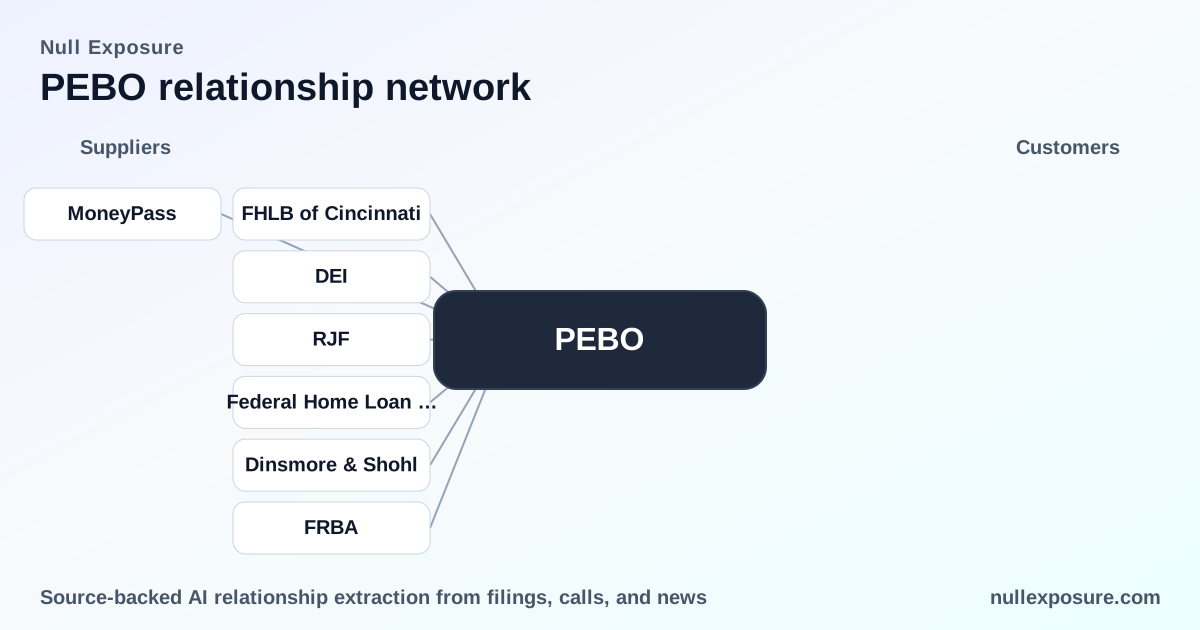
Peoples Bancorp (PEBO) — Supplier relationships, funding mix, and third‑party risk
Peoples Bancorp is a regional bank holding company that monetizes through net interest margin on commercial and retail loans, fee income from deposit and payment services, and balance‑sheet funding strategies that compress funding cost via wholesale sources. The firm's supplier footprint is dominated by secured wholesale funding relationships, professional advisors on M&A and branch rollouts, a national ATM network partner, and third‑party vendors that operate core banking systems — all of which directly affect liquidity, margin, and operational continuity. For a practitioner’s view of counterparties and how they shape capital and liquidity risk, review the supplier map at https://nullexposure.com/.
Funding posture and third‑party constraints that drive the business
Peoples operates with a mixed contracting posture that blends short‑term funding mechanics and longer‑dated real‑estate/equipment leases. The company uses short‑term instruments for tactical liquidity — including revolving credit facilities and brokered deposits hedged with short‑dated interest‑rate swaps — while maintaining fixed‑payment leases across branches and equipment with original terms up to 25 years. The firm documents an explicit dependence on a small number of strategic counterparties for secured wholesale funding and core systems, which elevates concentration and operational criticality.
- Contracting posture: active use of short‑term credit and hedges for brokered deposits alongside a smaller population of longer‑term property/equipment leases. Evidence in filings cites U.S. Bank loan amendments extending short facilities and active interest‑rate swap positions.
- Concentration and criticality: Peoples warns that loss or interruption of a critical vendor for core banking systems would be materially adverse; the company conducts annual third‑party risk and business continuity reviews to manage this exposure.
- Scale of funded capacity: Peoples discloses unused collateral‑based borrowing capacity in the hundreds of millions with the Federal Home Loan Bank and the Federal Reserve, signaling large, critical wholesale relationships that are central to liquidity management.
- Contract maturity mix: swap activity and 90‑day brokered deposit hedges indicate active, short‑dated interest‑rate exposure; leasing schedule disclosure points to longer‑term fixed obligations that anchor branch economics.
Explore detailed supplier profiles and risk summaries at https://nullexposure.com/ for investment teams evaluating counterparty concentration and funding resiliency.
Key supplier relationships investors must track
FHLB of Cincinnati
Peoples identifies the Federal Home Loan Bank of Cincinnati as a primary source of secured wholesale funding, supplying collateralized advances that underpin liquidity management and borrowing capacity. According to the company's 2024 10‑K (FY2024), this relationship is a core element of secured funding. Source: Peoples Bancorp 2024 Form 10‑K (pebo-2024-12-31).
FRB (Federal Reserve Board)
The company lists the Federal Reserve (FRB) as another primary secured wholesale funding channel, with large unused collateral borrowing capacity available to the bank for contingent liquidity. This is documented in the firm’s 2024 10‑K filing (FY2024). Source: Peoples Bancorp 2024 Form 10‑K (pebo-2024-12-31).
Federal Home Loan Bank (as noted in market coverage)
Market reporting on Q4 commentary reiterates the bank’s practice of securing lower‑cost funding via FHLB advances and brokered CDs, underscoring funding strategy execution and the role of wholesale advances in margin management. Source: Finviz Q4 market note (FY2026 coverage).
DEI (design/build partner for branch rebranding)
Peoples contracted DEI, a design/build firm, to implement a brand program across 36 branch locations in multiple states, representing a material, scoped capital and vendor relationship tied to branch strategy and customer experience. A Marietta Times report from November 2021 covered the brand implementation contract. Source: Marietta Times (November 2021).
Raymond James (financial advisor)
Peoples engaged Raymond James as an advisor on at least one acquisition transaction, demonstrating the use of external investment banking expertise for deal execution. Richmond BizSense reported that Raymond James advised Peoples on a Jackson Ward branch acquisition and rebranding in September 2021. Source: Richmond BizSense (September 2021).
Dinsmore & Shohl (legal advisor)
The law firm Dinsmore & Shohl acted as legal counsel on the same transaction where Raymond James advised, reflecting standard reliance on external legal counsel for M&A and regulatory matters. Richmond BizSense documented the firm’s role in September 2021. Source: Richmond BizSense (September 2021).
MoneyPass (ATM network partner)
Peoples offers customers access to more than 24,000 surcharge‑free ATMs through the nationwide MoneyPass network, an outsourced payments/ATM relationship that enhances deposit convenience and reduces branch‑footprint friction. This network partnership was referenced in local reporting about branch changes in January 2017. Source: The News‑Sentinel (January 2017).
What these relationships mean for investors — a concise risk and opportunity checklist
- Liquidity levered to wholesale counterparties. The FHLB and FRB lines represent not only available capacity but a structural funding lever; the company’s disclosure of hundreds of millions in unused capacity signals both access and dependence. This is a direct determinant of liquidity under stress and funding cost in rising‑rate environments. (Peoples 2024 10‑K).
- Short‑term funding sensitivity. The firm’s use of short‑dated brokered deposits hedged with three‑month SOFR swaps and revolving credit facilities indicates active interest‑rate and roll‑risk management. The presence of short‑term amendments to bank lines underscores exposure to re‑pricing and renewal cycles.
- Operational concentration risk. Peoples explicitly depends on a singular core‑systems vendor for customer‑facing banking systems, which elevates operational risk and the importance of vendor resilience and remediation plans.
- Capital allocation to branch strategy. The DEI engagement for multi‑state rollouts and the MoneyPass partnership reflect investments in distribution and customer access that support deposit stability and fee revenue.
- Advisory relationships signal M&A capability. Use of Raymond James and Dinsmore & Shohl on transactions indicates access to external capital markets and legal expertise for execution, which supports strategic optionality.
For a full supplier and counterparty scoring framework tailored to bank holding companies, visit https://nullexposure.com/ to see how these relationships map to liquidity, concentration, and operational‑resilience scores.
Bottom line: monitoring priorities for investors
Peoples Bancorp’s supplier ecosystem centers on high‑value wholesale funding partners and a small set of critical vendors whose continuity and pricing shape margins and resilience. Investors should prioritize: (1) quarterly disclosures on unused FHLB/FRB capacities and advance utilization; (2) updates on the core‑systems vendor and third‑party risk program; (3) changes in brokered deposit sizing and swap positions; and (4) execution on branch rebranding and ATM partnerships that influence deposit flows. These items collectively determine funding cost, capital deployment flexibility, and operational continuity.
If you evaluate regional bank counterparties for investment or operational planning, review the supplier coverage and monitoring tools at https://nullexposure.com/ for actionable signals and ongoing tracking.