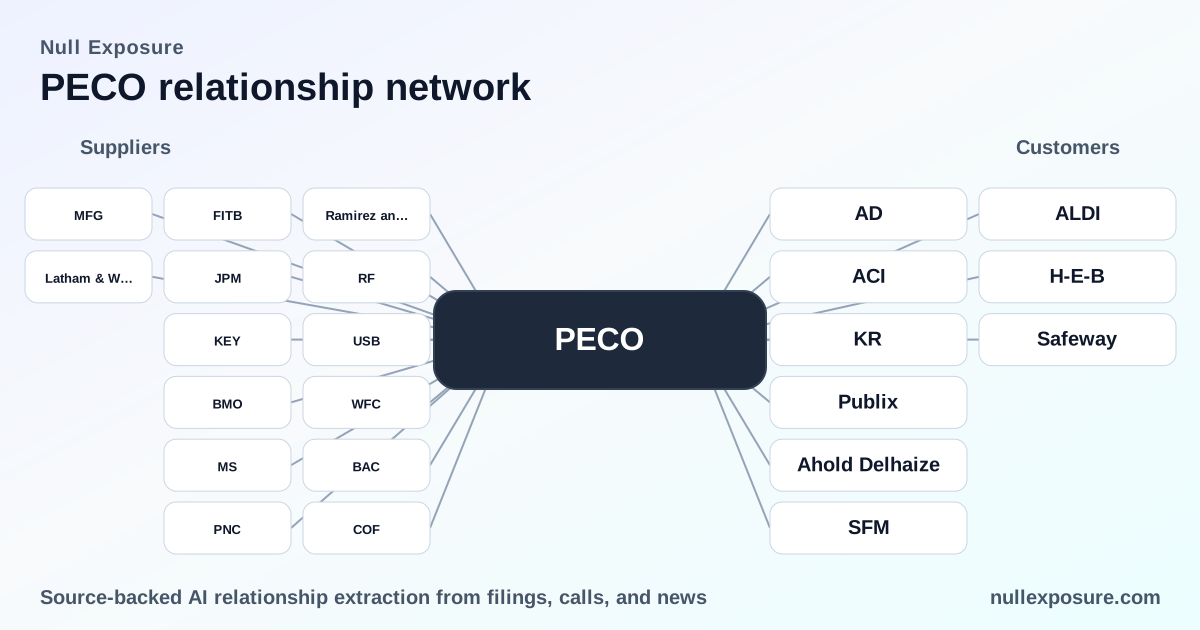
PECO supplier relationships: what the February 2026 bond deal reveals for investors and operators
Phillips Edison & Company, Inc. (PECO) is a grocery‑anchored retail REIT that monetizes through rental income, property operations, selective development and capital markets activity — including unsecured bond issuance to finance growth and refinance maturities. The company leverages a national tenant base and repeat access to investment‑grade underwriting capacity to manage liquidity and cost of capital. Recent activity around a $350 million senior unsecured note offering in February 2026 is the clearest near‑term window into PECO’s supplier ecosystem and contracting posture. For a consolidated view of supplier relationships and what they imply for underwriting risk, legal support and market access, visit https://nullexposure.com/.
Quick read: why the February 2026 bond syndicate matters
PECO priced $350 million of 4.75% senior unsecured notes due 2033 in February 2026, and that offering is the catalyst for the supplier relationships captured in public reports. The transaction confirms two strategic facts for investors: PECO accesses a broad institutional underwriting syndicate for unsecured issuance, and the company engages major law firms for deal counsel, reflecting a mature capital markets playbook. According to PECO’s press release published via GlobeNewswire on February 24, 2026, multiple banks acted as joint book‑running managers on the deal and Latham & Watkins served as legal counsel.
For deeper supplier relationship intelligence and historical context on similar transactions, see https://nullexposure.com/.
Who showed up on the cap‑markets side (and what that means)
The following relationships were explicitly reported in coverage of the February 2026 note offering. Each entry is a plain‑English summary of the counterparty role with a concise source reference.
-
Ramirez and Co., Inc. — Co‑manager on the offering. Ramirez participated as a co‑manager on the $350 million notes, per PECO’s GlobeNewswire press release (Feb 24, 2026).
Source: GlobeNewswire press release, February 24, 2026. -
Regions Securities LLC — Joint book‑running manager. Regions Securities is listed among the syndicate of joint book‑running managers on the notes, reflecting a role in distribution and price discovery.
Source: GlobeNewswire press release, February 24, 2026. -
US Bancorp — Joint book‑running manager. US Bancorp is named in the underwriting group supporting the unsecured notes, indicating institutional distribution breadth.
Source: GlobeNewswire press release, February 24, 2026. -
Wells Fargo Securities / Wells Fargo — Joint book‑running manager. Wells Fargo Securities served as a joint book‑running manager on the issuance, a signal of established market relationships and placement capability.
Source: GlobeNewswire press release, February 24, 2026; earnings call summary (Intellectia.ai), March 2026. -
BofA Securities / Bank of America — Joint book‑running manager. BofA Securities (Bank of America) was part of the lead manager group, supporting distribution and investor reach for the unsecured paper.
Source: GlobeNewswire press release, February 24, 2026; earnings call summary (Intellectia.ai), March 2026. -
Capital One Securities — Joint book‑running manager. Capital One Securities appears in the syndicate list, representing another mid‑sized dealer participant.
Source: GlobeNewswire press release, February 24, 2026. -
Fifth Third Securities — Joint book‑running manager. Fifth Third was included among the underwriters and contributed to the placement ensemble.
Source: GlobeNewswire press release, February 24, 2026. -
J.P. Morgan — Joint book‑running manager. J.P. Morgan served as a joint book‑running manager, underscoring access to top‑tier institutional channels.
Source: GlobeNewswire press release, February 24, 2026. -
KeyBanc Capital Markets — Joint book‑running manager. KeyBanc Capital Markets is listed in the syndicate, supporting sales into regional institutional accounts.
Source: GlobeNewswire press release, February 24, 2026. -
Morgan Stanley — Joint book‑running manager. Morgan Stanley joined the lead managers on the offering, providing international institutional reach and secondary liquidity support.
Source: GlobeNewswire press release, February 24, 2026; earnings call summary (Intellectia.ai), March 2026. -
PNC Capital Markets LLC — Joint book‑running manager. PNC Capital Markets is named in the underwriting group, contributing to distribution and pricing.
Source: GlobeNewswire press release, February 24, 2026. -
BMO Capital Markets — Joint book‑running manager. BMO Capital Markets participated in the syndicate as a book‑running manager on the issue.
Source: GlobeNewswire press release, February 24, 2026. -
Mizuho — Joint book‑running manager. Mizuho is listed among the managers on the notes offering, indicating international bank participation.
Source: GlobeNewswire press release, February 24, 2026. -
Bank of America (coverage note) — Market credibility signal. Media coverage and analyst highlights reiterated Bank of America’s role in the underwriting, which analysts flagged as enhancing bond market confidence.
Source: Intellectia.ai summary of PECO Q4 2025 highlights, March 2026.
Legal counsel and advisory: deal governance
- Latham & Watkins LLP — Transaction counsel to PECO. Latham & Watkins represented PECO on the offering with a corporate team across Los Angeles and New York, indicating standard top‑tier legal support for unsecured note documentation and regulatory filings.
Source: Latham & Watkins announcement, February 2026; Latham press posting.
What the relationships tell investors about PECO’s operating model
-
Contracting posture and maturity: The breadth of the underwriter syndicate and engagement of a major law firm indicate a mature, repeatable capital markets approach. PECO can place unsecured debt across a mix of global and regional banks, which supports refinancing flexibility and the ability to tap liquidity without requiring asset sales.
-
Concentration and criticality: The syndicate structure reduces single‑counterparty concentration risk for distribution, but PECO remains reliant on capital markets for sizable unsecured debt issuance; sustained access to this group is critical to the company’s funding strategy.
-
Geographic signal (company‑level): PECO conducts operations solely in the United States and does not segment performance by region, which is an important company‑level constraint on diversification and recession exposure. This is a strategic choice that concentrates operational risk in the U.S. consumer and retail cycle.
Source: PECO company disclosure on operational geography. -
Counterparty quality: The participation of major global banks (J.P. Morgan, Morgan Stanley, Bank of America, Wells Fargo) and top legal counsel reduces execution risk for bond deals and signals institutional investor comfort with PECO’s credit profile in the current cycle.
If you want a tailored map of a specific counterparty’s exposure to PECO or historical syndicate roles, see our platform at https://nullexposure.com/ for customized supplier analytics.
Investment implications and risk checklist
PECO’s demonstrated ability to place unsecured debt with a deep syndicate is a positive liquidity signal for investors, but it also highlights the company’s dependence on capital markets pricing and distribution capacity. Key considerations:
- Positive: Diversified underwriter syndicate and top‑tier legal counsel support efficient deal execution and investor reach.
- Watch: Any deterioration in market access or a sustained rise in unsecured borrowing costs would have direct implications for leverage strategy and dividend coverage.
- Operational concentration: U.S.-only operations concentrate retail cyclical risk; investor monitoring should focus on same‑store rent performance and grocery anchor stability.
For operational teams, these supplier ties validate using a broad mix of regional and global banks to preserve optionality in future financings.
Final note: the February 2026 transaction is an explicit market test of PECO’s credit access; the underwriting roster and counsel profile are high‑quality signals that institutional markets continue to underwrite PECO’s unsecured issuance. For ongoing monitoring of these supplier relationships and how they evolve across future transactions, visit https://nullexposure.com/.