Pegasystems (PEGA): How supplier relationships drive Blueprint, cloud economics, and margin dynamics
Pegasystems monetizes by selling enterprise business software through a mix of software licenses, cloud subscriptions, marketplace offerings, and professional services, while outsourcing significant hosting and delivery work to third parties and systems integrators. That go-to-market mix lets Pega scale sales of AI-enabled products like Blueprint and Notes-to-Blueprint quickly, but it also shifts cost structure and execution risk into partner ecosystems that directly affect margins and time-to-value for customers. For investors evaluating PEGA as a supplier to enterprises or as a vendor partner, focus on the partner footprint, hosting posture, and margin sensitivity to outsourced delivery.
Read more company intelligence on the homepage: NullExposure.
How Pega makes money — the operating model in plain language
Pega sells enterprise-grade workflow and decisioning software and increasingly emphasizes cloud subscriptions and AI-enabled product extensions. Revenue is recurring and skewed toward subscription and services, with FY figures showing about $1.75B in trailing revenue and healthy operating margins (operating margin ~24.9%). Pega’s profitability and valuation (market cap roughly $7.27B) depend on three levers:
- product adoption of new AI and cloud capabilities (volume),
- partner throughput that delivers and customizes those products for end customers (delivery), and
- the cost of third-party hosting and integrator fees (costs).
The company’s contracting posture is partner-centric and reliant on third-party hosting, meaning Pega controls product roadmaps and licensing but often outsources hosting or implementation work. That structure reduces capital intensity but transfers execution risk and recurring costs to suppliers and integrators, which has observable pressure on margins in recent commentary.
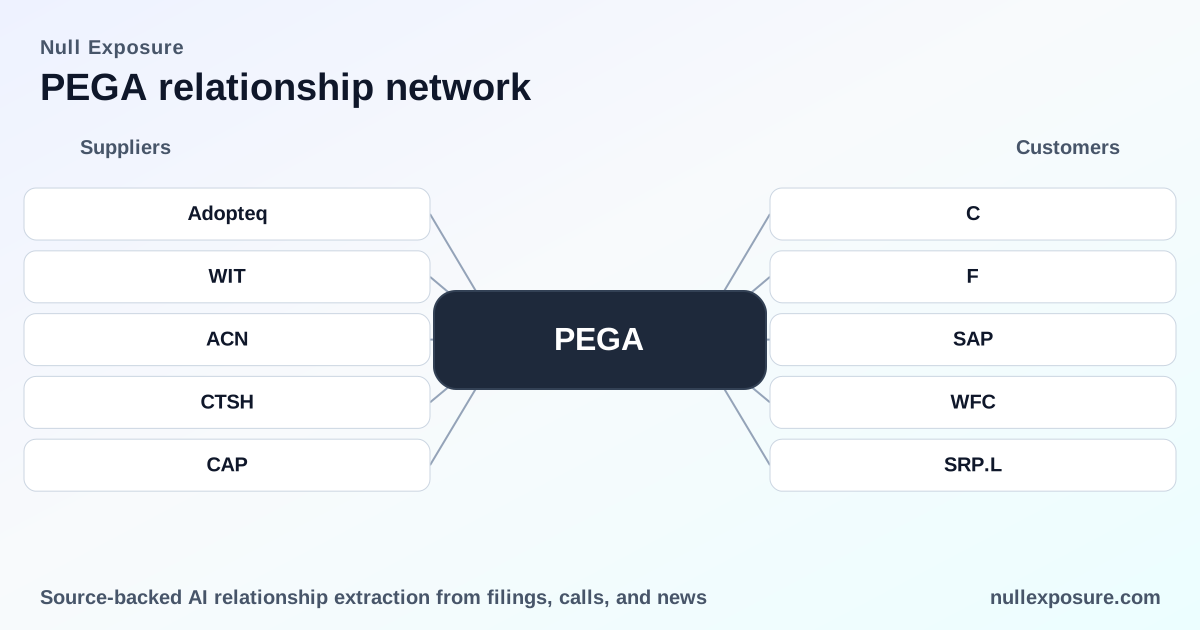
Supplier relationships that matter (what the press shows)
Below are the partner and supplier ties surfaced in recent coverage, with short, investor-focused summaries and source references.
Adopteq — source of assets used to modernize Lotus Notes workloads
Pega acquired assets from Adopteq and used them to launch Notes to Blueprint, an AI-enabled solution that converts legacy Lotus Notes applications into cloud-based automated workflows, accelerating migrations for enterprise clients. According to Diginomica (March 10, 2026), Notes to Blueprint leverages software and experts Pega obtained from the Adopteq deal and is integrated into the broader Blueprint offering (https://diginomica.com/notable-development-pegasystems-taps-notes-replacement-market-opportunity?amp=).
Capgemini — premier partner on a marketplace-delivered modernization path
Capgemini is positioned as a Pega premier partner offering an end-to-end modernization solution on AWS Marketplace, delivering Notes-to-Blueprint as a packaged service for enterprise customers. Diginomica notes that the solution is available through Capgemini on AWS Marketplace, reflecting Pega’s strategy to combine partner delivery with cloud marketplace distribution (March 10, 2026 — https://diginomica.com/notable-development-pegasystems-taps-notes-replacement-market-opportunity?amp=). Key takeaway: Capgemini converts Pega IP into a deliverable service sold through cloud marketplaces.
Wipro — a systems integrator extension for Blueprint deployments
Pega increasingly relies on system integrators such as Wipro to deploy and extend Blueprint capabilities, making Wipro an execution partner for Pega’s enterprise rollouts. TradingView’s coverage of Pega’s Q4 commentary highlights Wipro among the SI partners expanding Blueprint’s reach (March 10, 2026 — https://www.tradingview.com/news/stockstory:af882f2ba094b:0-pega-q4-deep-dive-margin-pressures-persist-despite-cloud-and-ai-momentum/). Key takeaway: Wipro helps scale implementation but also introduces professional services cost into Pega’s unit economics.
Accenture — strategic SI partner amplifying product adoption
Accenture is named as a core systems integrator that helps deliver Pega’s Blueprint capabilities to large customers, effectively serving as both reseller and integrator in major transformation projects. Finviz’s analysis of Pega’s margin dynamics cites Accenture as a central partner in Pega’s partner-driven expansion strategy (March 10, 2026 — https://finviz.com/news/307949/pega-q4-deep-dive-margin-pressures-persist-despite-cloud-and-ai-momentum). Key takeaway: Accenture expands reach into large enterprise accounts but is a vector for outsourced delivery costs.
Cognizant — delivery partner for enterprise implementations
Cognizant is another systems integrator that Pega leverages to deliver Blueprint and related services; the company is repeatedly referenced alongside Accenture and Wipro in press coverage as part of the SI network Pega depends on. TradingView and Finviz reported Cognizant’s role in supporting partner-driven expansion of Pega’s offerings (March 10, 2026 — https://finviz.com/news/307949/pega-q4-deep-dive-margin-pressures-persist-despite-cloud-and-ai-momentum). Key takeaway: Cognizant increases implementation capacity but contributes to variable cost pressure as cloud and AI adoption scales.
Mid-read: if you’re benchmarking supplier risk or sourcing partners for enterprise modernization, our homepage has concise supplier profiles and relationship analytics: NullExposure.
What the supplier set tells investors about risk and runway
- Contracting posture: Pega’s cloud subscription model combined with significant third-party hosting and integrator reliance creates a lean capital posture but raises operational dependence on suppliers. The company disclosure emphasizes recurring third-party hosting expenses when clients do not self-manage deployments, highlighting a deliberate outsourcing strategy.
- Concentration vs. diversification: Working with global SIs (Accenture, Cognizant, Wipro, Capgemini) reduces single-partner dependence while creating multi-party execution complexity—broad reach but shared margins and coordination risk.
- Criticality: Partners are mission-critical for large-scale deployments (Blueprint adoption), so partner performance directly influences customer retention and implementation velocity.
- Maturity and margin sensitivity: Pega is a mature vendor with consistent profitability (operating margin ~24.9%) and mid-cap scale, yet press coverage links partner-driven growth with margin pressures, as outsourcing raises recurring costs when adoption accelerates.
These are company-level signals: the relationship_role evidence identified Pega’s reliance on third-party hosting and recurring hosting expenses as a material operating characteristic.
Investment implications and next steps for operators
For investors and operators assessing PEGA supplier relationships:
- Expect faster commercial reach from an SI-backed GTM model, with lower capital intensity but higher variable cost through implementation and hosting fees.
- Monitor margin trends and partner economics as adoption of AI-enabled products (Blueprint, Notes to Blueprint) scales.
- Track marketplace channels (AWS Marketplace via Capgemini) as a growth lever that shortens procurement cycles but shifts revenue recognition and service delivery models.
If you want a tailored supplier risk brief or a vendor relationship deep-dive for procurement or diligence, start here: NullExposure.
Actionable next steps:
- Validate which of Pega’s large customers use SI-led deployments versus self-managed hosting.
- Quantify implementation cost pass-through from SIs into customer TCO assumptions.
- Revisit margin guidance as Blueprint adoption and third-party hosting costs evolve.
For curated reports and relationship analytics that cut to the chase, visit NullExposure.
Overall, Pega’s partner-centric model accelerates product adoption and marketplace distribution, but the company’s economics now hinge on how efficiently partners convert demand without eroding margins — a central consideration for investors and operators evaluating PEGA supplier relationships.