Pelican Acquisition Corporation Right (PELIR): what investors need to know about supplier exposure and deal execution risk
Pelican Acquisition Corporation Right is a SPAC warrant listed on NASDAQ that delivers asymmetric upside tied to Pelican’s success in identifying and completing a business combination in technology or healthcare; its value is realized through deal-driven re-rating and exercise economics rather than operating cash flow. Investors in PELIR are effectively betting on transaction execution, target selection, and the chain of third-party suppliers the SPAC or its target engages during project build-out. For a concise vendor-and-risk view, see https://nullexposure.com/.
How Pelican is structured and where value is created
PELIR is a warrant instrument attached to a sponsor-led special purpose acquisition vehicle. The company carries no operating revenue, no EBITDA, and no public analyst coverage; its financial footprint is transaction-centric rather than commercial. Key company-level facts: PELIR is listed on NASDAQ, shows a negative book value of -0.003, a public float of 7,872,400 shares, and a 52-week trading range between $0.13 and $0.95. These attributes establish the investment as speculative, timing-sensitive, and highly correlated with the underlying SPAC’s progress toward a completed merger or liquidation.
SPAC warrants like PELIR monetize when counterparties convert warrants into equity on favorable terms or when the market re-rates post-merger; they do not generate operating cash flow while the SPAC is searching for a target. For direct vendor tracking and supplier exposure analysis, visit https://nullexposure.com/.
The supplier relationship observed: Desgagnes logistics agreement
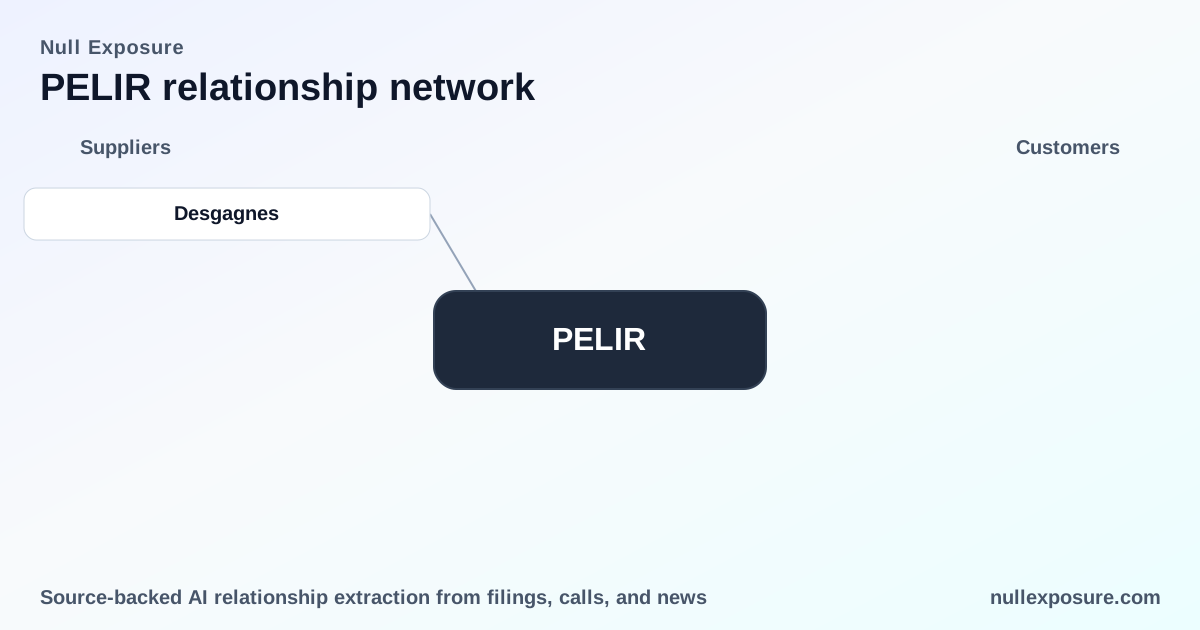
Pelican Acquisition, together with Greenland Exploration leadership (under the Greenland Energy banner), executed a strategic logistics agreement with Canadian maritime group Desgagnes to support transportation of cargo for planned drilling operations in the Jameson Land Basin. The arrangement was coordinated with and approved by Royal Arctic Line, Greenland’s state-owned shipping company, which controls maritime access to the region. According to a news post on Intellectia dated March 10, 2026, the agreement covers upcoming drilling logistics for operations coordinated by the Greenland Energy team (FY2026).
- Desgagnes — The company committed maritime logistics support for Pelican/Greenland Energy’s planned drilling campaign in Jameson Land Basin, with Royal Arctic Line coordination and approval. Source: Intellectia news item, March 10, 2026 (FY2026).
Why this supplier tie matters for investors and operators
The Desgagnes agreement is a concrete example of how target-level project execution introduces supplier and geopolitical complexity into a SPAC’s path to value creation. This is not an abstract vendor mention: the contract ties Pelican’s target activity to high-cost, long-lead logistics in an Arctic environment — a setting where supplier performance directly affects capital deployment schedules and cash burn. Royal Arctic Line’s coordination signals regulatory engagement at the sovereign level and reduces port-access uncertainty, but it also raises the bar for compliance and timeline discipline.
Practical implications:
- Execution risk increases. Logistics contracts in remote regions convert schedule slippage and weather disruption into meaningful value erosion for warrant holders.
- Operational criticality is high for this supplier class. Maritime logistics in Greenland is a gating factor for drilling commencement and continuation.
- Counterparty and regulatory complexity rises. The involvement of a state-owned shipping operator introduces additional approval steps and political stakeholders.
For ongoing monitoring of supplier developments and counterparties, check https://nullexposure.com/.
Company-level operating signals and constraints
Although there are no formal constraint documents in the public relationship payload, the observable behavior and instrument type imply several company-level signals relevant to due diligence:
- Contracting posture: Project-based and outcome-dependent. Agreements tied to exploration or drilling are typically short-term, heavily milestone-driven, and priced to reflect mobilization and demobilization costs.
- Concentration: Supplier concentration is meaningful at the project level. A small set of specialized maritime and logistics providers will determine operational viability for Arctic work.
- Criticality: High criticality of logistics suppliers for target execution. Without dependable maritime logistics, the target cannot deploy drilling rigs or move equipment —a direct path to missed milestones or increased cash requirements.
- Maturity: Early-stage and transactional. PELIR’s instrument status and the public absence of operating revenue indicate the entity is in a search/completion phase rather than a mature operating phase.
These are company-level signals, not assertions tied to any single relationship unless explicitly stated in source excerpts.
Risk factors that directly affect PELIR valuation
- Transaction risk: If the SPAC fails to complete a business combination within prescribed timelines, warrant value collapses to intrinsic liquidation outcomes.
- Execution and schedule risk: Arctic logistics agreements introduce seasonal windows and weather-driven volatility that have immediate balance-sheet consequences for a target, and therefore for warrant holders.
- Counterparty and regulatory risk: Coordination with Royal Arctic Line is a mitigation on access but increases governance complexity and exposure to sovereign policy shifts.
- Liquidity and market sensitivity: Warrants trade with heightened sensitivity to news flow around supplier contracts and deal milestones; the 52-week price dispersion demonstrates this volatility.
Practical next steps for investors and operators
- Monitor Form 8-Ks and other SEC filings for the sponsor and any announced target; those filings convert press-level assertions into enforceable commitments.
- Track supplier disclosure cadence and whether logistic agreements contain performance bonds, force majeure clauses, or exclusivity terms that materially affect execution risk.
- For a structured tracker of supplier relationships and counterparty risk tied to SPACs and warrants, visit https://nullexposure.com/.
Bottom line
PELIR is a speculative, deal-contingent instrument whose market value hinges on successful merger execution and the operational performance of any announced target. The Desgagnes logistics agreement is a material, project-level supplier tie that elevates execution risk and introduces Arctic-specific dependencies into Pelican’s value chain. Investors should treat this supplier linkage as a near-term risk vector to monitor through company filings and supplier notices.
For immediate supplier intelligence and ongoing monitoring of PELIR relationships, go to https://nullexposure.com/.