Penguin Solutions (PENG): supplier relationships that shape growth and risk
Thesis: Penguin Solutions is a memory-focused systems company that monetizes by selling specialized hardware, integrated memory modules, and managed infrastructure to enterprise and hyperscaler customers, while expanding software and services through channel and OEM partnerships. Revenue is driven by product sales and higher‑margin services anchored to strategic partnerships with component suppliers and systems integrators. For investors, the supplier map is a dual signal: it underpins Penguin’s route-to-market for AI and HPC workloads but also concentrates operational risk in a handful of providers.
Explore supplier risk and relationship mapping at https://nullexposure.com/ for a structured view of counterparties and exposure.
Business model in plain terms Penguin designs and ships memory-focused compute systems and supplements product sales with managed services and software platform revenue. The company sources commodity DRAM and HPC/AI components from external manufacturers, then sells integrated solutions through partnerships with systems integrators and OEM channel partners. Revenue TTM of $1.37B and gross profit of $392.9M show scale, while operating margin of ~7% reflects a hardware-plus-services mix. Licensing and royalty obligations exist for some product lines, creating a legal/contractual cost dimension to product economics.
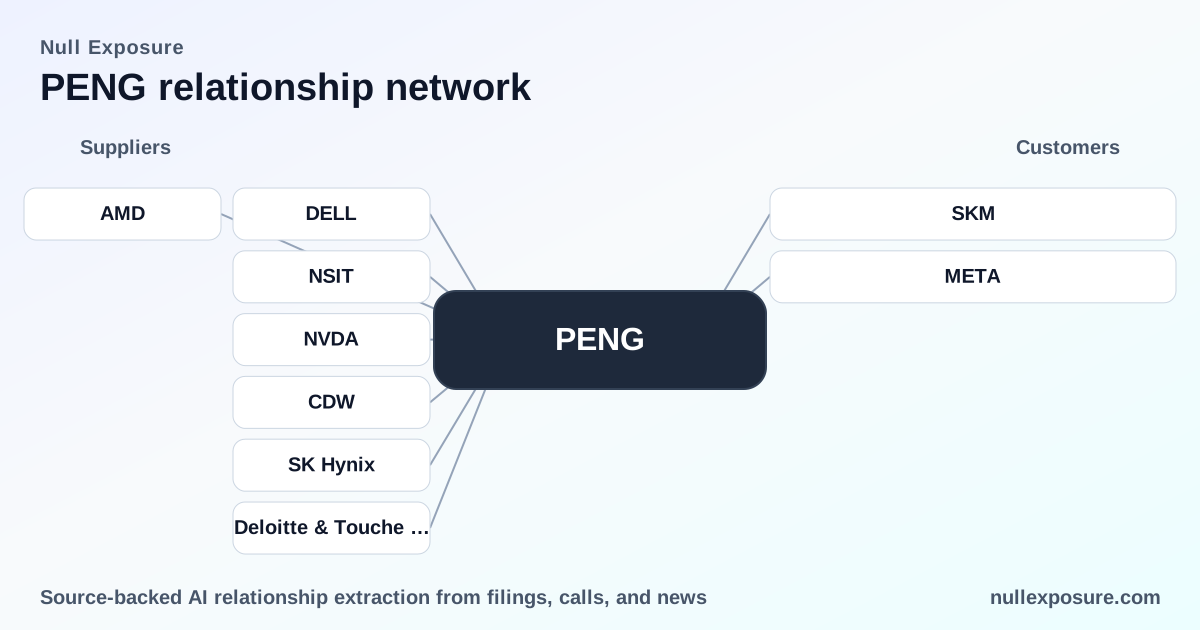
Supplier and partner landscape — who matters Below are every relationship pulled from Penguin’s public results, with concise takeaways and source references.
Dell / Dell Technologies
Penguin identified Dell as a key channel and systems partner that helps scale enterprise customer deployments and product rollouts. This relationship was named on Penguin’s 2025 Q4 earnings call and reiterated in coverage of FY2026 product plans. (Penguin 2025 Q4 earnings call; March 2026 and March 2026 media coverage)
Insight
Insight is listed alongside Dell and CDW as a channel partner Penguin is developing to broaden distribution and managed-services reach into enterprise accounts. The mention appears in the 2025 Q4 earnings call. (Penguin 2025 Q4 earnings call; first noted March 7, 2026)
NVIDIA
NVIDIA is framed as a strategic technology partner whose compute architectures anchor Penguin’s AI and HPC solutions, and product rollouts will center on NVIDIA technologies. This was stated on the 2025 Q4 earnings call and reinforced in multiple March 2026 media reports discussing Penguin’s AI positioning. (Penguin 2025 Q4 earnings call; March 2026 news coverage)
CDW
CDW is another commercial channel partner Penguin is expanding with to accelerate enterprise sales of integrated systems and services. The relationship appears in both the 2025 Q4 earnings call and subsequent March 2026 media write-ups. (Penguin 2025 Q4 earnings call; March 2026 press coverage)
SK Hynix
Penguin sources memory silicon from SK Hynix as part of its specialty memory supply chain, highlighting SK Hynix’s role as a direct component manufacturer for Penguin’s products. The company acknowledged this sourcing on the 2025 Q4 earnings call. (Penguin 2025 Q4 earnings call; first seen March 7, 2026)
Deloitte & Touche LLP
Shareholders ratified Deloitte & Touche LLP as Penguin’s independent registered public accounting firm for the fiscal year ending August 28, 2026, a governance item disclosed in a March 2026 press release. (Press release reported on The Globe and Mail; March 10, 2026)
Advanced Micro Devices (AMD)
AMD is cited in investor-facing coverage as a component technology underpinning upcoming product rollouts, alongside NVIDIA and Dell, supporting Penguin’s move deeper into AI/HPC offerings. (Market commentary on TradingView and Finviz; March 10, 2026)
Constraints and operating-model signals (company-level) Penguin’s public disclosures surface several cross-cutting operational characteristics that affect supplier management and investment analysis:
- Contracting posture: predominantly short-term purchase-order relationships. Penguin purchases a significant portion of materials on a purchase order basis and generally lacks long-term supplier commitments.
- Licensing exposure: potential royalty or license obligations exist for certain products and sales channels.
- Geographic footprint: multi‑region production and supplier footprint with concentration in APAC. Design and manufacturing activity is materially located in Malaysia, China, Taiwan and India, with commercial relationships spanning EMEA and North America.
- Concentration and criticality: supplier concentration is material and operationally critical. Penguin relies on a limited number of suppliers for significant raw materials and warned that disruptions at a small number of facilities could have a material adverse effect.
- Role mix: suppliers act as manufacturers and service providers. Penguin depends on third‑party fabrication for DRAM and wafers and uses external service providers for testing and security assessments.
- Spend magnitude: large vendor spend. Purchases from Penguin’s two largest suppliers were reported at roughly $0.6B and $0.4B in recent years, indicating multi‑hundred‑million dollar supplier relationships.
For an integrated map of counterparties and exposure, see https://nullexposure.com/.
How the supplier map drives growth — and where it creates fragility Penguin’s partner set is purposefully ecosystem‑oriented: NVIDIA and AMD provide the processor and accelerator technologies that enable Penguin’s AI and HPC positioning; Dell, Insight and CDW supply channels and systems integration to reach enterprise buyers; SK Hynix supplies commodity DRAM vital to product BOMs. This structure accelerates customer adoption while offloading R&D and manufacturing capital — a scalable commercial model.
At the same time, the model concentrates risk:
- Supplier concentration and APAC manufacturing concentration create single‑point operational exposures that can translate directly into revenue volatility.
- Short-term procurement increases price and availability volatility relative to long-term supply agreements.
- Licensing and royalty obligations add a fixed-cost element that can compress margins on lower-price hardware sales.
Financial context sharpens these risks: Penguin’s profit margin is thin (~1.9%) despite a healthy gross margin, making supplier cost swings meaningful to the bottom line. Market valuation signals (high trailing P/E vs. very low forward P/E) reflect investor expectations for rapid margin expansion tied to successful partner-led product rollouts.
Actionable takeaways for investors and operators
- For investors: model sensitivity to a supply disruption in APAC and to component price spikes; stress-test revenue and margin scenarios where SK Hynix or other top-two suppliers face capacity constraints. Monitor the evolution of partnerships with NVIDIA, AMD, Dell and CDW for revenue attribution and booking cadence.
- For operators: prioritize diversification of procurement where feasible, convert critical purchase-order relationships into contracted supply where pricing predictability matters, and document contingency manufacturing plans across APAC/EMEA/NA footprints.
Learn more about counterparty exposure and supplier concentration at https://nullexposure.com/.
Conclusion — what to watch next Penguin’s supplier relationships are both the growth engine and the principal risk vector for the company: partnerships with NVIDIA, AMD and major channel partners enable scaling into AI and enterprise segments, while supplier concentration, APAC manufacturing reliance, and short‑term procurement make operational continuity the critical variable for valuation downside protection. Monitor quarterly disclosures for any shift to longer-term supply contracts, material changes in top-supplier spend, or expanded revenue attribution to named partners.
For a structured diligence package and ongoing monitoring of Penguin’s counterparties, visit https://nullexposure.com/.