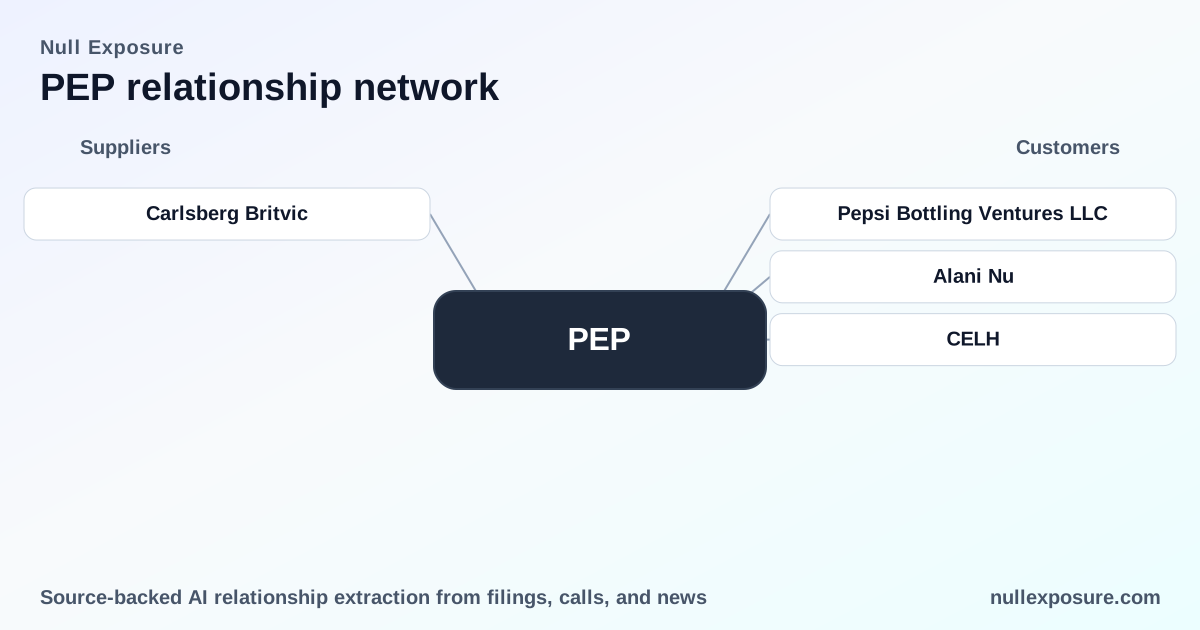
PepsiCo’s supplier footprint: what Carlsberg Britvic and corporate constraints tell investors
PepsiCo monetizes a global portfolio of snacks and beverages by owning brands, outsourcing production to a mix of authorized bottlers and contract manufacturers, and leveraging large-scale distribution contracts to capture margin through branded pricing and scale-driven cost efficiencies. Revenue is generated across branded, concentrated beverage and packaged food segments, while profitability depends on supply-chain leverage, commodity purchasing, and local manufacturing partnerships. For deeper supplier relationship intelligence and continuous monitoring, visit https://nullexposure.com/.
Why supplier relationships matter to investors now
PepsiCo’s operating model depends on a hybrid of in‑house manufacturing and external partners. This structure gives the company flexibility to scale into new markets quickly, but it also makes local bottlers and contract manufacturers operationally important for speed-to-market and cost control. Investor focus should be on who manufactures and distributes in target geographies, the contract tenor and payment terms, and the magnitude of confirmed supplier obligations that sit off the traditional balance sheet.
All relationships reported in the supplier results
Below are the supplier relationships surfaced in the provided results; each listing is covered exactly as found in the source material.
Carlsberg Britvic — MarketBeat alert (first mention)
PepsiCo is launching its Poppi soda brand in the UK and will leverage local bottler Carlsberg Britvic for production and distribution in this first rollout outside the U.S., expanding Poppi’s international growth options. Source: MarketBeat instant alert referencing the Poppi UK rollout, first seen 2026-03-10 (https://www.marketbeat.com/instant-alerts/filing-american-century-companies-inc-acquires-532694-shares-of-pepsico-inc-pep-2026-02-28/).
Carlsberg Britvic — MarketBeat alert (second mention)
A second MarketBeat notice repeats that PepsiCo is partnering with Carlsberg Britvic to produce and distribute Poppi in the UK, reinforcing that the company is using existing local bottling relationships to scale a high-growth beverage SKU internationally. Source: MarketBeat instant alert, first seen 2026-03-10 (https://www.marketbeat.com/instant-alerts/filing-erste-asset-management-gmbh-sells-7923-shares-of-pepsico-inc-pep-2026-02-28/).
Takeaway: Both entries point to the same commercial arrangement—PepsiCo is deploying an established local bottler (Carlsberg Britvic) to execute a targeted international launch for a branded beverage SKU, reflecting the company’s repeatable playbook for geographic rollouts.
What the company-level constraints reveal about how PepsiCo contracts and allocates risk
PepsiCo’s disclosures and supplier program excerpts deliver clear signals about its contracting posture and supply strategy:
- Contract tenor is commercially short-term oriented. The company states payment terms with a majority of suppliers generally range from 60 to 90 days, which signals a working-capital driven procurement posture that preserves cash flow and negotiating flexibility.
- Sourcing is globally diversified. PepsiCo reports mitigating raw-material supply risk through purchases from multiple geographies and suppliers, indicating deliberate concentration management across commodities and inputs.
- PepsiCo operates as both buyer and orchestrator of manufacturing. The filing language describes purchases in the open market for many commodities and the use of authorized bottlers and contract manufacturers to make and distribute products in more than 200 countries and territories.
- Service-provider dependence is material. The company outlines reliance on third-party service providers for procurement, manufacturing support, IT, and administrative functions, positioning software, cloud, and administrative vendors as structural elements of operations.
- Supplier finance and confirmed obligations exist on an active basis. Disclosures show a line for “confirmed obligations outstanding at end of year” recorded as $1,681, signifying an active supplier-finance program and non-trivial off‑balance exposure in payables-financing channels.
- Spend magnitude signals large supplier relationships. A spend-band tag of $100m_plus is recorded as a company-level signal, consistent with PepsiCo’s scale and the class of its principal manufacturing and bottling partners.
These disclosures are corporate-level signals drawn from PepsiCo’s filings and supplier-program summaries; they reflect aggregate procurement posture, not an attribute tied to any single named bottler unless the filing explicitly states so.
How these inputs shape investment risk and opportunity
PepsiCo’s model creates both resilience and concentrated operational exposure. Use the following investor guideposts:
- Operational leverage through local bottlers is a growth enabler. The Poppi rollout via Carlsberg Britvic demonstrates a low-capex, rapid-market-entry strategy that preserves PepsiCo’s margin profile while testing SKU economics in new regions.
- Short payment terms support cash conversion but increase supplier pressure. A 60–90 day common payment window preserves corporate cash but keeps suppliers reliant on programs like supplier finance, which can transfer working‑capital stress down the chain.
- Global sourcing reduces single-origin commodity risk but increases supplier network complexity. Multi-geography purchasing lowers the chance of a single-point raw-material shock but requires sophisticated procurement and logistics controls.
- Third-party services are mission-critical. Outsourced IT, payroll, and administrative functions introduce third-party operational risk that is not remedied by brand strength alone.
If you track supplier counterparty performance or want signals on bottler concentration and payment practices, NullExposure provides a consolidated view and alerts for changes in supplier status—explore more at https://nullexposure.com/.
Practical implications for portfolio managers and operators
- For investors, bottler and contract-manufacturer announcements are actionable: successfully managed rollouts indicate scalable SKU economics; disruptive execution problems suggest margin pressure ahead of product-level revenue gains.
- For operators, the combination of short supplier payment terms and an active supplier finance program requires continuous monitoring of supplier liquidity and contract renewal timelines.
- For risk teams, the documented reliance on third-party service providers elevates the importance of vendor resilience testing, especially in IT and logistics functions.
Final recommendation and next steps
PepsiCo’s use of local bottlers like Carlsberg Britvic to internationalize fast-growing SKUs is a deliberate growth tactic that matches its hybrid manufacturing model and centralized brand ownership. Investors should treat bottler partnerships as operationally critical relationships and watch supplier-finance exposures and payment-term evolution as early indicators of stress or leverage.
For more supplier intelligence and ongoing alerts tied to bottlers, contract manufacturers, and confirmed obligations, visit https://nullexposure.com/ and sign up for tailored coverage.