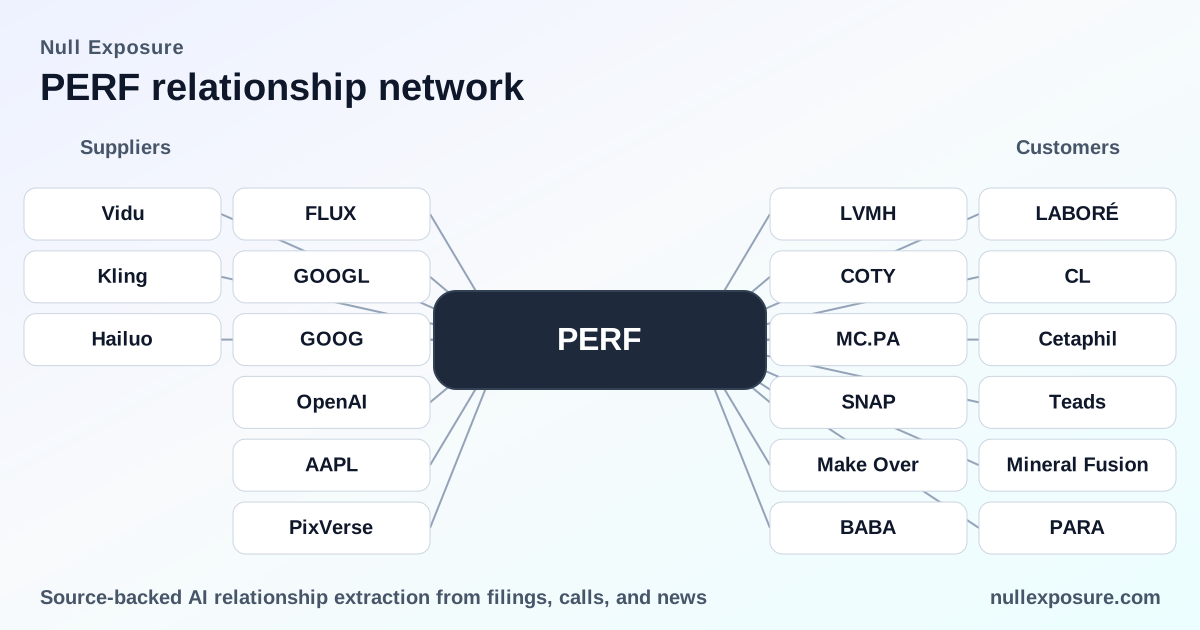
Perfect Corp. (PERF): Supplier map and what it means for investors
Perfect Corp. is a beauty-technology company that monetizes through mobile app subscriptions (YouCam), enterprise SaaS, and digital distribution channels, with recurring revenue increasingly routed through app stores and third‑party AI/image providers. Its FY‑TTM financial profile shows $69.2M revenue, strong gross margins (~77%), and subscription-led margin pressure from app‑store fees, which directly connects supplier relationships to near‑term margin dynamics.
For a quick vendor-risk readout and supplier diligence, see the company homepage for primary filings and disclosures: Null Exposure homepage.
What the supplier list actually contains — a field guide for investors
Below I cover every relationship referenced in the collected results and explain the operational and margin implications in plain English.
Google (multiple roles: AI engines and app distribution)
Perfect Corp. now exposes users to Google’s AI image models (Gemini and Imagen) inside YouCam and also identifies Google as a digital distribution partner that charges payment processing fees for mobile subscriptions; both integrations influence product capabilities and gross margin. A March 2026 Yahoo Finance item documented Google model support in the YouCam multi‑engine rollout, and a July 2025 BizWire filing syndicated via FinancialContent cited Google among app‑store partners driving higher third‑party payment fees. (Yahoo Finance, Mar 2026; FinancialContent / BizWire, Jul 2025)
Apple (app store/payment processing partner)
Apple is named explicitly as a digital distribution partner whose processing fees have risen with YouCam subscription growth, directly compressing gross margin. That disclosure came in the company’s FY2025 unaudited results cited in a July 2025 FinancialContent/BizWire release. (FinancialContent / BizWire, Jul 2025)
OpenAI (image engine supplier)
Perfect Corp. added OpenAI’s GPT‑Image‑1 to its list of selectable AI image backends inside YouCam, enabling customers to choose between multiple image-generation engines for creative tasks. This integration was reported in the March 2026 Yahoo Finance piece on the YouCam AI expansion. (Yahoo Finance, Mar 2026)
Flux (AI engine option)
Flux is one of the selectable top‑tier image engines listed in the YouCam multi‑engine offering, giving Perfect a multi‑vendor image generation strategy rather than single‑provider dependence. The Flux inclusion was noted in the same March 2026 Yahoo Finance coverage of the YouCam update. (Yahoo Finance, Mar 2026)
PixVerse (video model contributor)
PixVerse 5 is included among video backends in the new multi‑model video engine that Perfect announced, expanding YouCam’s video capabilities and vendor diversity for media generation. This was described in Yahoo Finance’s March 2026 article on the new multi‑model video engine. (Yahoo Finance, Mar 2026)
Vidu (video model contributor)
Vidu Q2 is listed as a component of the multi‑model video engine, indicating Perfect aggregates specialized video models to improve product performance and to hedge supplier risk. The March 2026 news item covered this vendor list. (Yahoo Finance, Mar 2026)
Kling (video model contributor)
Kling 2.5 Turbo appears among the curated video models in Perfect’s multi‑model engine, reinforcing the company’s strategy of multi‑vendor sourcing for advanced media features. The vendor was cited in the Yahoo Finance report on the YouCam AI expansion. (Yahoo Finance, Mar 2026)
Hailuo (video model contributor)
Hailuo 02 is another named video model in the multi‑model engine, supporting the company’s model‑mix approach to video generation and product differentiation. The inclusion was reported in the March 2026 Yahoo Finance piece. (Yahoo Finance, Mar 2026)
How these relationships drive operating posture, concentration and risk
Perfect Corp.’s supplier footprint shows a deliberate move toward multi‑vendor AI and video model aggregation, which is an operational posture that reduces single‑vendor technology risk while increasing integration overhead and variable costs tied to third‑party compute or licensing. The public excerpts provide two clear, company‑level signals:
- Contracting posture: The company uses a multi‑supplier strategy for AI/image/video engines (OpenAI, Google, Flux, PixVerse, Vidu, Kling, Hailuo). That is an active vendor diversification posture rather than exclusive dependence on a single provider.
- Cost concentration and criticality: App store partners (Google and Apple) are explicit cost centers; rising third‑party payment processing fees are already cited as a primary driver of gross margin decline in FY2025 results, which makes these distribution relationships commercially critical for short‑term margins.
- Vendor maturity and integration complexity: The roster includes both large platform providers (Google, OpenAI, Apple) and specialized model vendors (Flux, PixVerse, Vidu, Kling, Hailuo). This mix signals a product maturity pattern where Perfect layers best‑of‑breed models into a consumer/enterprise UX, increasing both commercial optionality and operational complexity.
- Disclosure signal: The collected results contain no explicit, contract‑level constraints (no supplier exclusivity, minimum commitments, or termination penalties extracted), which should be treated as a company‑level signal of no disclosed supplier constraints in this dataset, not proof none exist.
Financially, this supplier posture is consequential: subscription revenue growth is positive but increases gross margin exposure to app‑store economics, while multi‑vendor AI sourcing supports feature competitiveness at the expense of variable AI/compute costs.
For a broader supplier-risk and contract review, visit Null Exposure.
What investors should watch next — actionable checkpoints
- Monitor quarterly commentary for changes in app‑store fee exposure and any renegotiation or migration strategies that could materially restore margins. The July 2025 filing already flagged this as a primary margin driver.
- Track concentration metrics and vendor spend across Google/OpenAI/Apple to quantify how much of gross margin and product capability rests on external models and payment platforms.
- Evaluate the integration roadmap and its cost trajectory: more third‑party models generally mean better product parity and differentiation, but also higher variable costs and potential licensing complexity.
- Review insider and institutional ownership: insiders hold ~58% of shares while institutions own under 9%, which is a governance signal about who controls strategic vendor decisions.
For immediate supplier diligence and to map contracts to margin impact, check the company’s filings and supplier disclosures at Null Exposure.
Bottom line for investors
Perfect Corp.’s supplier set confirms a strategy of multi‑vendor AI and video sourcing combined with app‑store distribution that is profitable top‑line but margin‑sensitive. The company’s FY‑TTM revenue ($69.2M) and gross profit (~$53.5M) show commercial traction, while the explicit linkage of increased payment processing fees to gross margin should be treated as a live operational risk until the company reduces app‑store friction or offsets fees with higher‑value monetization.
To convert this read into investment action: prioritize monitoring distribution fee trends, vendor spend disclosure, and any material supplier contracts disclosed in future filings. For targeted supplier intelligence and contract mapping, start at Null Exposure.